
SIL-Quadtree: Bridging the Gap Between Social Networks and Semantic Trajectories
Social space keyword query based on semantic trajectory q
This paper introduces the Social space Keyword Query based on semantic Trajectory (SKQT) task, which integrates social network relationships into spatial-keyword trajectory retrieval. The authors propose the SIL-Quadtree, a hybrid index structure that combines spatial, textual, and social factors to efficiently return the top-k personalized semantic trajectories.
TL;DR
This research tackles the challenge of personalized location recommendations by introducing SKQT (Social space Keyword Query based on semantic Trajectory). Beyond just finding the "closest" path with the right keywords, it weights results by social relevance—favoring locations your friends have positively reviewed. To handle this complexity, the authors developed the SIL-Quadtree index, which prunes search spaces using a combination of spatial, textual, and social filters.
Background: Why Distance and Keywords Aren't Enough
Imagine you are visiting a new city and searching for a "Coffee" and "Library" trail. Most systems would give you the shortest path between those two points. But wouldn't you prefer the route that your friends have shared and liked? Traditional Spatial Keyword Queries (SKQ) are socially blind. By ignoring the user's social circle, these systems miss out on the high-quality, personalized "group wisdom" inherent in Location-Based Social Networks (LBSNs) like Foursquare or Weibo.
The Problem & Motivation
The core difficulty lies in the curse of dimensionality. Adding social relationships to an already complex spatial-textual query search makes the search space explode. Existing indices (like R-trees or standard Quadtrees) aren't built to prune based on social proximity. The authors realized that a new hybrid index was needed—one that could tell the system to stop looking at a specific geographical branch if it lacks social relevance to the specific user.
Methodology: The SIL-Quadtree Architecture
The proposed SIL-Quadtree (Social Inverted Linear Quadtree) is a masterpiece of multi-constraint engineering. It utilizes several key mechanisms:
- Morton Coding: For efficient linear mapping of 2D space onto a 1D disk-based structure (B+ Tree).
- Social Relevance Integration: Non-leaf nodes store summarized social information of their children, allowing the system to prune entire geographical areas if no "friends" have visited them.
- Signature Bit-Flags: Each node contains a hashed bit vector of trajectory IDs. This allows for a "Signature Test"—if a trajectory doesn't appear across all keyword-related trees, it's discarded immediately.
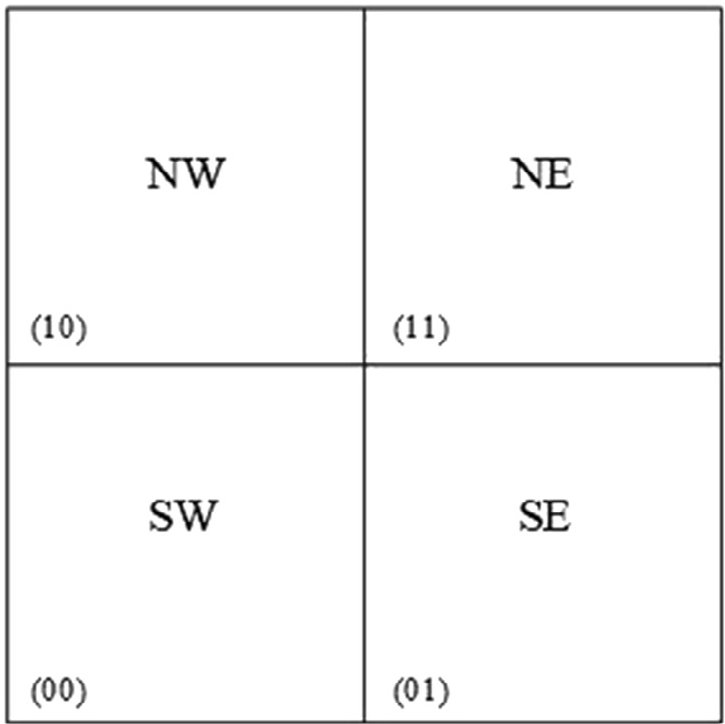
The Ranking Function
The ranking isn't just a simple sum. It's a ratio: This effectively seeks the "path of least resistance"—minimizing physical travel distance while maximizing social endorsement.
Experiments and Results
The authors compared their method against strong baselines (AC-Tree and Bck-tree) on the Gowalla and Brightkite datasets.
- Scalability: As the number of keywords increases, the performance of the SIL-Quadtree actually improves relative to baseline models. This is because more keywords provide more "Signature Test" pruning opportunities.
- I/O Efficiency: By clustering spatially close points on the same disk pages and using social thresholds, the SIL-Quadtree reduced disk I/O significantly compared to traditional R-tree-based approaches.
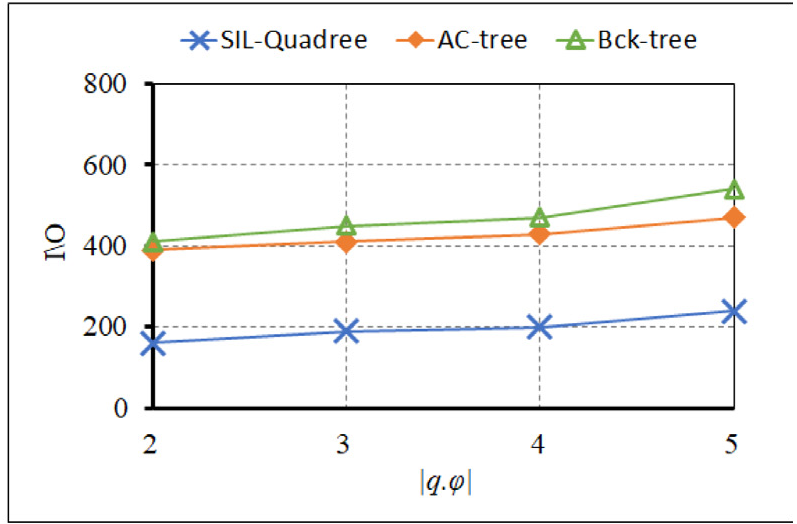 Fig: The effect of keyword count on I/O cost, demonstrating the SIL-Quadtree's superior pruning.
Critical Insight & Conclusion
The SIL-Quadtree proves that social data is not just "extra metadata"; it is a powerful pruning dimension. By integrating social relevance directly into the heart of the spatial index, we can achieve personalized results without sacrificing real-time performance.
Limitations: The model assumes a static social graph. In reality, friendships and interests change. Future work could incorporate temporal-social dynamics, where the "freshness" of a friend's recommendation also impacts the ranking.
Takeaway: For developers of travel apps and social platforms, this research provides a blueprint for building recommendation engines that feel more "human" by prioritizing our social connections within the physical world.