
Social Spam Detection: Unmasking the Pollution of Collaborative Tagging
Social spam detection
The paper presents a comprehensive framework for detecting social spam in collaborative tagging systems. By introducing six novel features—TagSpam, TagBlur, DomFp, NumAds, Plagiarism, and ValidLinks—and employing various machine learning algorithms like LogitBoost and AdaBoost, the authors achieve over 98% detection accuracy with a low 2% false positive rate.
TL;DR
Social bookmarking systems are vulnerable to "social spam"—malicious posts designed to hijack traffic for financial gain. This paper introduces a multi-level detection framework using six distinct structural and semantic features. By combining these signals with ensemble learning, the researchers achieved a staggering 98.4% accuracy, effectively filtering out spammers with minimal impact on legitimate users.
The "Why": Motivation and the Financial Engine of Spam
Unlike early email spam, social spam isn't just annoying; it pollutes the "folksonomy"—the collective intelligence represented by tags, users, and resources. The authors point out a critical insight: spammers aren't just random; they are economically driven. Most social spam aims to drive traffic to sites filled with ads (e.g., Google AdSense) or plagiarized content to trick search engines.
This creates a "tragedy of the commons" where:
- Search engines lose precision.
- Users waste cognitive load on junk.
- Honest publishers lose revenue to "polluters."
Methodology: A Multi-Level Defense
The authors propose that spam manifests at three levels: the Post, the Resource, and the User.
1. The Post Level: Semantic Blur
Spammers often use "Popularity Hijacking," attaching trending but unrelated tags (e.g., "music," "news," and "porn" on the same resource) to maximize visibility.
- TagSpam: Measures the probability of a tag being associated with known spammer accounts.
- TagBlur: Calculated using Mutual Information. It measures the semantic distance between tags in a single post. Legitimate posts are focused; spam posts are "blurry."
2. The Resource Level: Templates and Plagiarism
Since spammers often use automated tools to build "AdSense-ready" sites, their resources share structural DNA.
- DomFp (DOM Fingerprinting): Strips content to analyze HTML element order, using the "shingles" method to find structural similarity to known spam templates.
- Plagiarism: Uses search APIs to see if text snippets from the resource appear on authoritative sites like Wikipedia, indicating stolen content.
3. The User Level: Link Integrity
- ValidLinks: Spammers often use "disposable" domains that go offline once flagged. This feature tracks the ratio of alive vs. dead links in a user's profile.
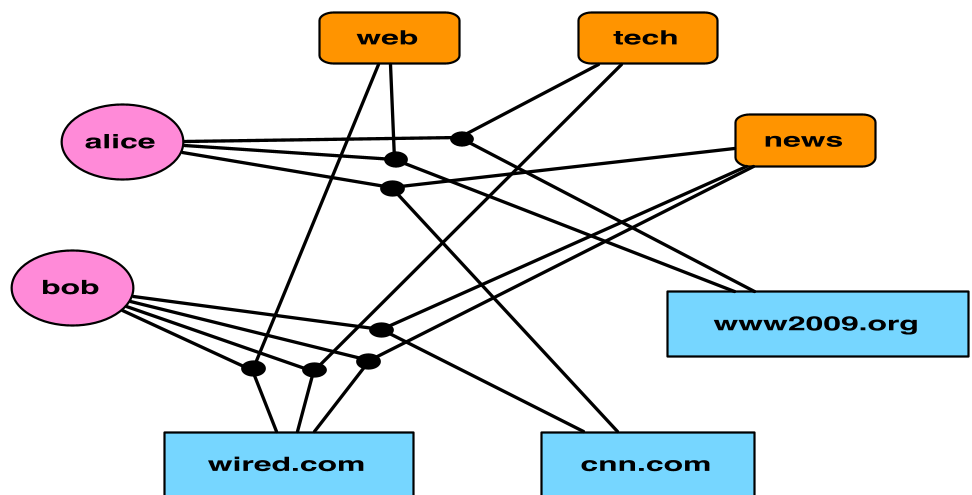 Figure: The tripartite graph represention of a folksonomy, showing the connections between Users, Resources, and Tags.
Experimental Results & SOTA Comparison
The evaluation focused on the BibSonomy dataset, a benchmark for social spam.
Performance Breakdown:
- Individual King: The
TagSpamfeature proved most powerful, achieving an AUC of 0.99 on its own. - Ensemble Power: While an SVM reached 96.75% accuracy, the AdaBoost algorithm excelled at combining diverse features (like the non-linear ValidLinks) to reach 98.38% accuracy.
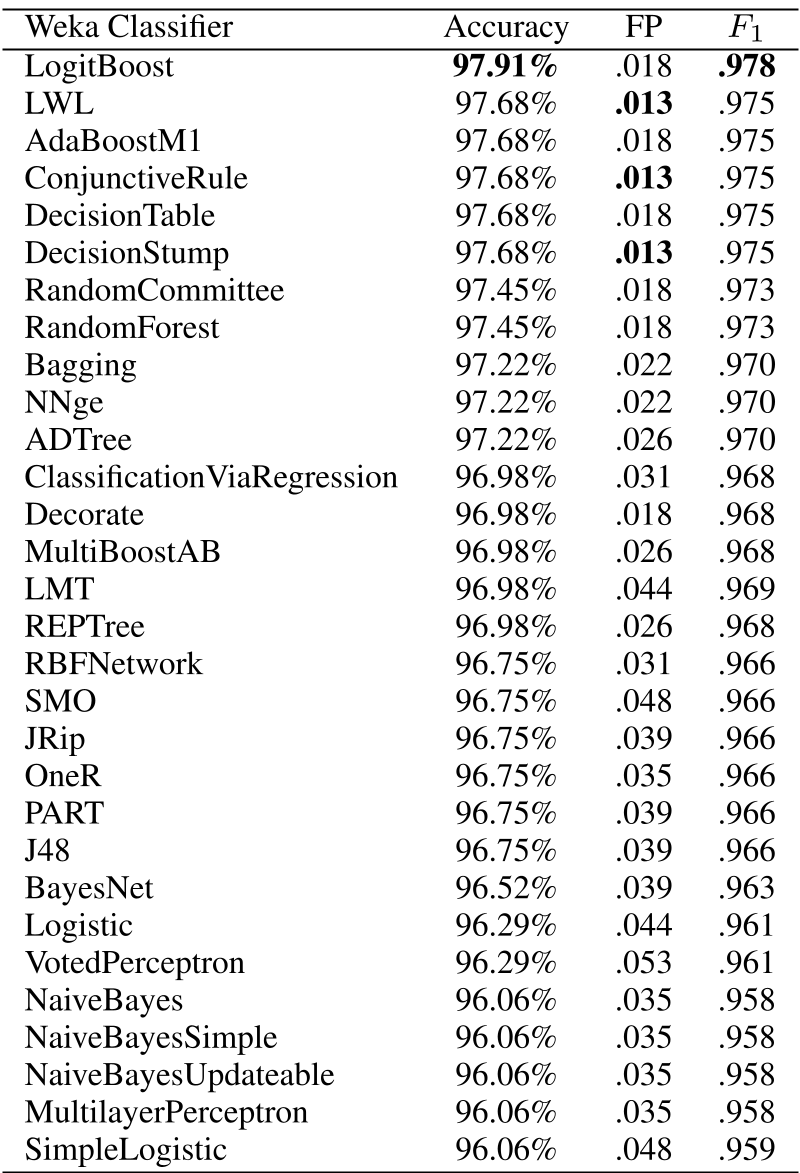 Table: Performance of various Weka classifiers. Note the high accuracy across almost all algorithms, proving the robustness of the chosen features.
The study reveals that spammers leave footprints across different dimensions. For instance, while a spammer might try to use "legitimate-looking" tags, their resource structure (DomFp) or their high frequency of broken links (ValidLinks) will eventually give them away.
Critical Insight & Future Outlook
This paper's enduring value lies in its economic analysis of spam. By understanding that "Social spam is a targets of opportunity," the researchers moved beyond simple keyword blacklists to behavioral and structural analysis.
Limitations:
- Cold Start: Features like
TagSpamrequire an initial labeled dataset. - Arms Race: As detection becomes more sophisticated, spammers may adopt AI to generate "original-looking" content and more diverse DOM structures.
The authors have made their dataset public at GiveALink.org, providing a vital resource for the community to continue this escalating "arms race" against Web 2.0 pollution.