
Beyond the Word-Filter: Mastering Social Spam with Bayesian Network Classifiers
Social Spam Discovery Using Bayesian Network Classifiers Based on Feature Extractions
This paper introduces a specialized social spam discovery framework leveraging Bayesian Network Classifiers (BNCs) to identify unwelcome messages and friend requests in Social Networking Services (SNSs). By moving beyond content-based analysis to incorporate structural features like Katz influence scores and trust propagation, the system effectively manages the unique challenges of SNS spam.
TL;DR
Social spam isn't just about "Viagra" or "stock tips" anymore. In the world of Social Networking Services (SNSs), spam manifest as unwanted friend requests and intrusive interactions that often carry zero text. This paper presents a novel framework that moves the battlefield from Content Analysis to Relational Context, using adaptive Bayesian Network Classifiers (BNCs) to model the complex dependencies between user behavior, network topology, and personality.
Background Positioning
While traditional spam detection relies on NLP-heavy pipelines, this work carves out a niche in Structural Social Analysis. It positions itself as a scalable, online learning solution that addresses the subjectivity of "unwanted" messages—a problem where traditional SVMs or Naive Bayes models often stumble due to high training costs or oversimplified independence assumptions.
Problem & Motivation: Why Text-Filtering Fails
Most spam research focuses on E-mails or Web pages. However, the authors identify three critical "Social Spam" characteristics:
- Content Scarcity: A friend request might contain no words at all.
- Subjectivity: One user's "networking opportunity" is another user's "harassment."
- Feature Dependency: Acceptance of a request is rarely an isolated variable; it depends on whether the sender is a "Friend of a Friend" (FoF) AND the recipient's personal social openness.
Methodology: The Core Architecture
The authors propose a multi-faceted feature extraction engine that looks at:
- Behavioral History: Request Reject/Acceptance Ratios (RR/AR).
- Topology/Influence: Katz scores to identify "Celebrities" and trust propagation to identify "Seed Nodes."
- Relational Context: "Friend’s Friend" (FF) status and "Same Community" (SC) membership.
- User Psychology: Categorizing recipients as "Introvert" or "Extrovert" based on their existing neighbor count.
Structural and Parameter Learning
To model these features, the system doesn't just treat them as a flat vector. It uses Conditional Mutual Information to build a Bayesian Network where edges represent real relationships between variables.
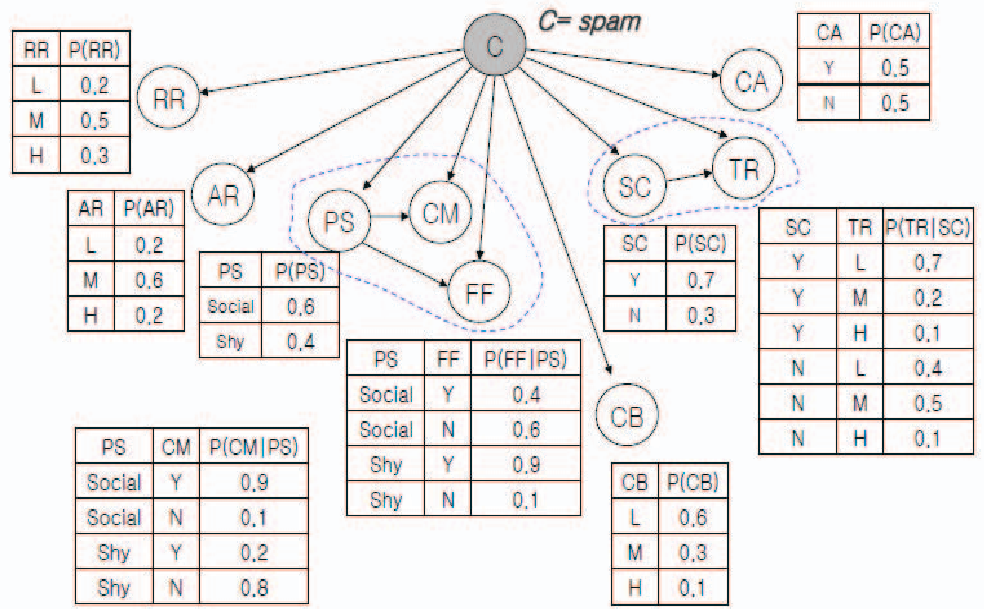 Figure 1: The BNC structure highlighting how Class labels (C) influence features and how features like Personality (PS) and Commonness (CM) interact.
The "Online" aspect is handled via the Voting EM algorithm. This allows the model to update its "beliefs" as new data arrives without retraining from scratch, using a learning rate () to balance past knowledge with current trends.
Experiments & Results: Engineering for Speed
A major contribution of this work is the Likelihood Computation Optimization. In a social graph with millions of nodes, calculating a spam score in real-time is expensive.
The authors split the posterior likelihood into three components:
- Sender-dependent (): Cached on the sender's side.
- Recipient-dependent (): Cached on the recipient's side.
- Mutual-dependent (): Only this small fraction is computed at the moment of the request.
This "Divide and Conquer" approach ensures that the BNC can scale to real-world SNS demands, significantly reducing the computational overhead compared to global graph algorithms or intensive SVM kernels.
Critical Analysis & Conclusion
Takeaway
This paper shifts the paradigm of spam detection from "what is said" to "who is interacting and how." By quantifying "Social Trust" and "Personality," it creates a filter that is adaptive to individual user preferences.
Limitations
- Evolution of Content: While the paper argues content analysis is secondary, modern spammers often use LLM-generated personalized messages that might bypass basic "blacklist" similarity scores (CA feature).
- Privacy Concerns: Extracting "Personality" and "Interests" requires deep access to user profiles, which may clash with modern data privacy regulations (like GDPR) that weren't as prevalent at the time of this research.
Future Outlook
The logic of "Sender/Recipient/Mutual" caching is highly relevant today for edge computing and decentralized social networks. Integrating these Bayesian priors with modern Graph Neural Networks (GNNs) could represent the next leap in sub-millisecond social moderation.