
Beyond the Blacklist: Decoding Social Spam with Bayesian Networks
Social Spam Discovery Using Bayesian Network Classifiers Based on Feature Extractions
This paper introduces a specialized social spam discovery framework that utilizes Bayesian Network Classifiers (BNCs) to detect unwanted friend requests and messages on Social Networking Services (SNS). By moving beyond content-based filtering, the authors achieve robust detection through novel feature extraction—including Katz scores for celebrity influence and trust propagation—tailored for the subjective nature of social interactions.
TL;DR
Social spam—unwanted friend requests and intrusive messages—is the "new plague" of SNS. This paper moves away from outdated keyword-based filters to a sophisticated Bayesian Network Classifier (BNC) approach. By modeling the intricate dependencies between a user's personality, their social "celebrity" status (Katz score), and common interests, the authors provide a scalable, online learning framework that adapts to the subjective nature of social interactions.
The "Invisible" Content Problem
In traditional email spam, we look for "Viagra" or "Stock" keywords. But how do you filter a friend request that has zero text?
The authors identify three fatal flaws in existing methods:
- Content Deficiency: Friend requests often contain no message.
- Subjectivity: A request from a stranger might be a welcome social opportunity for an extrovert but a "spam" intrusion for an introvert.
- Feature Correlation: Unlike traditional Naive Bayes assumptions, social features (like being a 'friend’s friend' and 'sharing a community') are tightly interconnected.
Methodology: Mapping the Social DNA
The researcher's primary contribution lies in Feature Extraction and Dependency Modeling. Instead of isolated variables, they construct a directed acyclic graph that represents the "Social Logic" of a request.
1. Feature Engineering for the Social Age
- Topological Features: Utilizing Katz Scores to measure the "Celebrity" influence of a sender and Trust Propagation from known non-spammers.
- Behavioral Ratios: Tracking Request Reject Ratio (RR) and Acceptance Ratio (AR) to identify aggressive outreach patterns.
- Psychological Profiling: A unique "Personality" (PS) feature tracks if a user is generally "Extrovert" or "Introvert" based on their existing neighbor count.
2. Bayesian Network Structure
The system uses Conditional Mutual Information to find which features influence each other. For example, the probability of accepting a "Friend's Friend" is conditioned on the recipient’s "Personality."
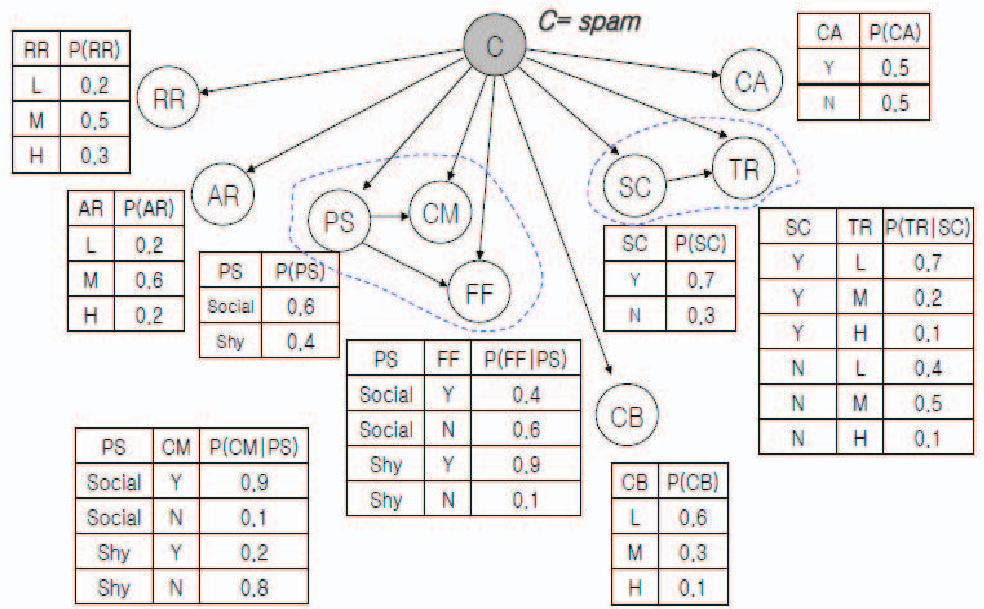 Figure 1: The Bayesian network showing dependencies between Class(C), Personality(PS), and Commonness(CM).
Adaptive Online Learning
Social networks are not static; a celebrity today might be a spammer tomorrow. The authors implement an Online BNC using:
- Structure Update: Adaptively regenerating the network graph when enough new data is collected.
- Parameter Tuning (Voting EM): Using a learning rate () to balance historical data with real-time behavior. This ensures the filter doesn't become "stale" as user habits shift.
Experimental Insights & Scalability
The paper emphasizes that a major hurdle for BNCs is the computational cost of posterior likelihood. To solve this, the authors propose a caching mechanism:
- Sender-side probabilities and recipient-side probabilities are pre-computed.
- Only the "Interaction Features" (like common interests) are computed on-the-fly.
This optimization allows the system to process friend requests in real-time even across massive social graphs, overcoming the "expensive training" bottleneck usually associated with Support Vector Machines (SVM).
Critical Analysis & Future Outlook
While the paper provides a robust statistical alternative to content filtering, it relies heavily on binary/categorical states (e.g., Introvert vs. Extrovert). In a modern context, these could be refined using continuous latent embeddings or Deep Learning.
Key Takeaways:
- Social spam detection is a contextual problem, not a content problem.
- Bayesian Networks excel here because they explicitly model the "Why" (e.g., "I accepted this request because we share a community").
- Scalability is achieved by separating static node features from dynamic interaction features.
Conclusion
This work serves as a foundational bridge between traditional machine learning and modern social graph analysis. By recognizing that social "spamness" is in the eye of the beholder, the authors have paved the way for personalized, context-aware digital boundaries.