
MRE: Decoding the Latent Language of Social Spammers via Multi-Relational Embedding
Social Spammer Detection: A Multi-Relational Embedding Approach
The paper proposes MRE (Multi-Relational Embedding), a content-independent framework for social spammer detection that leverages graph embedding to model heterogeneous relations. By fusing multiple social interactions into a shared latent space, it achieves state-of-the-art performance on large-scale social network datasets like Tagged.com.
TL;DR
To catch a spammer, you must look at not just what they say, but how they interact across the entire social ecosystem. This paper introduces Multi-Relational Embedding (MRE), a framework that bypasses messy text analysis (often unavailable due to privacy) to identify spammers through their unique "relational footprint." By embedding users and various interaction types (like "gifts," "pokes," or "blocks") into a unified latent space, MRE achieves a significant boost in detection accuracy on real-world datasets with millions of users.
Context: Why Content-Independent Detection?
Most spam detection research focuses on NLP—analyzing the text of reviews or messages. However, in modern social platforms:
- Privacy is Paramount: Direct message content is often encrypted or restricted.
- Topology is King: The way a spammer connects to legitimate users is mathematically distinct from organic human behavior.
Previous methods used "Graph-based features" (calculating PageRank or k-core for each relation like Friend Request) or "Sequence-based features" (analyzing the order of actions). The fatal flaw? Interaction neglect. They treated "Adding a Friend" and "Sending a Gift" as two separate graphs, missing the "cross-talk" between these behaviors.
Methodology: The MRE Architecture
The core insight of MRE is that users have dual roles: they are Sources (senders) and Destinations (receivers). A spammer acts as a aggressive source but a passive/abnormal destination.
1. The Multi-Relational Objective
Instead of simple adjacency matrices, MRE learns latent vectors for users and for relations. It models the frequency of a relation between user and of type as:
This allows the model to learn that certain relations (like "Report Abuse") have heavy weights in identifying spammers, while others (like "View Profile") are more neutral.
2. Directional Awareness
Unlike traditional Matrix Factorization, MRE assigns sending and receiving vectors to both users and relations. This is crucial because a spammer "sending a message" has a completely different semantic meaning than a legitimate user "receiving a message."
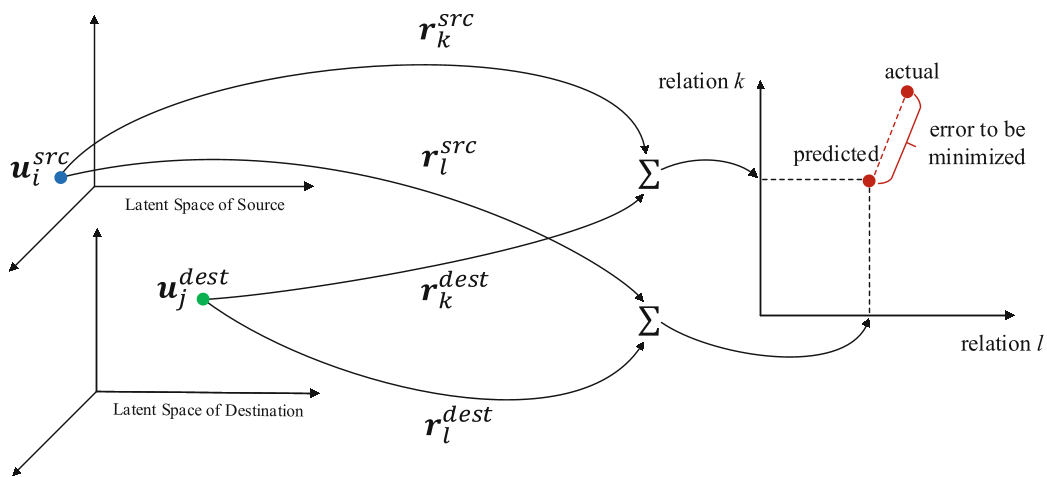 Figure: The interaction between source/destination user vectors and multi-relational transfer matrices.
Experimental Battleground: Tagged.com
The authors tested MRE on a massive slice of Tagged.com data: 4 million users and over 85 million interactions across 7 relation types (Message, Add Friend, Pet Game, etc.).
Key Results: Precision vs. Recall
The biggest challenge in spam detection is the "False Positive" problem—banning a real user by mistake.
| Features | F-measure (LR) | Precision (LR) |
|---|---|---|
| Graph Features | 0.5308 | 0.4537 |
| Sequential (k-gram) | 0.6253 | 0.4907 |
| MRE (z=30) | 0.6844 | 0.6138 |
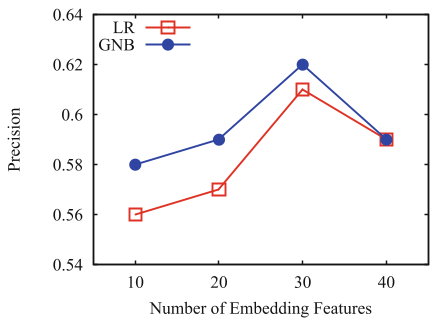 Figure: Analysis of Embedding Dimensions. Note how Precision and F-measure peak at z=30, suggesting an optimal balance of feature complexity.
Critical Insight: The Value of Latent Roles
Why did MRE win?
- Synergy: It doesn't just add features; it learns how relations influence each other. For example, a user who sends many messages and is frequently blocked is more likely a spammer than someone who just sends many messages.
- Representational Efficiency: Instead of 100+ manual features, 30 latent variables captured more "signal" from the noise.
Conclusion & Future Outlook
MRE represents a shift from "feature engineering" to "representation learning" in social cybersecurity. While the current model uses a standard L2 loss, the authors suggest the next step is parallelization to handle even larger graphs.
Takeaway for Practitioners: If your social platform has multiple interaction types, stop building separate classifiers for each. Embed them into a single latent space where the "spammer subspace" can be clearly isolated.
Paper: Social Spammer Detection: A Multi-Relational Embedding Approach Key Terms: Graph Embedding, Spammer Detection, Multi-relational Learning.