
Mapping the Global Brain: A Social and Spatial Network Analysis of Research Communities
A Social and Spatial Network Approach to the Investigation of Research Communities over the World Wide Web
This paper introduces a computational framework for deriving social networks from web-embedded semantics, specifically analyzing the GIScience research community. Using graph theory complemented by spatial and thematic operators, the authors map academic trajectories (PhD to faculty positions) to reveal the underlying structural and geographic properties of conferences like COSIT and GIScience.
TL;DR
This paper moves beyond simple citation counts to analyze the "Human Capital Flow" of the GIScience community. By mining academic trajectories from the World Wide Web, the authors construct a social network of universities, applying new mathematical indices to measure how geography and theme influence the "attractiveness" and "centrality" of global research hubs.
The Motivation: Beyond the Questionnaire
Traditionally, understanding how a scientific field evolves required tedious surveys or manual citation mapping. However, citations only tell part of the story. The real "blood" of a research community is the movement of its people—where they get their PhDs and where they move as faculty.
The authors argue that the Web provides a "Semantic Space" where these movements are hidden in faculty bios and CVs. The challenge is: how do we turn these messy trajectories into a formal model that accounts for both the graph structure and physical geography?
Methodology: Social Meets Spatial
The authors model the community as a hypergraph , where:
- Nodes (): Universities or Research Centers.
- Links (): The academic movement of a researcher. If a scholar moves from UCL to Maine, it creates a directed link.
1. Centrality vs. Dispersion
While traditional metrics like Betweenness Centrality identify which universities act as "bridges," they don't explain where those bridges lead. The authors introduce the Geographic Dispersion (): This formula quantifies whether a university's influence is local (trajectories within the same country) or global (international mobility). A positive value indicates a "Global Hub," while a negative value suggests a "National Stronghold."
2. The Weight of Heterogeneity
The Heterogeneity Index () focuses on the diversity of connections. By weighting this by the node's degree (), the model can distinguish between a university that is simply large and one that is a diverse crossroads for international talent.
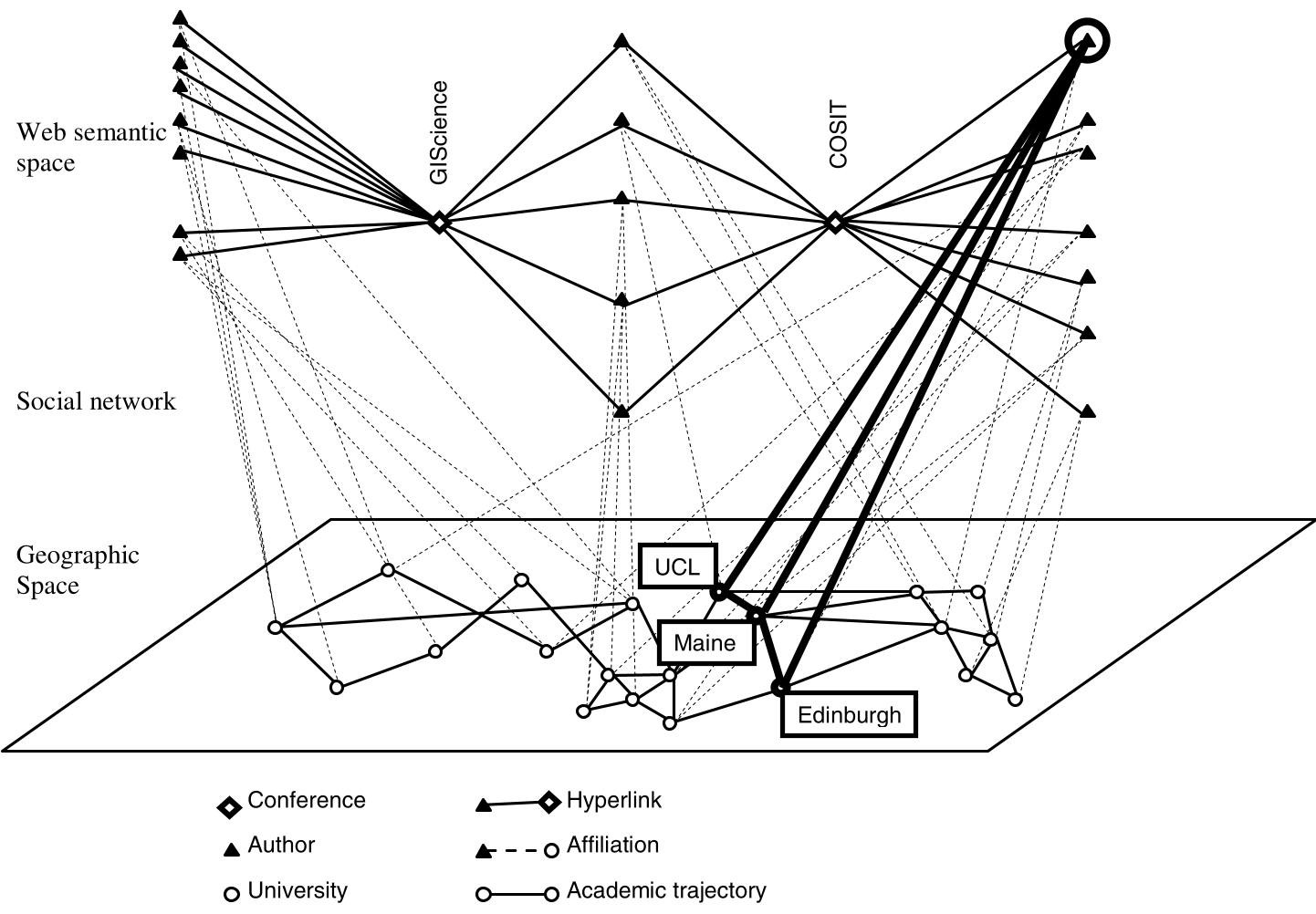 Figure 1: The conceptual workflow—from Web-based trajectories to a spatially grounded social network.
Real-World Findings: GIScience vs. COSIT
The researchers applied this to participants of two major conferences: COSIT (Spatial Information Theory) and GIScience.
- Key Players: Universities like UCSB, SUNY Buffalo, and Maine emerged as massive hubs.
- The "Repulsive" Power of TU Vienna: Interestingly, TU Vienna showed high "out-degree." It serves as a "nursery," producing high-quality PhDs who then migrate to other nodes, thereby seeding the rest of the network.
- Connectivity Patterns: COSIT is a "tight-knit" community with a strong central core. In contrast, GIScience is more fragmented and heavily dominated by North American institutions.
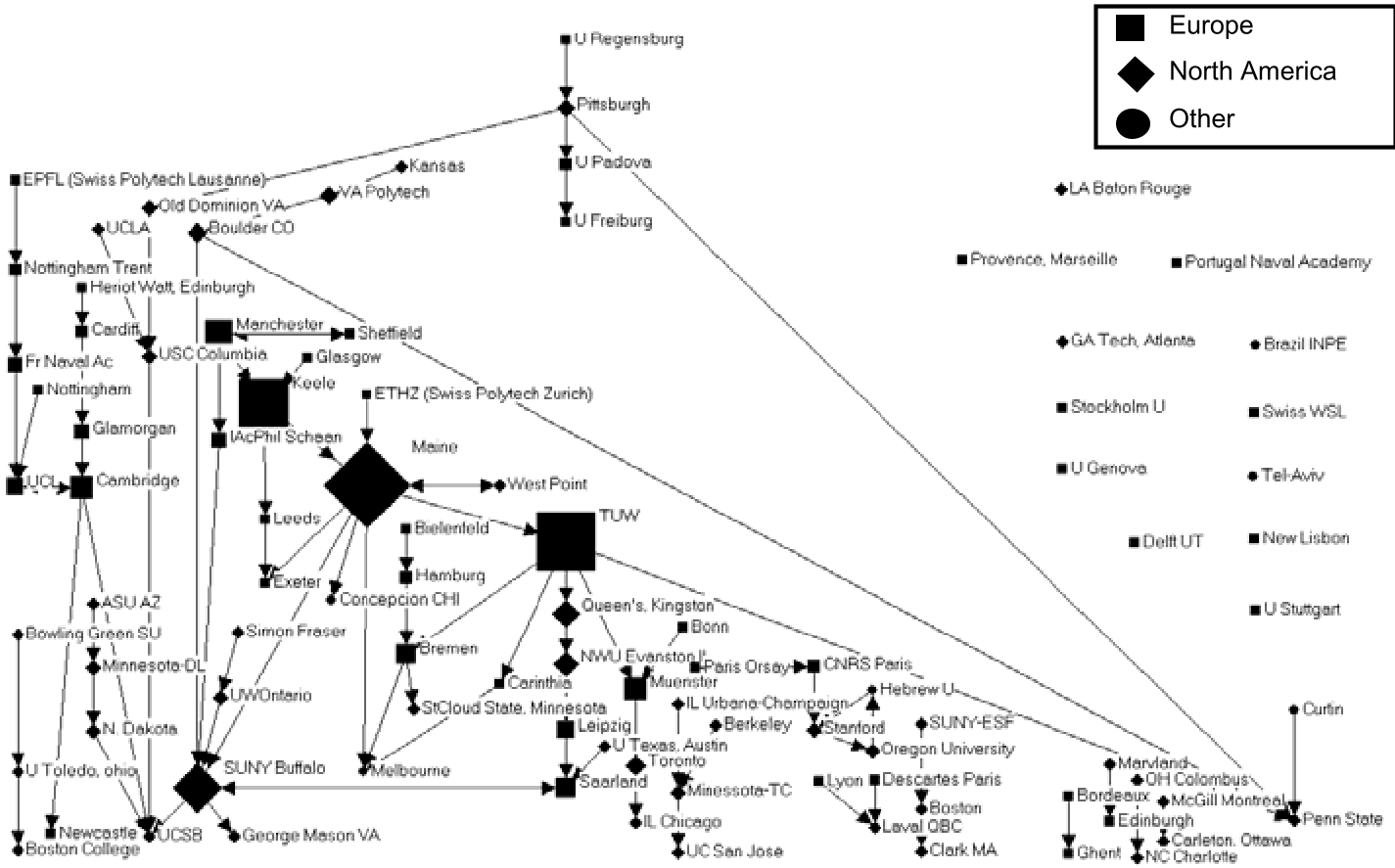 Figure 2: The "Flow" of academia. You can see how specific universities serve as attractors in the global academic stream.
Critical Insights & Takeaways
The study reveals a distinct geographic bias. For example, while European and North American universities both "export" talent, the end points of academic trajectories show a clear trend towards North America.
The most fascinating metric is the difference in "International Policy." UCSB, while a "Cut Point" (a critical node for network cohesion), was found to be primarily connected to other US universities. Conversely, SUNY Buffalo and University of Maine act as international gateways, with connections almost exclusively to non-US institutions.
Limitations & Future Work
The authors acknowledge that their data relies on the "digital footprint" of researchers. If a professor doesn't maintain a personal website, they effectively vanish from the model. Future iterations aim to include temporal dimensions—tracking how these networks evolve over decades rather than just a single conference cycle.
Conclusion
This research proves that the Web is not just a repository of documents, but a mirror of human migration. By applying spatial operators to social graphs, we can finally quantify the "gravity" of academic institutions and see how knowledge truly travels across the globe.