
Social and Spatial Proactive Caching: The Shift from Reactive to Predictive 5G Networks
Social and spatial proactive caching for mobile data offloading
The paper introduces a proactive caching framework for 5G small cell networks (SCNs) that integrates social context and device-to-device (D2D) communication. By combining Collaborative Filtering (SVD-based) and Chinese Restaurant Process (CRP) models, it predicts user demands to offload backhaul traffic, achieving up to 22% backhaul savings and a 26% increase in user satisfaction.
TL;DR
To combat the exponential surge in mobile video traffic, this paper proposes a paradigm shift from "reactive" to "proactive" networking. By leveraging Machine Learning (SVD) and Social Network Analysis (Centrality/CRP), the authors demonstrate that network edge nodes (Base Stations and Smartphones) can predict and cache content before it is even requested, reducing backhaul strain by 22% and boosting user satisfaction by 26%.
Background: The Backhaul Bottleneck
Modern mobile operators are facing a "breaking point" due to the 500-fold increase in video traffic. Small Cell Networks (SCNs) were proposed as a solution, but they suffer from a fundamental flaw: they are mostly reactive. They wait for a user to request a file and then scramble to fetch it via the backhaul. If the backhaul is limited, the result is high latency and dropped connections.
The authors argue that human behavior is remarkably predictable. If we know what a user is likely to watch based on their social circle and history, why wait for the request?
Methodology: The "Social + Spatial" Core
The paper bifurcates the solution into two specialized caching scenarios:
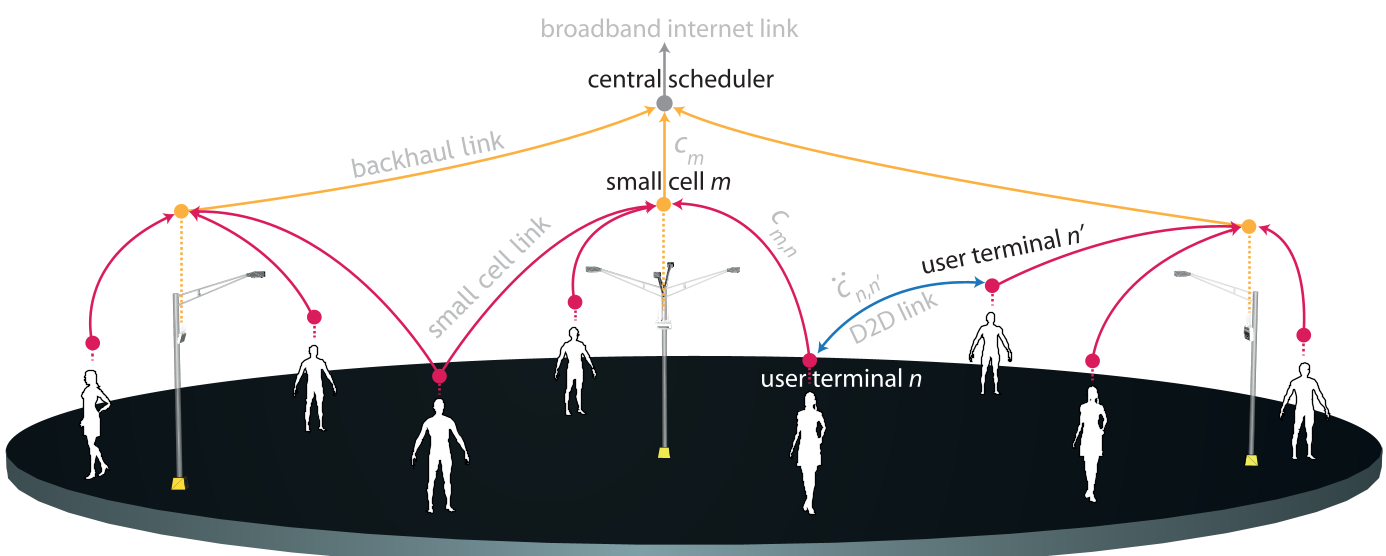
1. Spatial Proactive Caching (Small Base Stations)
Instead of simple "Top-K" popular caching, the authors use Collaborative Filtering.
- The Insight: User-file request matrices are sparse. By using Regularized Singular Value Decomposition (SVD), the Small Base Station (SBS) can "fill in the blanks" of the popularity matrix , predicting the probability of a specific user requesting a specific file.
- Action: Files are pushed to the SBS cache during off-peak hours based on these predictions.
2. Social-Aware D2D Caching (The Social Edge)
This moves the cache even closer—to the users' own devices.
- Eigenvector Centrality: The system identifies "Influential Users" who are socially well-connected and physically mobile.
- Chinese Restaurant Process (CRP): To model how content spreads, the authors use CRP. In this metaphor, a user's choice to "sit at a table" (view a file) is influenced by how many others are already there. This captures the viral nature of social media content.
- D2D Delivery: When a user wants a file, the SBS checks if a nearby "influential peer" has it in their cache. If yes, the file is delivered via Device-to-Device (D2D) communication, bypassing the cellular network entirely.
Experimental Insights
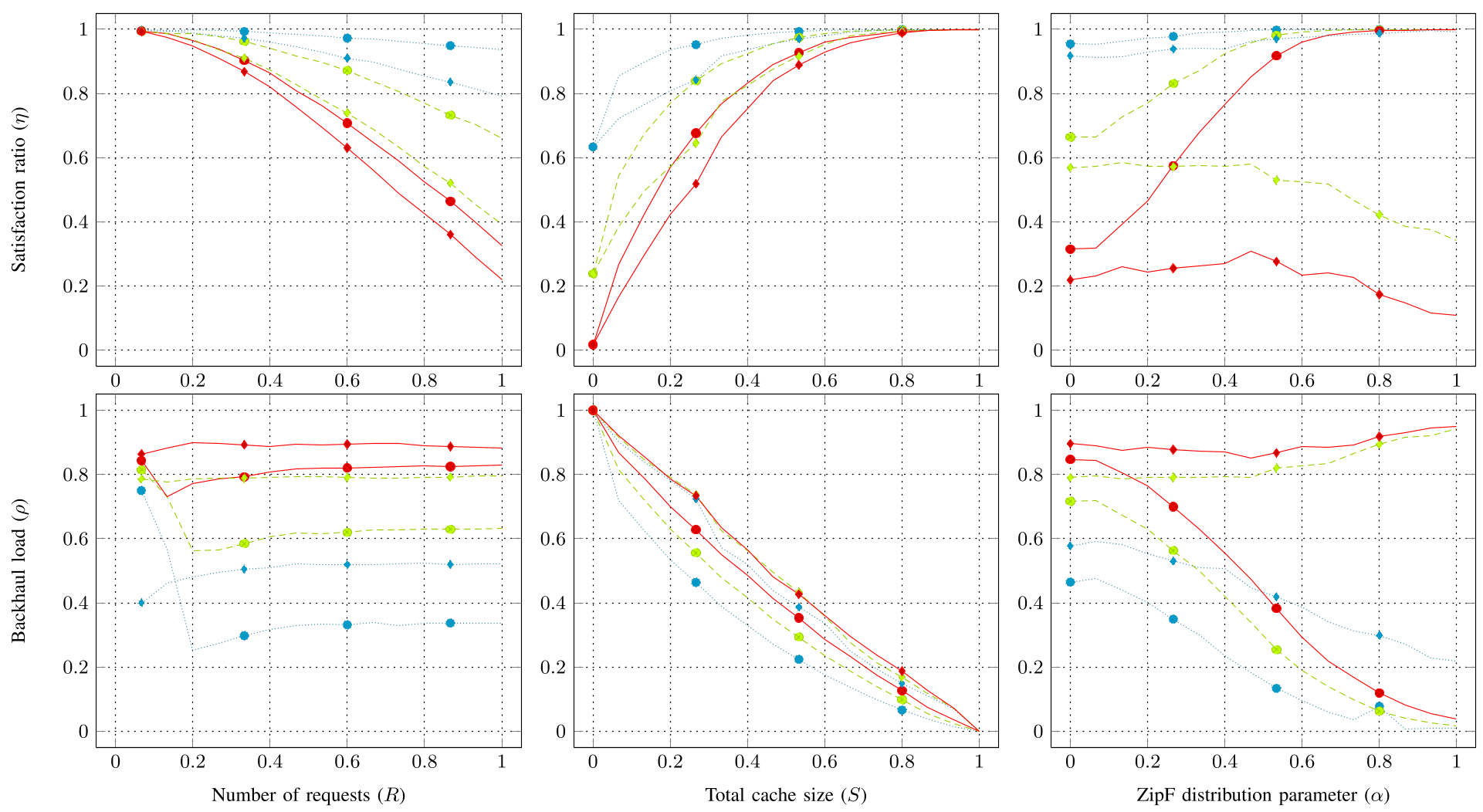
The study evaluated the system under varied loads and ZipF distributions (which model content popularity).
- Satisfaction Ratio: The proactive approach is significantly more robust as the number of requests increases. While the reactive approach "breaks" under high load, the proactive model maintains higher QoS.
- The "Cold Start" Caveat: Interestingly, at very low request volumes, the proactive model can occasionally perform slightly worse than random caching due to the "cold start" problem in Collaborative Filtering (insufficient data to make accurate predictions).
- Cache Size Impact: As edge storage becomes cheaper and larger, the gains of proactive caching grow almost linearly before saturating, suggesting that over-provisioning edge storage is a highly cost-effective 5G strategy.
Critical Analysis & Conclusion
Takeaway
The paper effectively proves that predictability is a resource. By leveraging social ties and SVD-based prediction, the network can trade off cheap storage (on SBS and smartphones) for expensive, congested backhaul bandwidth.
Limitations
- Privacy: The model assumes the operator has access to social graphs and file viewing history, which may face regulatory hurdles (GDPR).
- Battery Drain: D2D dissemination requires influential users to use their own battery to serve others, a problem the authors assume "incentive mechanisms" will solve, but don't define here.
Future Work
The next logical step is Distributed MIMO Caching, where multiple base stations coordinate their caches to create a massive, virtualized edge storage pool, further reducing redundancy and increasing the hit rate.