
Mapping the Flow of Life: A Network Science Perspective on US Organ Transplantation
The Social Structure of Organ Transplantation in the United States
This paper introduces a Network Science approach to analyze the US organ transplantation system by constructing Geographical Social Networks (GSNs) from UNOS data (1987-2010). By applying community detection algorithms, the study evaluates whether organ allocation adheres to geographic locality across different organ types.
TL;DR
Researchers have applied Network Science to the US organ transplantation system to "audit" whether organs are staying local. By treating transplant data as a Geographical Social Network (GSN), the study identifies that while heart and liver allocations are geographically efficient, the kidney and intestine systems show structural anomalies that suggest a need for policy reform.
Background: The Structural Dilemma
In the United States, the gap between organ supply and demand is a humanitarian crisis. With demand growing at 20% annually compared to a meager 5% increase in donors, the United Network for Organ Sharing (UNOS) faces the Herculean task of fair allocation. Current policies prioritize "locality" because organs (like kidneys) degrade within 36-48 hours. However, whether these policies are actually working as intended across different organ types remained a black box—until now.
Motivation: Organs as a Networked Commodity
The authors propose a shift in perspective: view an organ as a commodity flowing through a network. The fundamental question is: Are organs being kept locally whenever possible? To answer this, they moved beyond simple statistics to Community Analysis, seeking to determine if the "social structure" of transplants naturally aligns with geographical boundaries.
Methodology: Building the GSN
The authors utilized the UNOS database containing records of all US transplants since 1987.
- Node Definition: States are treated as nodes.
- Edge Definition: An edge is formed when a transplant occurs between a donor in State A and a recipient in State B.
- Weighting: The number of transplants determines the edge weight.
- Thresholding (): Because the network is nearly "fully connected" (most states have at least one transplant between them), the authors applied a threshold to strip away weak connections, revealing the "backbone" of the system.
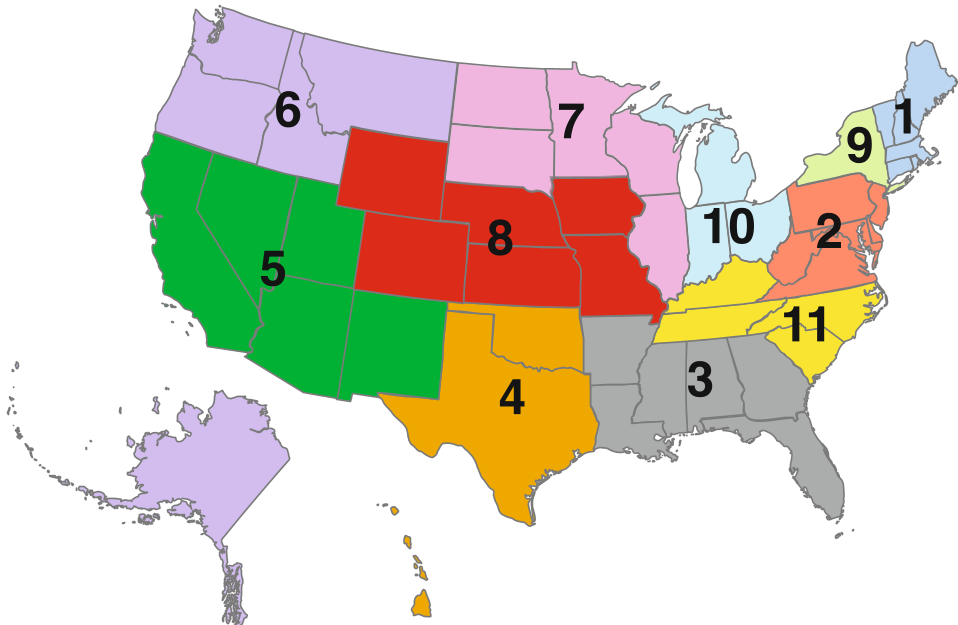 Figure 1: The 11 standard UNOS regions used as the baseline for geographical allocation.
The "Fast Unfolding" of Communities
Using the Blondel algorithm, the researchers detected clusters where states are more tightly linked to each other than to the rest of the country.
Insights from the Results
The findings revealed a stark contrast between different organ types:
- Heart & Liver: These networks showed high Geographic Coherence. The communities formed correlated almost perfectly with physical US regions, suggesting that the strict time-sensitivity of these organs forces a localized structure.
- Intestine & Kidney: These networks appeared "messy." For instance, in the kidney network, New York clustered with the Southeast (Florida/Texas) rather than its neighbors. This suggests that factors other than distance—possibly insurance policies (Medicaid), clinical expertise, or ethnic disparities—are driving the flow of these organs.
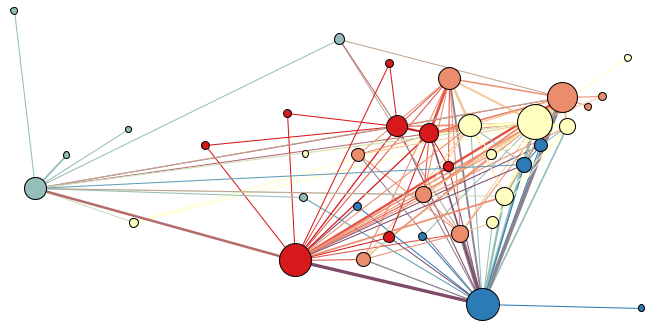 Figure 2: Community detection results for (a) Intestine, (b) Lung, (c) Pancreas, (d) Heart, and (e) Liver. Notice the clear geographical clustering in (d) vs the fragmented structure in (a).
Critical Analysis & Conclusion
The value of this study lies in its ability to visualize systemic inequality.
Takeaway
The "locality" of organ donation is not uniform. The fact that Kidney and Intestine networks do not form clean geographical communities indicates that the current system might be failing to optimize for distance, or worse, is reflecting deep-seated socioeconomic biases where patients in certain states are forced to "search" far afield for life-saving surgery.
Limitations & Future Work
While the study provides a macro-view, it lacks granularity. The authors acknowledge that future iterations must include demographic dimensions—race, education, and income—to determine if these network "anomalies" are actually symptoms of social injustice. By modeling these as multi-layer networks, we can move from simply observing the flow of organs to actively engineering a fairer allocation system.