
STARS: Bridging Social Hubs and Temporal Drift for High-Precision Recommendations
Social and Temporal-Aware Personalized Recommendation for Best Spreaders on Information Sharing
The paper introduces STARS (Social and Temporal-Aware personalized Recommendation for the best Spreaders), a framework designed to enhance Recommender Systems by integrating social influence and temporal dynamics. It utilizes Eigen Vector Centrality (EVC) within a k-shell structure to identify influential users and outperforms conventional context-aware models in prediction accuracy and profitability.
TL;DR
The STARS (Social and Temporal-Aware Recommendation for Spreaders) framework tackles the twin challenges of information overload and shifting user preferences. By identifying social "super-spreaders" using graph centrality and prioritizing recent feedback via temporal weighting, it significantly outperforms traditional context-aware systems, boasting a nearly 10% gain in precision and superior profit optimization for e-commerce.
Problem & Motivation: The Static Recommendation Trap
Most Recommender Systems (RS) view user interest as a static snapshot. However, in the real world, user tastes are fluid—a phenomenon known as Preference Drift. Conventional models often fail because:
- Cold-Start Sensitivity: They cannot handle new users or items effectively due to a lack of historical data.
- Temporal Neglect: They treat a rating from three years ago with the same importance as one from yesterday.
- Social Blindness: They ignore the ripple effect of influential users (Best Spreaders) who drive trends within Online Social Networks (OSNs).
The authors' insight is simple yet powerful: to move the needle on accuracy, an RS must identify who is influential and when their feedback was provided.
Methodology: The Three Pillars of STARS
The STARS methodology is structured into three distinct logical phases designed to filter through the noise of big data.
1. Influential Node Identification
Instead of treating all users equally, STARS searches for "Information Hubs." It uses Eigen Vector Centrality (EVC) within a k-shell structure. This allows the system to find nodes that are not just highly connected, but connected to other highly connected nodes—the true opinion leaders.
2. Preference Analysis
The system blends explicit feedback (direct ratings) with implicit feedback (browsing behavior). It populates a User-Item matrix and uses Pearson Correlation Coefficients to predict missing values, ensuring that even sparse data can yield a recommendation.
3. Temporal Dynamics Integration
This is the "secret sauce." STARS applies a weight to feedback. Recent interactions () are weighted more heavily than older ones (). This ensures the recommendation is aligned with the user’s current lifestyle rather than their past.
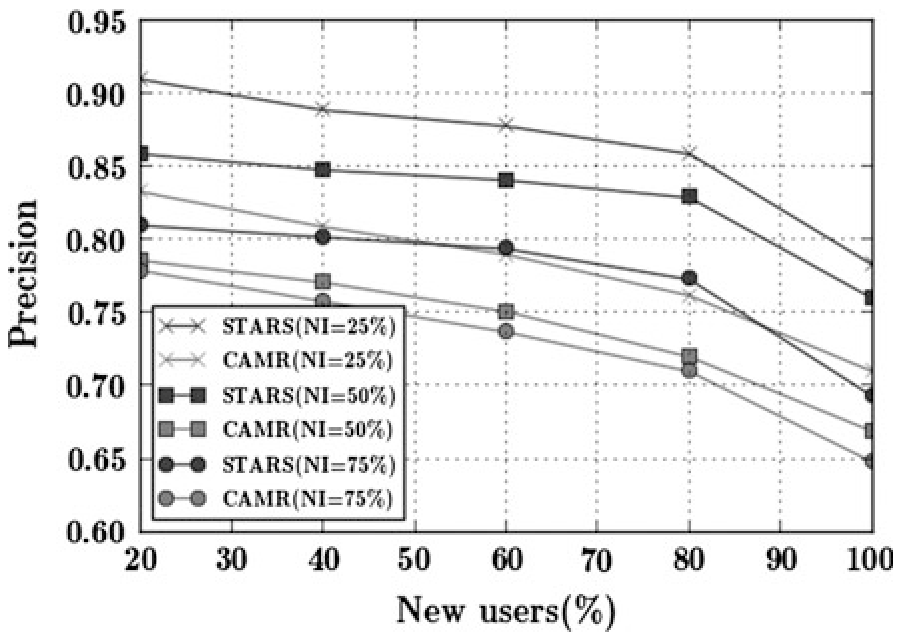 Figure 1: While the provided snippet shows a Precision chart, the architecture relies on this multi-phase filtering of OSN and OS data.
Experimental Results: Proving the Value
The study compared STARS against the Context-Aware Movie Recommendation (CAMR) approach.
- Precision and Recall: Even when 80% of the users were "new" (a extreme cold-start scenario), STARS maintained logic-driven recommendations, outperforming CAMR by 9.24% in precision.
- F-Measure & Time: The F-measure was significantly higher at time than at , validating that temporal awareness directly translates to recommendation quality.
- Commercial Profitability: By targeting "Interesting Social influence Hubs" (ISH), the system reached a 96% profit efficiency, proving that viral marketing is more effective when you identify the right starting nodes.
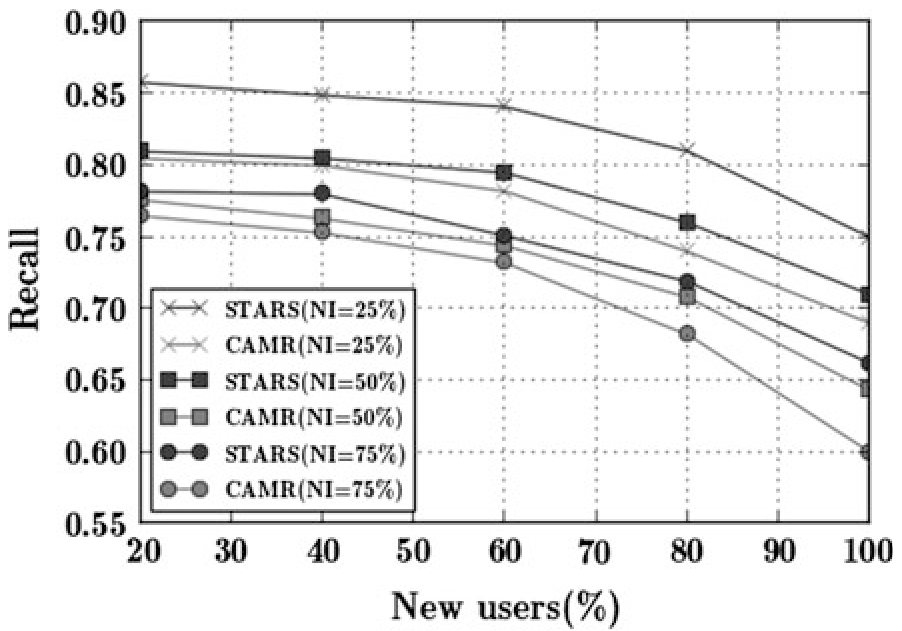 Figure 2: The Recall comparison highlights STARS' resilience as the percentage of new users increases.
Critical Analysis & Conclusion
Takeaway: STARS proves that Recommendation is not just a data-matching problem; it is a spatio-temporal graph problem. By combining the stability of k-shell graph theory with the agility of temporal weighting, STARS solves the "drift" issue that plagues current e-commerce platforms.
Limitations: The reliance on Pearson Correlation for the user-item matrix suggests that as the item catalog scales into the millions, the system might face computational bottlenecks. Future iterations could benefit from replacing the traditional Matrix Factorization with Graph Neural Networks (GNNs) to further refine the influence propagation modeling.
Final Thought: For developers building modern e-commerce engines, the lesson is clear: Stop treating time as a neutral variable. The "Recent" tag is your most valuable feature.