
STARS: Bridging Social Influence and Temporal Dynamics for Precision Recommender Systems
Social and Temporal-Aware Personalized Recommendation for Best Spreaders on Information Sharing
The paper introduces STARS (Social and Temporal-Aware personalized Recommendation for Best Spreaders), a framework designed to improve E-commerce recommendations by integrating Online Social Networks (OSNs) and Online Shops (OSs). It identifies influential "best spreaders" via Eigenvector Centrality and utilizes temporal dynamics to adapt to shifting user preferences, achieving state-of-the-art accuracy in dynamic environments.
Executive Summary
In the hyper-competitive landscape of Online Shopping (OS), static recommendation algorithms are increasingly obsolete. User preferences are not fixed; they "drift" as products evolve and social trends shift. This paper presents STARS, a novel approach that synchronizes Social Influence Identification with Temporal Dynamics. By targeting the "Best Spreaders" in a social network and weighing recent feedback more heavily than ancient history, STARS effectively tackles the perennial challenges of cold-starts and information overload.
The Core Challenge: The Moving Target of User Interest
Most conventional Recommender Systems (RS) suffer from two primary limitations:
- Cold-Start & Data Sparsity: New users lack sufficient historical data for accurate profiling.
- Temporal Obsolescence: A user's interest in a product from a year ago rarely reflects their intent today.
The authors argue that social influence is the missing link. If we can identify "Information Hubs"—users with high connectivity and influence—we can drive viral marketing efficiency while using their social context to refine recommendations for others.
Methodology: The STARS Framework
The STARS approach is structured into three distinct logical phases:
Phase 1: Identifying Information Hubs
Instead of treating all users equally, STARS utilizes Eigenvector Centrality (EVC) within a k-shell structure. Unlike simple degree centrality (counting followers), EVC acknowledges that a connection to another influential person is more valuable than many connections to isolated users.
Phase 2: Dual Feedback Analysis
The system analyzes both Explicit feedback (ratings) and Implicit feedback (behavioral logs). It constructs a user-item matrix and applies Pearson Correlation to measure similarities between items, which is particularly useful for handling new users by looking at item-to-item relationships.
Phase 3: Temporal-Aware Weighting
This is the "Secret Sauce." STARS filters items based on brand and time (). It assigns a weight to feedback, where . This ensures that the model prioritizes who the user is becoming rather than who they used to be.
 Note: The methodology integrates OSN structures with OS transaction data.
Experimental Insights
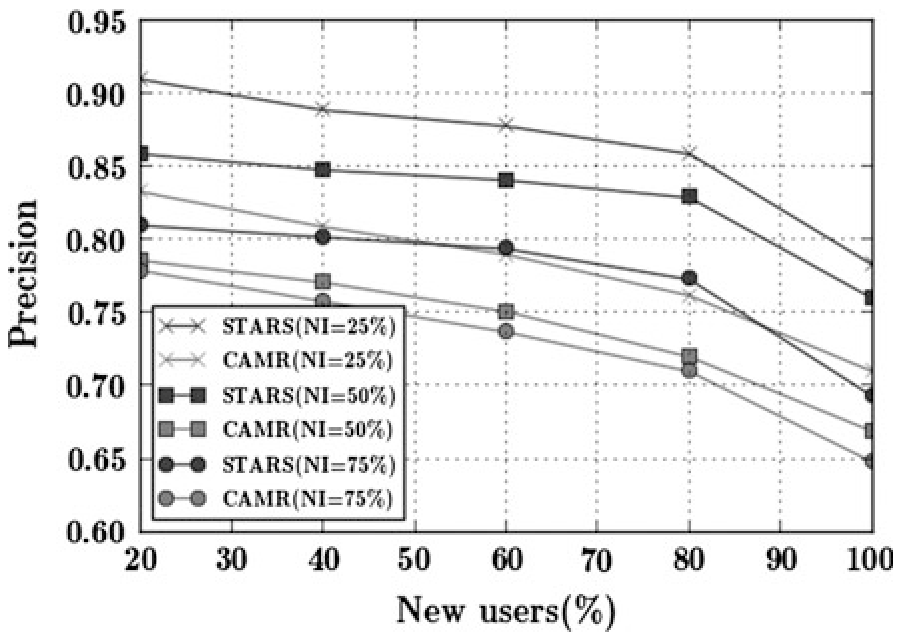
The researchers compared STARS against the Context-Aware Movie Recommendation (CAMR) approach. The results across several metrics were telling:
- Precision and Recall: STARS maintained significantly higher precision even as the percentage of "New Users" increased. Specifically, it saw a 9.24% lead in Precision over CAMR when handling 20% new user ratios.
- The Power of Recency (F-Measure): As shown in the ablation of Feedback Time (FT), the F-measure was highest at time and degraded as the system looked further back (, ). This confirms that recent preferences are the most accurate predictors of future purchases.
- Profitability: By focusing on "Interesting Social influence Hubs" (ISH), STARS reached a 96% target profit margin, proving that targeting the "right" users is as important as the recommendation itself.
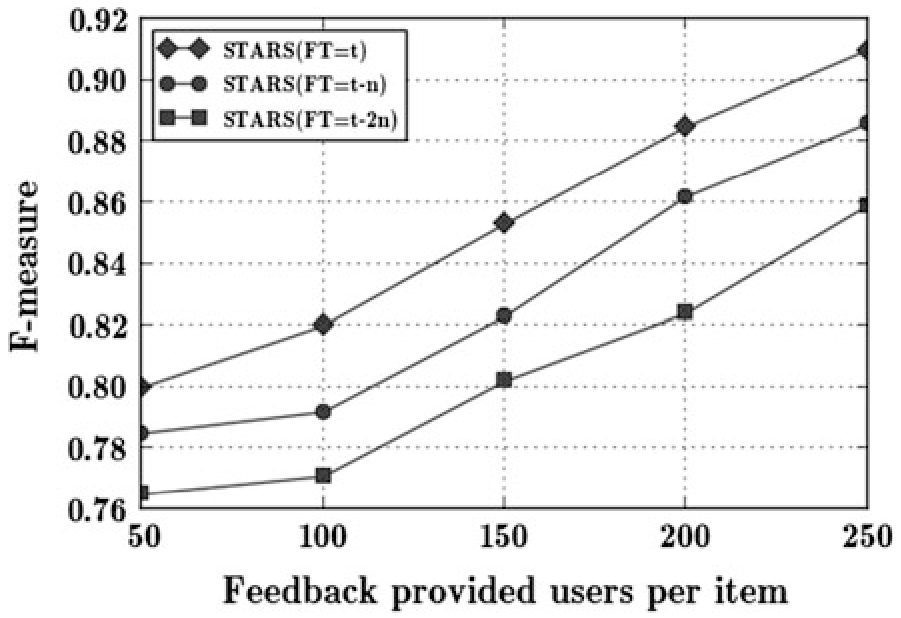 Figure: Profit optimization based on social influence hub density.
Critical Perspective: Beyond the Ratings
The standout achievement of STARS is its holistic view of the user. While many models focus purely on the mathematics of the User-Item matrix, STARS treats the user as an entity within a social graph and a timeline.
Limitations to Consider:
- Computational Intensity: Calculating Eigenvector Centrality on massive graphs (like Facebook or X) in real-time is notoriously expensive. The paper uses a k-shell optimization, but scalability to billions of nodes remains a question.
- Privacy Concerns: The bridge between OSN (Social) and OS (Shopping) data assumes a high degree of data interoperability, which may face regulatory hurdles (like GDPR).
Conclusion
STARS demonstrates that the next frontier of personalization lies in Recency and Reach. By identifying the best spreaders and respecting the decay of interest over time, the framework provides a robust blueprint for the next generation of E-commerce intelligence. For practitioners, the takeaway is clear: stop looking at your users in a vacuum—look at their social "shell" and their most recent clicks.