
ST-CoR: Integrating Social and Temporal Dynamics via Collaborative Ranking
12130_Social temporal collaborative ranking for context aware movie recommendation.
The paper introduces the Social Temporal Collaborative Ranking (ST-CoR) model, a context-aware movie recommendation framework that integrates explicit and implicit feedback. By combining sequential matrix factorization with social network regularization, it achieved significant improvements over state-of-the-art baselines like SVD++ and BPR on the CAMRa 2010 dataset.
TL;DR
The Social Temporal Collaborative Ranking (ST-CoR) model is a breakthrough in context-aware recommendation. It moves beyond predicting absolute scores (regression) to modeling relative preferences (ranking). By incorporating time-aware parameters and social network regularization, it effectively addresses heterogeneous feedback and the cold-start problem, drastically outperforming standard matrix factorization techniques.
Problem & Motivation: The Static Data Trap
Most recommendation engines treat user preferences as static snapshots. However, real-world behavior is fluid:
- Heterogeneity: Users don't just rate; they "favorite," "collect," and "comment." Standard regression models struggle to scale these different signal strengths.
- Temporal Fluctuations: A user's mood changes (e.g., wanting comedies at Christmas), and item popularity spikes (e.g., Oscar-nominated movies).
- Social Context: Our friends influence our choices, yet classical CF models ignore explicit social graphs.
The authors argue that a pairwise ranking approach is the most natural way to unify these disparate signals.
Methodology: The Core Architecture
The ST-CoR framework is built on three pillars:
1. Unified Pairwise Ranking
Instead of modeling a rating , the model focuses on the probability that user prefers item over item . Using the Bradley-Terry model, they define the likelihood of a preference based on the difference between latent scores: This allows both explicit (ratings) and implicit (actions) data to be converted into a single training format: .
2. Sequential Matrix Factorization
To handle time, the authors discretize the timeline into steps. They introduce time-dependent factor matrices:
- User-based: tracks evolving user interests.
- Item-based: tracks shifting item popularity. To prevent overfitting, they implement a Temporal Smoothness Regularization that penalizes drastic changes between consecutive time steps.
3. Social Regularization
Leveraging the "homophily" effect, the model adds a constraint: This ensures that connected friends in the social graph have similar latent factor representations, which is particularly powerful for "cold-start" users with few ratings.

Experiments & Results
The model was tested on the Filmtipset dataset (CAMRa 2010). ST-CoR dominated the competition:
| Algorithm | AUC | MAP |
|---|---|---|
| SVD++ | 0.8362 | 0.0166 |
| BPR | 0.9285 | 0.0267 |
| ST-CoR | 0.9410 | 0.0840 |
Key Insights:
- Item-based temporal modeling proved more effective than user-based modeling for this dataset, as movie popularity changes faster than general user tastes.
- Social influence is context-dependent: It improved performance during the Oscar week (a movie-centric event) but was less effective during Christmas (a family-centric event).
- Mitigating Cold-Start: Social regularization provided the biggest boost for the "least active" users (as shown in the analysis of user segments).
Critical Analysis & Conclusion
The ST-CoR model succeeds because it treats recommendation as a dynamic ranking problem rather than a static regression task. Its ability to "regularize" across both time and social space makes it robust against the sparsity typically found in real-world data.
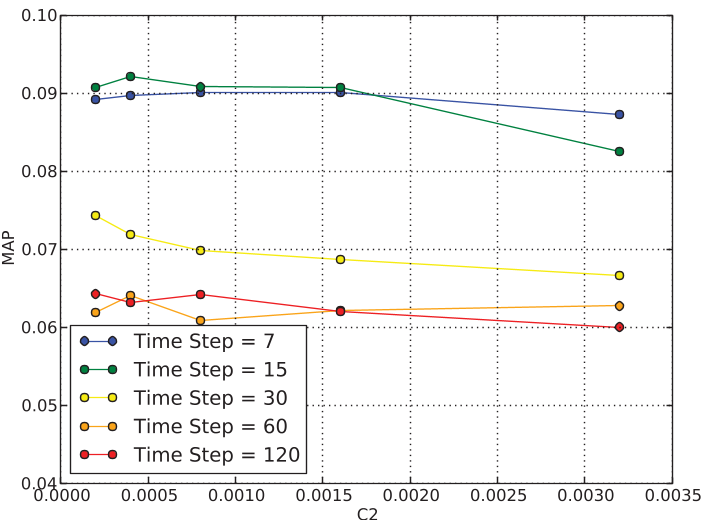
Limitations: The model requires careful tuning of (regularization weights). Future work should aim for automatable hyperparameter tuning via Bayesian optimization.
Final Takeaway: For modern platforms, social and temporal signals are not just "extras"—they are essential components that, when modeled via pairwise ranking, provide a massive leap in recommendation accuracy.