
Strategizing Social Therapy: Using Diffusion Theory to Deploy Robots in Elderly Care
Towards social-therapeutic robots: How to strategically implement a robot for social group therapy?
This paper proposes a mathematical framework for strategically deploying sociable robots in group therapy settings (e.g., elderly care). It introduces an Agent-Based Model (ABM) combined with Diffusion of Innovations theory to predict how Human-Robot Social Interaction (HRSI) spreads and utilizes entropy-based metrics to identify "innovators" who catalyze social adoption across a network.
TL;DR
Building a social robot is only half the battle; the other half is knowing how to introduce it to a community. This paper presents a theoretical bridge between robotics and social psychology, using Agent-Based Modeling (ABM) and Information Theory to strategically pick "innovators" in a social group. By targeting the right individuals first, researchers can accelerate the acceptance of therapeutic robots and measure their success through groups-wide "social entropy" reduction.
The "Seeding" Problem in Social Therapy
When a robot like the seal-like Paro enters a nursing home, its success isn't just about how many people touch it, but how it changes the way people talk to each other. Most studies focus on the individual user, overlooking the "network effect."
The authors argue that introducing a robot is an Innovation Diffusion process. If you give the robot to a person with no social influence, the innovation dies. If you identify the "Key Players"—the social glue of the group—the interaction spreads like a healthy contagion.
Methodology: Entropy as a Social Compass
The paper introduces two core mathematical tools:
- Diffusion Modeling: Using a sigmoid function, the authors model how likely an agent is to adopt the robot based on their neighbors' behavior and the robot's social complexity .
- Key Player Identification: Instead of just counting a person's friends (Vertex Degree), they use Entropy Reduction. They calculate the entropy of the network, then "remove" an agent and see how much the total network connectivity drops (). Those who cause the biggest drop are your "Innovators."
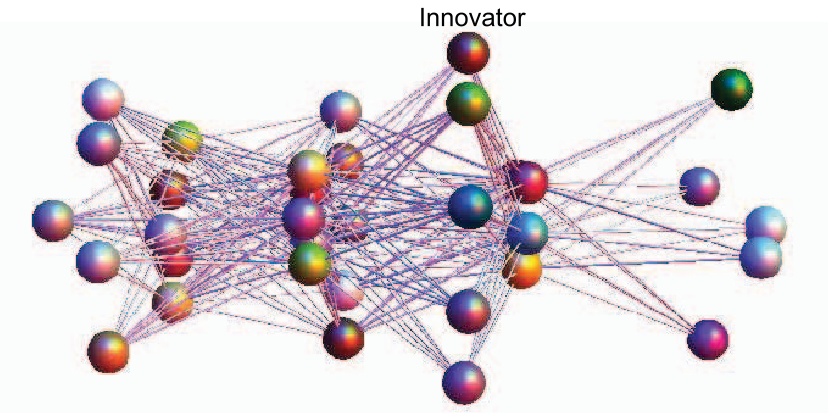 Fig 1 & 2: Social networks with varying innovator connections. The researchers tested how the number of "neighbors" an early adopter has impacts the speed of group-wide adoption.
Simulation & Real-World Validation
The simulations (Fig 3 and 4) prove a vital point: social adoption follows an S-curve. When the innovator has more neighbors (15 vs 10), the "Preference" toward the robot () reaches saturation significantly faster.
The Paro Experiment Re-analyzed
The authors took raw data from a famous study on the Paro robot and applied their entropy formula.
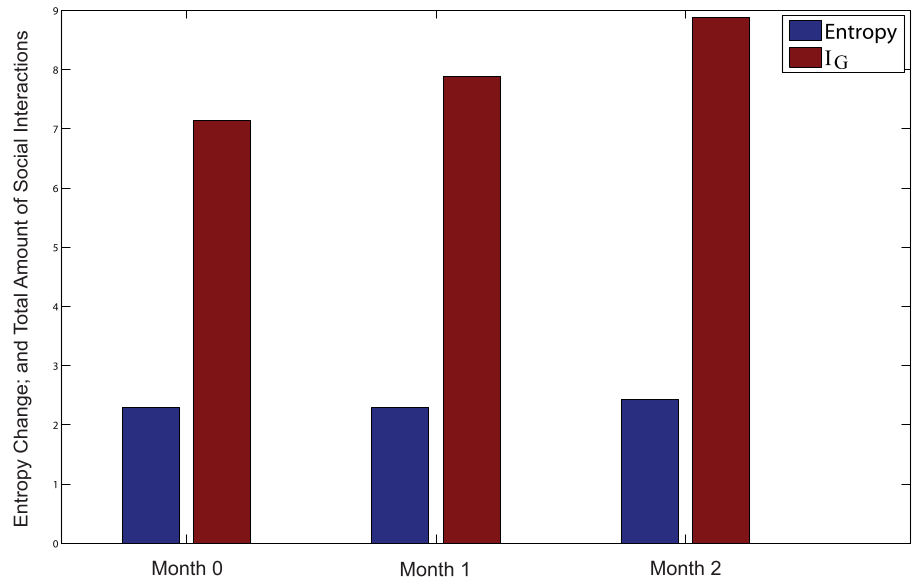 Fig 9: The upward trend in Entropy () and Total Interaction () over two months suggests the robot didn't just entertain; it made the social network more uniform and robust.
By analyzing the adjacency matrices of residents' time spent together, they found that:
- Total Interaction () rose from 7.14 to 8.88.
- Entropy () increased from 2.29 to 2.42.
In information-theoretic terms, higher social entropy is a good thing here—it means social interactions are becoming more evenly distributed among group members, rather than being concentrated in just one or two cliques.
Critical Insight & Future Outlook
The most profound takeaway is the Information-Theoretic identifies better innovators. As shown in the comparison between Agent 2 and Agent 3, simple "local connectivity" (vertex degree) is a decent predictor, but "overall network influence" (entropy reduction) is the superior metric for maximizing therapeutic reach.
Limitations: The model assumes a static social network, whereas real-life networks are dynamic and fluid. Future work needs to account for how the robot itself creates new edges in the graph that didn't exist before its arrival.
Conclusion
This work moves social robotics away from being a "toy" toward being a strategic intervention tool. By quantifying the "social effect" through entropy, healthcare facilities can finally measure the ROI of therapeutic robots in terms of social health and group cohesion.