
Deconvolving the Social Web: How Shared Locations Reveal the Strength of Human Ties
Social ties and checkin sites: connections and latent structures in location-based social networks
This paper explores the latent relationship between geospatial check-in behaviors and social connectivity in Location-Based Social Networks (LBSNs). By proposing a statistical deconvolution model and validating it on Brightkite, Gowalla, and Yelp datasets, the authors demonstrate that shared check-ins are strong predictors of social ties and reveal tiered network structures.
TL;DR
Not all social connections are created equal. This research demonstrates that in Location-Based Social Networks (LBSNs), we can "deconvolve" a messy social graph into meaningful layers—distinguishing family and close friends from mere acquaintances—simply by analyzing the statistical overlap of check-in locations. By identifying these "strong ties" through high-frequency shared locations, the study reveals latent structures that facilitate the flow of influence more efficiently.
Problem & Motivation: The Monolithic Graph Fallacy
In the world of social network analysis, we often treat a "friend" edge as a binary entity: you are either connected, or you aren't. However, the reality of human interaction is vastly more nuanced. Your relationship with a sibling involves high spatial overlap (home, favorite cafes), whereas a professional acquaintance might share only a single conference location.
The authors argue that standard LBSNs (like the historical Brightkite or Yelp) are actually multi-tiered networks superimposed on each other. The core problem is: How can we mathematically separate these layers to understand which ties actually drive social influence?
Methodology: Bayesian Deconvolution
The study approaches this by posing three key hypotheses centered around "Triadic Closure"—the idea that if A knows B and B knows C, A and C are likely to meet.
1. The Asymmetry of Friendship and Locations
Using a Bayesian approach, the authors define:
- Proposition 1: High shared check-ins () imply friendship (), but being friends doesn't necessarily mean you check in at the same places frequently.
Mathematically, is high for large , but is surprisingly low for large . Essentially, high-frequency location overlap is a "smoking gun" for a social tie, but social ties represent a wide spectrum of behaviors where many friends rarely meet in the physical world.
2. Network Tiering through Clustering
By partitioning the social graph into layers based on the number of shared check-ins, the authors analyze the Clustering Coefficient of each layer.
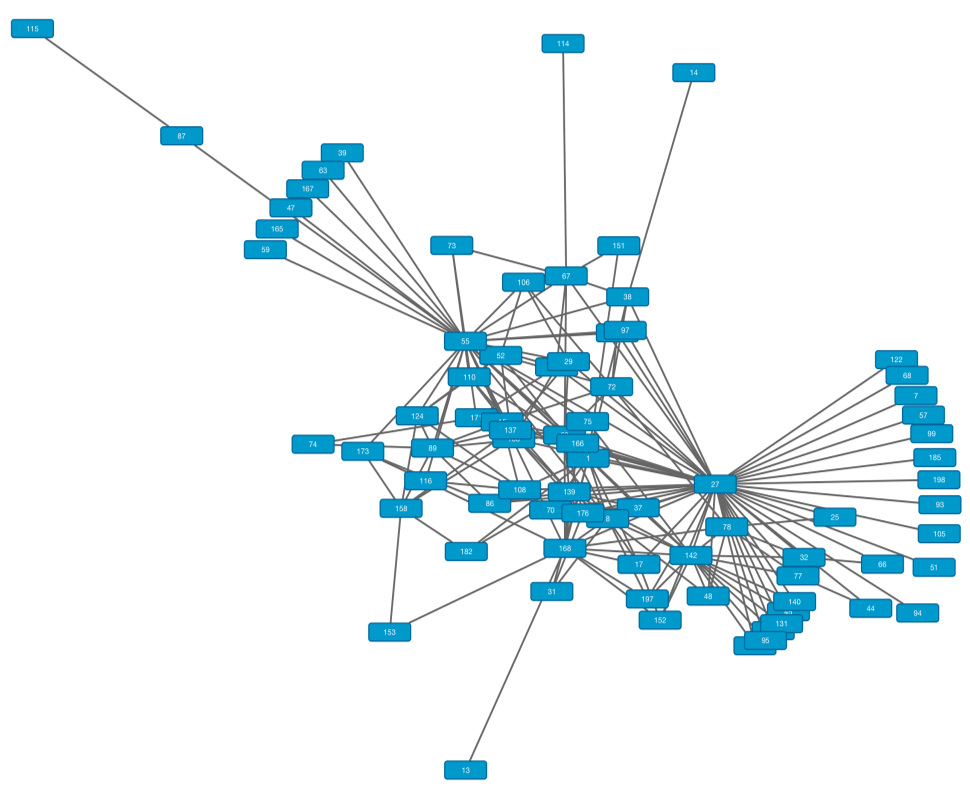 Figure: Visualizing the deconvolution of a Yelp subgraph. (a) shows the full network, (b) the sparse 'weak ties' with 0 check-ins, and (c) the denser 'strong ties' layer.
Experimental Insights: Strong vs. Weak Ties
The validation on three massive datasets (Brightkite, Gowalla, and Yelp) yielded striking results:
- The Power of 20: In Yelp, the sum of conditional probabilities for friendship increases by two orders of magnitude when moving from low () to high () shared check-ins.
- Clustering Bias: The "Strong Ties" layer (high ) shows a distribution of clustering coefficients skewed heavily toward 1.0, indicating tight-knit communities (cliques).
- The Bridge Effect: Conversely, social ties with zero shared check-ins show clustering even lower than the baseline network. These are the "Weak Ties"—acquaintances that act as bridges between disparate social circles.
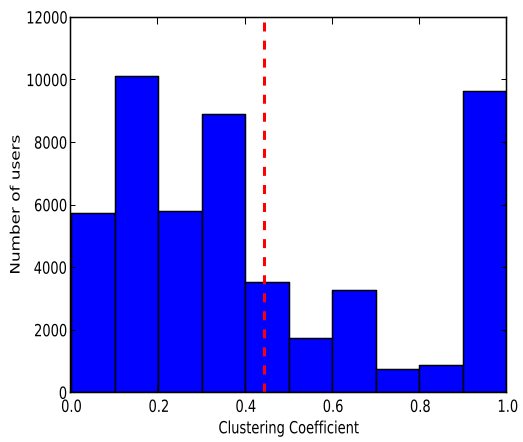 Figure: Clustering coefficients for Brightkite. As shared check-ins increase from (a) zero to (c) more than five, the mean clustering coefficient (dotted line) shifts significantly to the right.
Critical Analysis & Conclusion
Takeaway
This work provides a robust statistical framework for social weight discovery. By using node attributes (location) to weigh edges, we can move beyond simple graph topology and understand the functional role of a connection. Product designers can use this to prioritize notifications or recommendations from "strong tie" layers.
Limitations
The data relies on public API check-ins, which are inherently "noisy" and "performative." People don't check in everywhere they go—often only at "interesting" places. This bias might over-represent leisure-based strong ties while missing domestic ones.
Future Outlook
The Authors suggest a fascinating next step: Incentivized Structure Shaping. If high-frequency check-ins create strong ties, can a platform foster community density by incentivizing users to visit the same locations? This moves LBSNs from passive observation platforms to active social engineering tools.