
Beyond Randomness: Mimicking the Human Fabric in Complex Networks
Social ties, homophily and extraversion--introversion to generate complex networks
The paper proposes a novel social network generation model that integrates sociologically-grounded concepts—Social Ties, Homophily, and Extraversion-Introversion—to create "Complex Networks." The method effectively produces synthetic graphs that exhibit the dual characteristics of Small-World (high clustering, low path length) and Scale-Free (power-law degree distribution) properties while maintaining structural motifs like large cliques found in real-world data.
TL;DR
While many algorithms can churn out graphs with "Small-World" or "Scale-Free" labels, they often fail the "eye test" of real-world social structures. This paper introduces a sociologically-driven model that uses cliques as building blocks and extraversion as a merging mechanism. The result? Synthetic networks that don't just have the right stats, but actually look and behave like real human societies—complete with dense groups and influential bridges.
Background Positioning: The Gap Between Math and Sociology
In the coordinate system of Network Science, we have two classic poles: the Watts-Strogatz model (excellent clustering but no hubs) and the Barabási-Albert model (perfect hubs but zero clustering). While hybrids exist, many fail to capture the "Motifs" of social life—specifically the large cliques (groups of friends, co-authors, or teammates) that define our daily interactions. This paper moves the needle from "statistical mimicry" to "structural authenticity."
The Core Insight: Humans are Socially Layered
The authors argue that social networks are built on three pillars:
- Social Ties (Cliques): We exist in groups, not just pairs.
- Homophily: We connect with similar others, reinforcing these groups.
- Extraversion-Introversion: Some "extroverts" bridge multiple groups, while "introverts" stay anchored in one.
Methodology: Building a Society in Three Steps
Phase 1: The Building Blocks
Instead of adding one node at a time (as seen in preferential attachment models), the algorithm begins by generating a set of disconnected cliques (). The sizes are variable, representing everything from a small research trio to a large corporate department.
Phase 2: Defining the Socialites
To achieve a Scale-Free property, the model assigns "Open Connection" (OC) values to nodes using a power-law distribution. This mathematically represents the Extraversion-Introversion trait: a few nodes are destined to be international socialites (high OC), while most are homebodies (low OC).
Phase 3: The Merge
The magic happens here. Nodes from different cliques are merged based on their OC values. An extrovert from Clique A might be merged with a node from Clique B, effectively becoming a bridge.
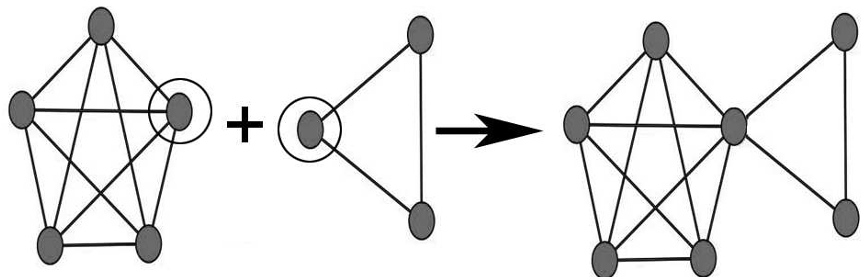 Fig 1: Merging two nodes from different cliques to represent a single individual with multiple affiliations.
Experiments & Results: The Structural Difference
The authors compared their model against SOTA benchmarks like the Holme-Kim and Klemm-Eguiluz models. While those models can force triads (3-node groups), they fail to generate large, dense cliques.
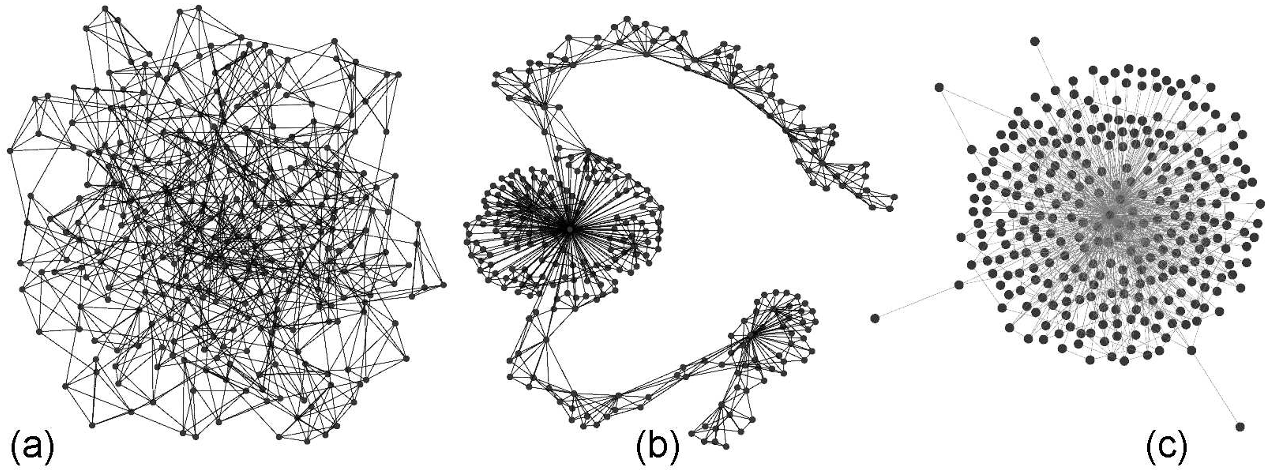 Fig 2: Comparison of different models. Notice how the proposed model (similar to real co-authorship networks) maintains dense, varied clusters.
Key Quantifiable Wins:
- Clustering Coefficient: Consistently high (~0.64 - 0.74), matching real-world co-authorship data much better than random graphs.
- Power-Law Fit: The degree distribution exponent stays near the "magic number" of 3.0, characteristic of natural systems.
- Geodesic Distance: Maintains the "Six Degrees of Separation" efficiency (averaging 5.0 - 6.0 even as nodes increase).
Critical Analysis & Conclusion
The Takeaway
This model proves that preferential attachment is not enough. To build a realistic network, you must start with community-based building blocks. By merging these blocks through "extrovert" nodes, the model naturally captures both the local density and the global connectivity of human society.
Limitations & Future Work
While the model is structurally superior, it operates on a "minimal parameter" set. This means it doesn't always perfectly match the specialized metrics of non-social networks (like transportation or biological systems). The authors suggest that the next frontier is applying these "social" rules to Online Social Networks (OSNs) like Facebook or Twitter, where digital homophily might create even more complex "echo chamber" structures.
The project highlights a vital lesson for AI and network researchers: to understand the graph, you must first understand the social psychology of those who form the edges.