
Beyond Connectivity: The Socio-Technical Blueprint for Telecentre Success in Jamaica
Social Ties, Literacy, Location and the Perception of Economic Opportunity: Factors Influencing Telecentre Success in a Development Context
This paper investigates the critical success factors for telecentres in Jamaica using a grounded theory approach. It proposes a conceptual framework that highlights how social capital, literacy, location, and perceived economic opportunities drive the usage and sustainability of ICT access points in developing contexts.
TL;DR
Access to a computer does not equate to digital inclusion. This paper deconstructs the experience of Jamaican telecentres to show that social ties and economic motivation are the real engines of ICT adoption. By moving beyond "access" to "effective use," the authors provide a framework showing how social capital can bridge the literacy gap and ensure the sustainability of community technology hubs.
The "Missing Link" in Digital Development
For decades, the "Digital Divide" was treated as a hardware problem: if we build it, they will come. However, many telecentres in developing nations become "ghost hubs" despite high-speed connections. The researchers identified that the missing link isn't the bandwidth—it’s the social infrastructure. In Jamaica, factors like the shame associated with illiteracy or the specific need to communicate with the diaspora (strong ties) dictate whether a villager enters a telecentre or stays outside.
Methodology: High-Touch Fieldwork
The authors didn't just look at usage logs; they went to four distinct sites across Jamaica—from the bustling Kingston Metropolitan Area to the rural fishing villages of Westmoreland. Using a Grounded Theory approach, they interviewed managers and observed participants to see how people actually used the technology.
The Conceptual Framework
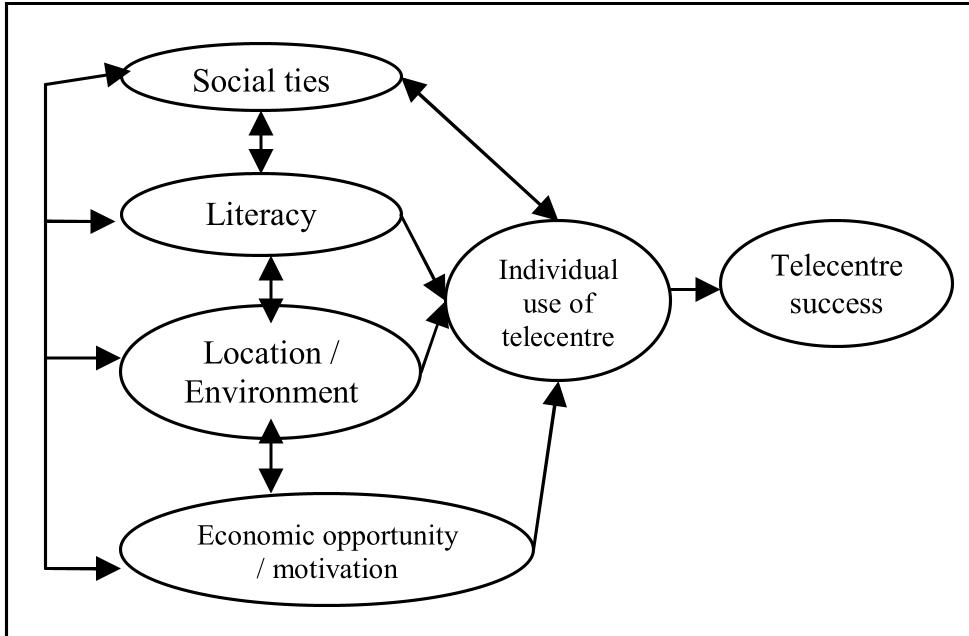
The core contribution of this research is a framework that links social science theories with ICT practice. The authors argue that telecentre usage is a result of the interplay between four constructs:
- Social Ties: Both "bonding" (strong family links) and "bridging" (weak ties with classmates).
- Literacy: Viewed not just as an obstacle, but as a motivator for secret learning.
- Location & Environment: Proximity to local NGOs and schools.
- Economic Opportunity: The perception that ICT skills lead to "alternative livelihoods."
Deep Dive: The Literacy-Social Tie Trade-off
One of the most profound insights of the paper is Proposition 4: When literacy levels are low, and the number of social ties is high, it is likely that telecentre use will be high.
In the field, researchers observed illiterate users who were highly motivated to use the internet to talk to children abroad. Instead of giving up, they leveraged their social capital—asking a literate friend or a younger family member to "drive" the computer for them. This "proxy use" shifts the definition of success from individual skill to community capability.
Key Empirical Findings
The study highlights several non-obvious success factors:
- The Gender Nuance: Women were more likely to join official literacy classes, while men often "pretended" to read while focusing on financial-technical skills (like connecting laptops to sound systems for events).
- The Power of Location: Clustering telecentres with fishermen’s societies or post offices created a "natural" footfall, reducing the intimidation factor of the technology.

Critical Insight & Conclusion
The Jamaican experience proves that telecentres are not just internet cafes; they are social incubators.
Takeaway for Practitioners:
- Don't ignore the "analog" networks: Use existing social ties to promote digital services.
- Design for the "Shame Factor": Literacy training must be discrete and integrated into functional tasks (like job applications).
- Focus on Motivation: Users prioritize ICT when they see a direct line to economic gain or family connection.
While the study is limited to four sites, its grounded theory provides a robust jumping-off point for future research into Community Informatics—reminding us that in the world of development, the "Social" is just as important as the "Technical."