
The Power of the Crowd-Within: Why Team Proposals Win in Corporate Crowdfunding
1257_Social Ties in Organizational Crowdfunding Benefits of Team-Authored Proposals.
This research investigates "Social Ties in Organizational Crowdfunding," specifically examining how team-authored proposals affect funding success within a corporate environment (IBM). The study demonstrates that projects with multiple co-proposers significantly outperform solo-authored ones in terms of funding probability and investor engagement.
TL;DR
Is crowdfunding inside a company just a popularity contest, or a new way to innovate? This study from IBM Research proves that team-authored proposals are significantly more successful than solo ones. By leveraging social ties and "homophily" (the tendency to associate with similar others), teams act as powerful catalysts that bridge the gap between departmental silos and corporate funding.
Background: Beyond Kickstarter
Crowdfunding is no longer just for indie game developers or gadget startups. Large enterprises are increasingly using "Organizational Crowdfunding" to let employees decide which internal projects deserve a budget. However, the social dynamics within a company are far tighter than the open internet. This paper explores how these internal social ties—specifically team structures—influence who gets funded and why.
Problem: The Solo-Innovator Myth
Many internal innovation programs focus on the "lone genius." However, solo-authored proposals often struggle to gain visibility. Prior work hasn't fully explored why some proposals fail to cross the "valley of death" in internal markets. The researchers hypothesized that the lack of social capital—specifically the localized influence of a team—is a primary bottleneck for internal innovation.
Methodology: Analyzing the IBM Ecosystem
The researchers analyzed data from an internal crowdfunding platform at IBM. They focused on several key metrics:
- Success Rate: Did the project hit its funding goal?
- Homophily: Did similarity (same country, same division, same department) between proposers and investors impact the money flow?
- Theil-Sen Regressions: A robust statistical method used to correlate team attributes with funding velocity (Dollars/Day).
 Figure 1: Conceptual overview of social ties in the crowdfunding process.
Key Insights: The Strength of Shared Identity
The most striking finding was the role of Homophily. We tend to fund people we relate to.
1. The Division Effect
Teams that shared the same corporate Division saw a significant boost in success (tau = +.284). This suggests that while departmental ties might be too narrow, belonging to the same broad division provides enough "shared ground" to build trust while maintaining a wide enough network to find investors.
2. Investors Follow Their Own
As shown in the data table below, there is a massive correlation between investors and proposers who share attributes.
| Attribute-in-common | Success (tau) | Investors/Day (tau) |
|---|---|---|
| Country | +.352 (p<.001) | +.359 (p<.001) |
| Division | +.335 (p<.001) | +.340 (p<.001) |
| Department | +.292 (p<.008) | +.212 (n.s.) |
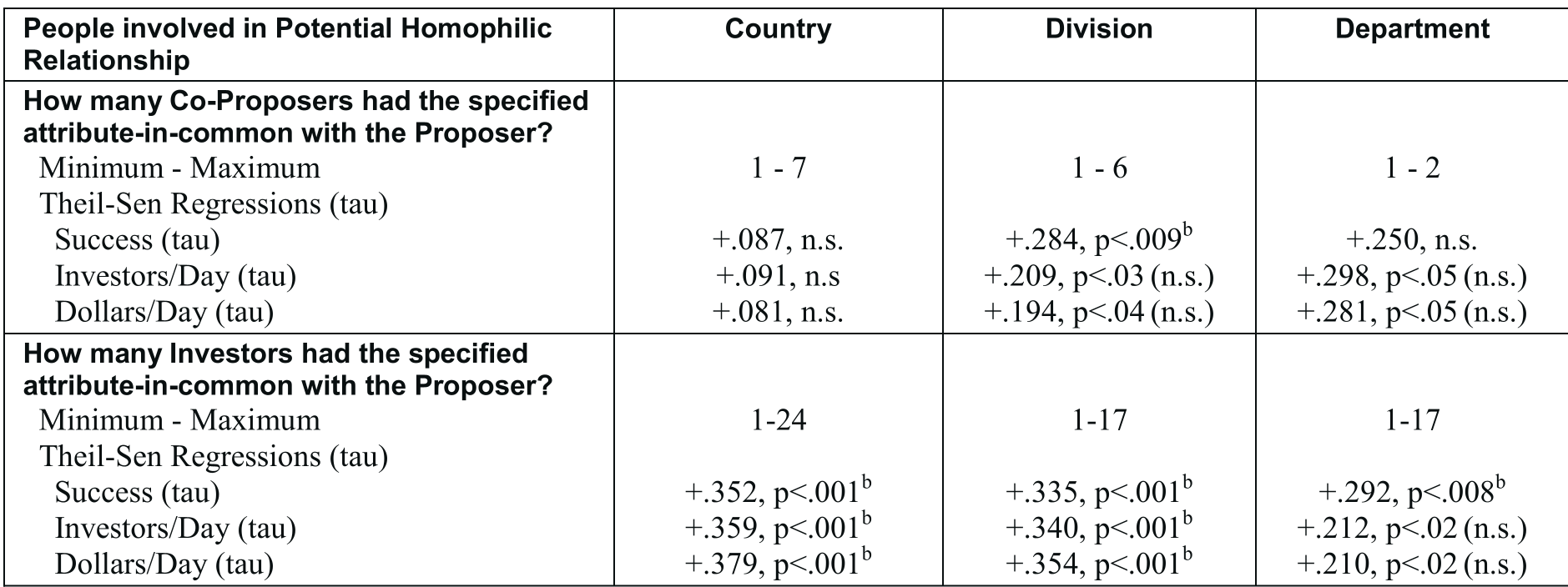 Figure 2: Statistical correlation between common attributes (homophily) and funding success.
Methodology: Why Teams Win
Why does having 3 co-authors beat 1?
- Network Multiplier: Each team member brings their own "weak ties" from different parts of the company.
- Ambassador Effect: Team members act as advocates, providing social proof to skeptical investors.
- Reduced Risk: A team proposal signals that the idea has already survived internal debate and has collective buy-in.
Critical Analysis & Conclusion
This paper provides a masterclass in how social capital transforms into financial capital within an organization.
Takeaway: If you are launching an internal project, don't go it alone. Find co-proposers outside your immediate department but within your division to maximize your "homophilic reach."
Limitations: The study is based on IBM, a massive global entity. The dynamics might differ in smaller startups where "everyone knows everyone," rendering division-level homophily moot. Furthermore, does homophily lead to "echo chambers" where only safe, familiar ideas get funded? This remains a critical question for future research.
Future Outlook: As remote work becomes the norm, understanding these "digital social ties" will be essential for any company looking to maintain an agile, crowdfunded innovation pipeline.