
Social Topic Modeling: Why Your Friends' Interests Matter More Than Their Check-ins
Social Topic Modeling for Point-of-Interest Recommendation in Location-Based Social Networks
The paper introduces the Social Topic (ST) model, a novel Point-of-Interest (POI) recommendation framework for Location-Based Social Networks (LBSNs). It integrates user-generated text and social networks into a unified topic modeling approach, achieving a significant Recall@10 improvement of up to 100% over traditional social-regularized matrix factorization on Yelp datasets.
TL;DR
Recommending a Point-of-Interest (POI) isn't like recommending a movie—your friend in London can't visit your favorite cafe in New York. This paper introduces the ST (Social Topic) model, which recognizes that social influence in LBSNs happens at the interest level rather than the location level. By blending LDA with social regularization and user-generated text, it achieves massive gains in recommendation accuracy, particularly for "cold start" users.
The "Physical Commitment" Paradox
In traditional social recommender systems, the logic is simple: if your friend likes a book, you probably will too. But in Location-Based Social Networks (LBSNs), this breaks down. Data shows that only 20.6% of friends on Foursquare share common POIs, compared to over 40% sharing common movies on platforms like Flixster.
The authors identify two fatal flaws in prior work:
- Physical Commitment: Visiting a POI requires time and travel; it's not a click.
- Geographical Disjointness: Friends often live in different neighborhoods or cities, making shared check-ins rare despite shared tastes.
Methodology: Bridging the Gap with Semantic Topics
The core insight of the Social Topic (ST) Model is that while you and your friend might never visit the same physical restaurant, you likely share a love for "Japanese Cuisine" or "Indie Coffee Shops."
The Architecture
The ST model extends Latent Dirichlet Allocation (LDA) by treating POIs and the words in user-generated tags/reviews as joint outputs of a latent topic.
- Topic Distributions (): Represent user interests.
- POI Distributions (): Represent what locations fit a topic.
- Word Distributions (): Capture the semantic meaning of that topic.
The social network is used to regularize these topic distributions, ensuring that friends' latent interests are pulled closer together, even if their physical footprints never overlap.
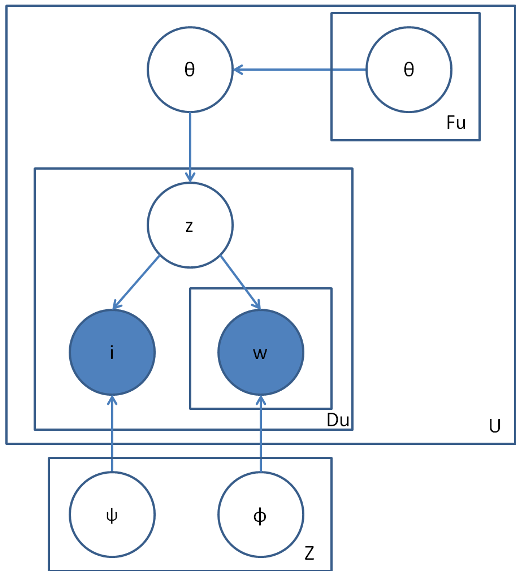 Fig 1: The ST Model architecture, where social influence (F) constrains the latent topic distribution ().
Experimental Results: Crushing the Baselines
The researchers tested the ST model against several heavyweights, including Probabilistic Matrix Factorization (PMF) and Social LDA (SLDA).
- Better than "Popular": While the Popularity (POP) baseline is notoriously hard to beat in POI tasks, ST was the only model to consistently outperform it across all datasets.
- Solving the Cold Start: For "cold start" users (those with fewer than 10 check-ins), ST's ability to use text data (words) proved far more informative than POI indices alone.
- Consistent Gains: On Yelp, the improvements in Recall@10 reached up to 100% over standard social-regularized methods.
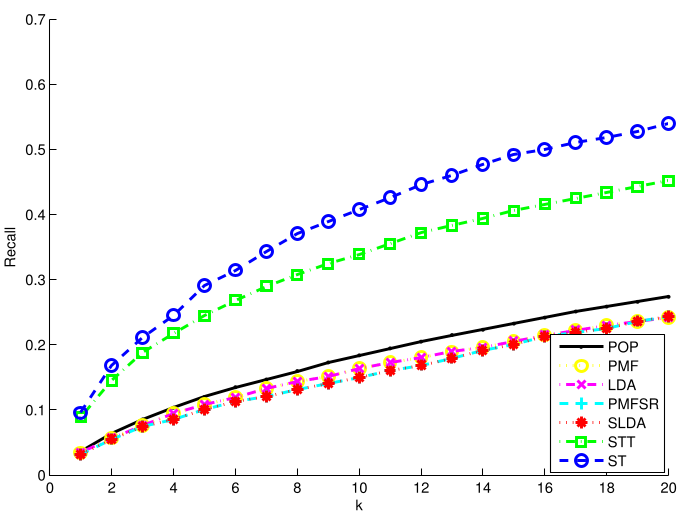 Fig 2: Recall@k comparison on Foursquare and Yelp. ST (solid top line) shows a clear dominance.
Critical Insight: Why Does It Work?
The success of this model lies in moving from Collaborative Filtering (which is sparse in LBSNs) to Content-Aware Topic Modeling. By mapping a user's friend network to semantic categories rather than coordinate points, the model effectively bypasses the "sparsity trap" of geographical distance.
Conclusion
The Social Topic model serves as a vital reminder that in the era of big data, the context (what is being said in reviews) and the nature of the domain (geography) are just as important as the link (the social graph). For future LBSN systems, the path forward involves deeper integration of spatial factors and perhaps, as the authors suggest, even transportation and regional competitiveness metadata.