
The Socialized.Net: Leveraging Social Topologies for Decentralized Search and Integrity
Social Topology Analyzed
The paper introduces "The Socialized.Net," a fully decentralized P2P search infrastructure that leverages semantic routing and social topology. By analyzing real-world trace data from FileList.org, the authors demonstrate that social P2P networks can achieve high search precision (P@10 around 45%) and efficiently isolate malicious nodes by prioritizing neighbors based on local "node preference" and reputations.
TL;DR
The Socialized.Net redefines Peer-to-Peer (P2P) search by moving away from mechanical hashing (DHTs) or blind flooding (Gnutella). Instead, it mimics human interaction by building a social topology where nodes choose neighbors based on shared interests and historical reliability. By utilizing a "Social Routing" algorithm, it achieves high precision and effectively isolates malicious actors without requiring a central server.
The Problem: The Scalability and Trust Paradox
In the landscape of distributed systems, we typically find two extremes:
- Unstructured Flooding: Simple but catastrophic for bandwidth as the network grows.
- Structured DHTs: Highly efficient for exact key-lookups but notoriously poor at keyword searching and personalized discovery.
Furthermore, the "social" aspect of the internet—the fact that users have specific niches and varying levels of honesty—was largely ignored. Most P2P systems struggle with malicious nodes (those spreading fake files) and free-riders (those who don't share). The challenge is: how do we create an efficient search mechanism that is both personalized and resistant to bad actors in a 100% decentralized environment?
The Core Insight: Subjective Preference
The authors suggest that your neighbors shouldn't be assigned by a hash function; they should be earned. The Socialized.Net introduces a routing layer that calculates a "Node Preference" based on:
- Semantic Similarity: Does this neighbor have the kind of keywords I looking for?
- Behavioral Ratios: Is this node actually contributing (Contribution Ratio)? Is it sending me "Bogus" data? Does it act as a bottleneck (Relay Ratio)?
This information is stored locally, but a node's reputation is "gossiped" across the network, allowing a web of trust to emerge organically.
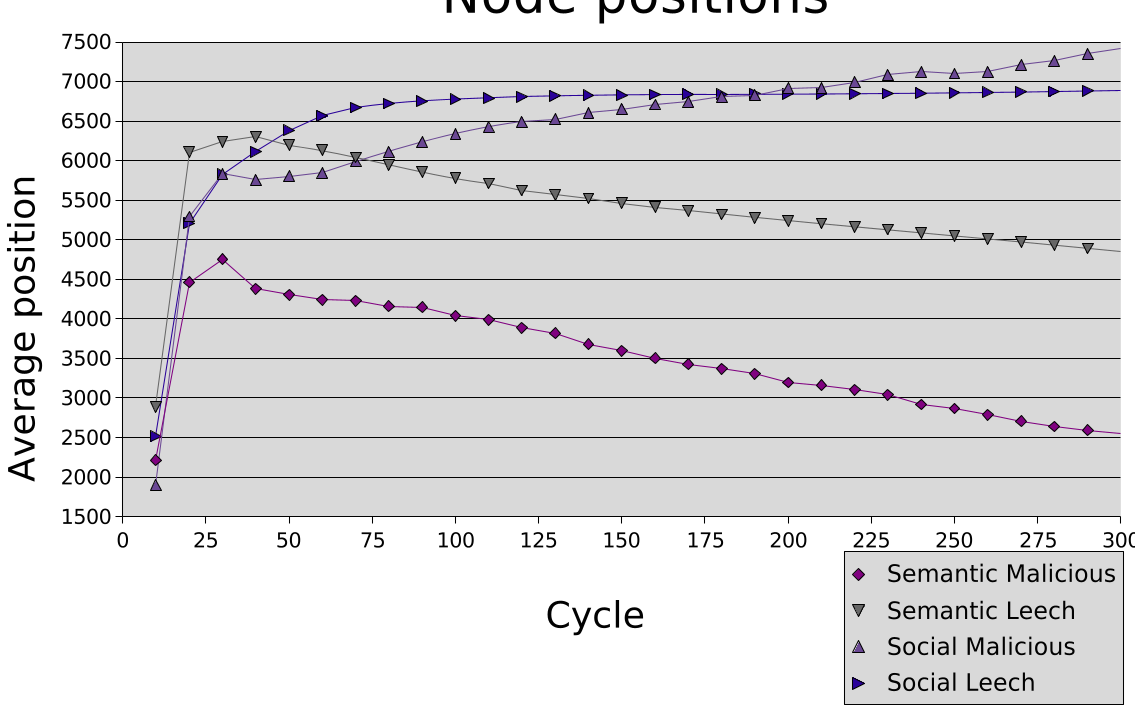 Fig 1: Notice how Social Routing (the line with points) quickly identifies and demotes Malicious nodes compared to pure Semantic routing.
Methodology: From Real-World Traces to Simulation
The authors didn't just theorize; they crawled FileList.org, a popular BitTorrent site with 100,000 users. They found that users naturally form "clusters" around specific types of content—the Small World Phenomenon.
By simulating 8,713 of these nodes, they compared three routing types:
- Random: Inefficient, low precision.
- Semantic: Accurate but "gullible" to malicious nodes that pretend to have popular content.
- Social: Accurate AND defensive. It combines the "What" (semantic match) with the "Who" (trust score).
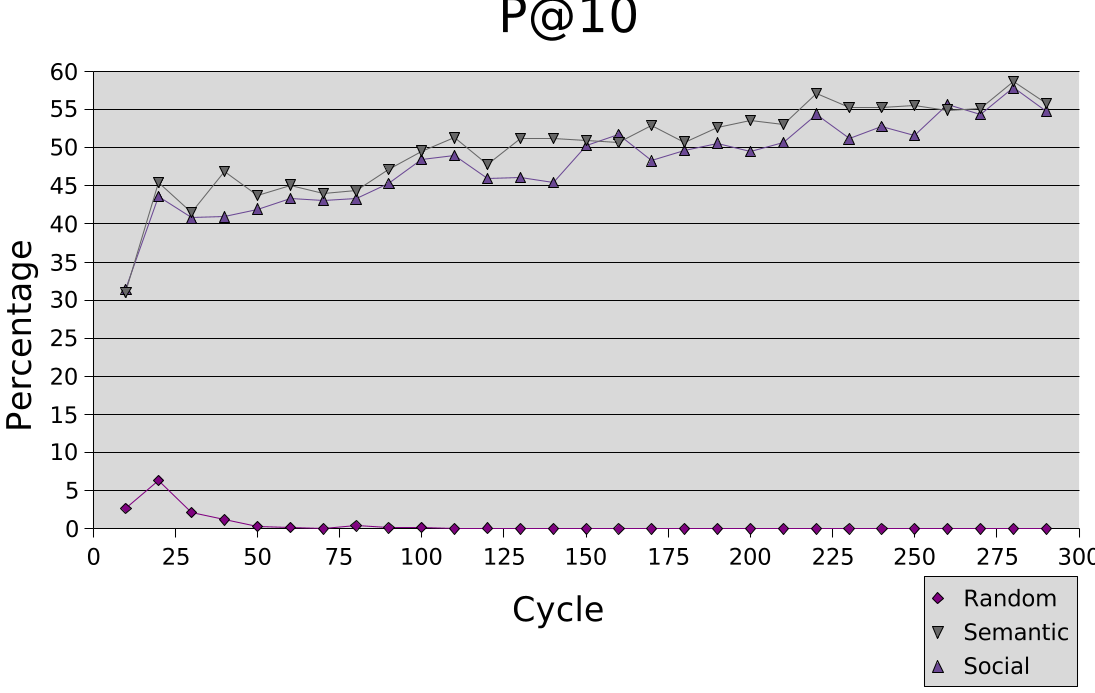 Fig 2: Search precision (P@10) stabilizes quickly for semantic-based protocols, far outperforming random walks.
Why It Matters
The most striking result is the Separation Level. In a network of nearly 9,000 nodes, almost any target resource could be reached in just two jumps (separation of 2). This confirms that "social" P2P networks aren't just a gimmick; they are mathematically efficient structures that minimize the path to content.
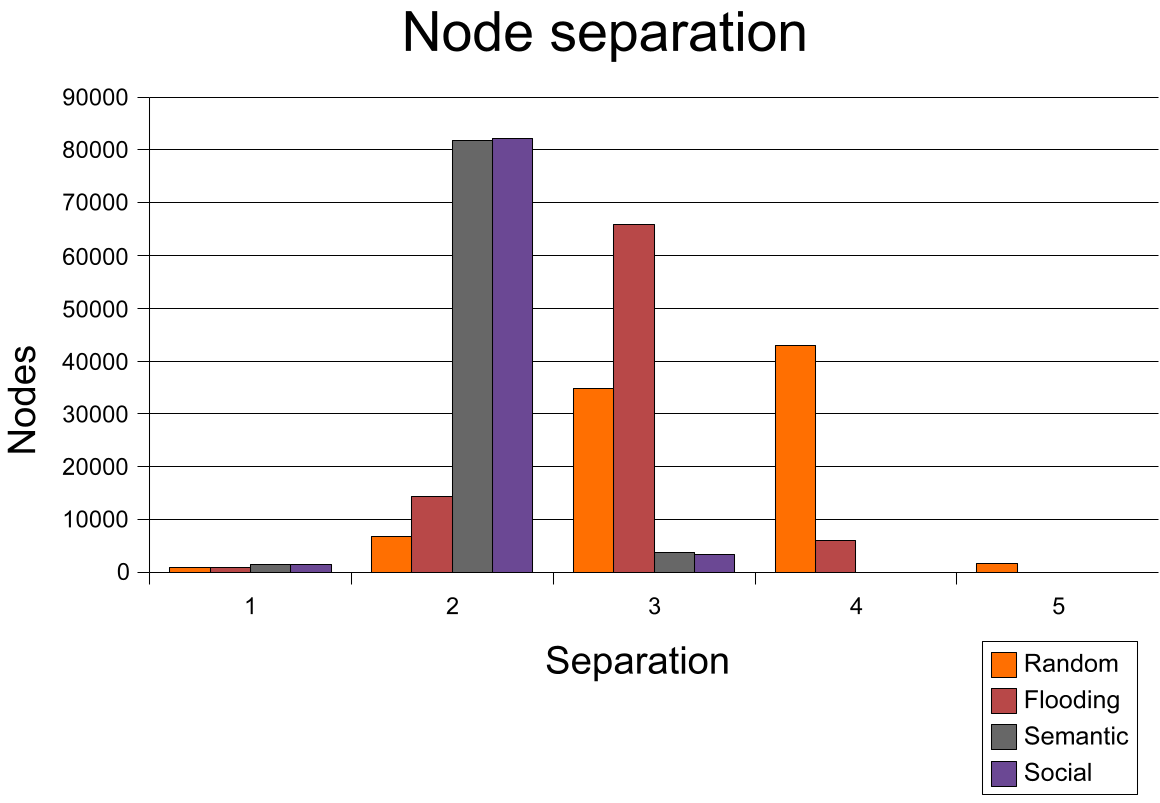 Fig 3: The separation between nodes in the proposed topologies is significantly tighter than random flooding.
Critical Analysis & Future Outlook
Strengths:
- Integrity: The "Bogus ratio" is a powerful, locally-verifiable way to fight viruses and spam in P2P systems.
- Personalization: Since the rating is subjective, a node can prefer "pop music" while another prefers "jazz," and their topologies will naturally optimize for those specific sub-cultures.
Limitations:
- Recall Rate: At 55%, the system still misses roughly half of the relevant documents. While precision is high (the results you do get are good), the network isn't yet exhaustive.
- Cold Start: Bootstrapping a new user into the "correct" social cluster still requires a central gateway or significant time.
Conclusion: The Socialized.Net proves that "Social Topology" is more than just a buzzword. It is a viable backbone for decentralized search that handles the chaos of human behavior (malice and laziness) through the simple, elegant application of local preference and semantic grouping.