
Beyond the Glass Office: Navigating Social Transparency in Modern Enterprise Systems
Social Transparency in Enterprise Information Systems: Peculiarities and Assessment Factors
This paper defines "Social Transparency" in Enterprise Information Systems (EIS) as the voluntary sharing of personal and group information to foster workplace trust and engagement. It introduces a novel assessment framework identified through qualitative focus groups to manage the risks of online transparency, such as information overload and stressful competition.
TL;DR
Social transparency—the voluntary act of sharing one’s work status, interests, and progress online—is a double-edged sword. While it builds trust and motivates teams, it can also trigger "unproductive competition" and "information overload." This paper provides a roadmap for system architects to assess and mitigate these risks by focusing on four pillars: Recipients, Content, Presentation, and Timeliness.
Background: The Shift to Online Sociality
In the modern workplace, Slack, Teams, and specialized Enterprise Social Software (SSE) have replaced the water cooler. Transparency is no longer just about management sharing quarterly goals; it’s about individuals broadcasting their current mood, work hurdles, and personal achievements. This "Social Transparency" is vital for decentralized teams but, if left unmanaged, can become a source of workplace anxiety.
The Problem: The Hidden Costs of Openness
Prior research often treated transparency as an unalloyed good. However, the authors argue that an ad-hoc approach creates friction:
- Information Overload: Constant updates distract from deep work.
- The Hawthorne Effect: Employees may perform for the "camera" of the system rather than focusing on actual value.
- Unwanted Grouping: Transparency can inadvertently create "in-groups" and "out-groups."
Methodology: The Anatomy of Digital Transparency
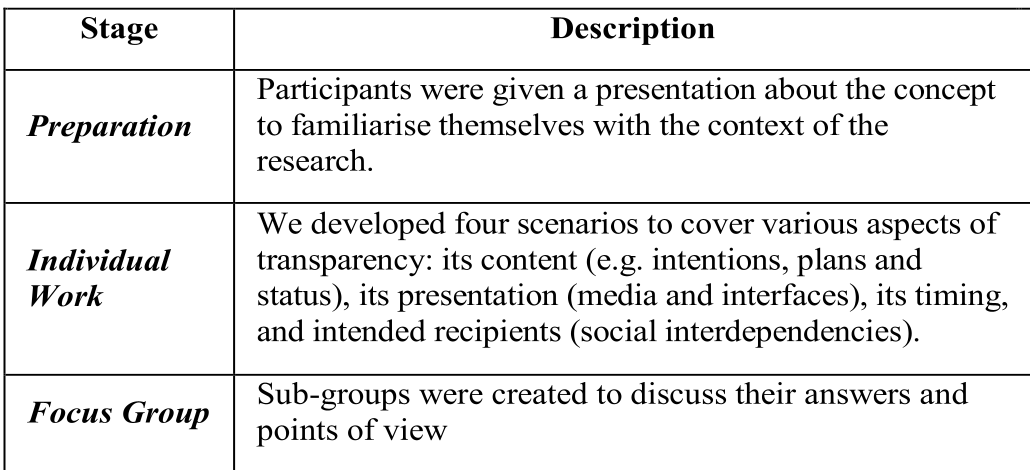
The research utilized focus groups from diverse fields (computing, psychology, management) to dissect how online transparency differs from face-to-face interaction. The authors identified several Peculiarities of Online Social Transparency:
- Archivability & Traceability: Unlike a passing hallway comment, digital transparency leaves a permanent, searchable record.
- Trackability: Senders know exactly who viewed their information, allowing for better expectation management.
- Presentation Adaptability: The ability to filter or change formats (text vs. audio) to match the recipient's context.
Core Framework: The Assessment Factors
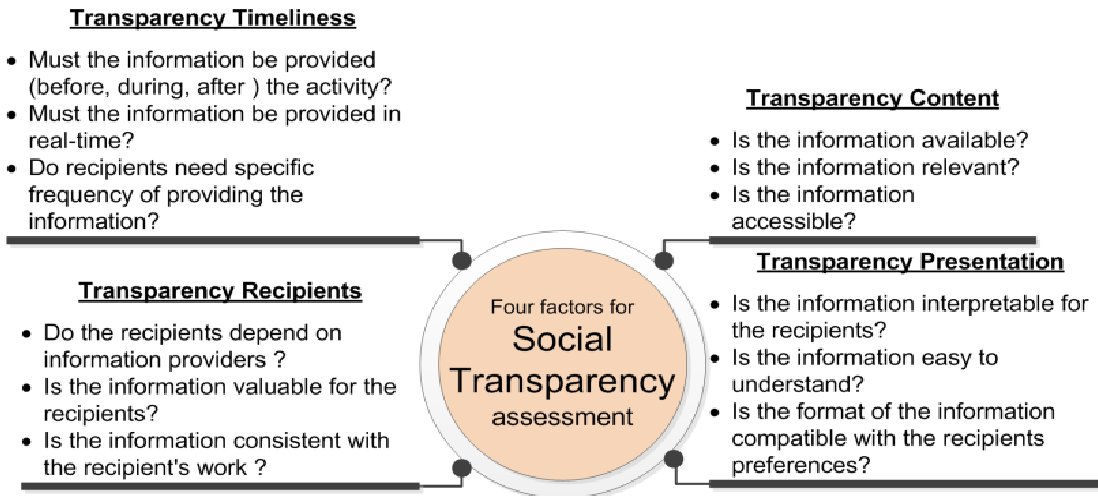
To help system analysts, the paper proposes a concept map (Fig. 1) that serves as a baseline for auditing how transparent a system should be.
1. Transparency Recipients
Information should be filtered based on the dependency between actors. An intern and a CEO do not need the same level of transparency regarding a teammate's daily progress.
2. Content Control
The researchers emphasize Relevance and Accessibility. Transparency is only "quality" transparency if the data is applicable to the task at hand and reachable in the user's current environment (e.g., audio formats for those driving).
3. The Dimension of Time (Timeliness)
This is perhaps the most critical insight. Transparency needs vary across an activity's lifecycle:
- Before: Establishing roles and intentions.
- During: Managing real-time status and availability.
- After: Feedback and improvement.
Critical Insight: The "Voluntary" Paradox
The paper highlights that social transparency is voluntary. Because it is not strictly "business critical" (like a project deadline), its success depends entirely on the will of the actors. If the system is perceived as a tool for surveillance rather than collaboration, users will simply stop self-reporting, leading to a "dark" information environment.
Conclusion and Future Outlook
This work moves us toward a "Context-Aware" model of workplace transparency. The future of Enterprise Information Systems lies in Selectability—giving employees the tools to tune their own transparency "volume" to balance visibility with mental well-being.
Limitations: The study is qualitative and based on a limited focus group size (14 individuals). Future work will need to validate these assessment factors through quantitative metrics and A/B testing in live enterprise environments.