
The Social Transparency Framework: Decoding the Hidden Signals of Online Collaboration
Social transparency in networked information exchange: a theoretical framework
This paper introduces a theoretical framework for "Social Transparency" in networked information exchange, categorizing it into Identity, Content, and Interaction dimensions. It synthesizes prior CSCW research on social translucence and awareness to explain how social meta-data influences online collaboration and information quality.
TL;DR
In the digital age, we don't just exchange information; we exchange the context surrounding it. This seminal paper by Stuart et al. moves beyond simple communication models to define Social Transparency—the availability of social meta-data. It argues that making identities, content histories, and third-party interactions visible fundamentally reshapes trust, productivity, and innovation in networked environments.
Beyond Data: The Rise of Social Meta-Data
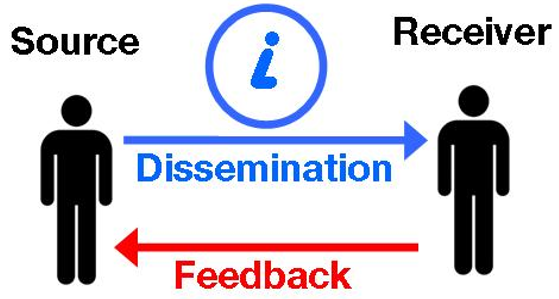
For decades, information exchange was viewed through a simple "sender-receiver" tunnel. Today, that tunnel is transparent. When you edit a Wikipedia page or retweet a thread, your real name, your past contributions, and the number of people watching you are all visible.
The authors argue that this transparency isn't just a technical feature; it's a social force. However, prior research (like "Social Translucence") was too narrow. We need a broader map to understand why people behave differently when they are "watched" by the system.
The Three Pillars of Social Transparency
1. Identity Transparency: The Accountability Loop
This refers to the visibility of the sender’s and receiver’s real identities.
- The Intuition: Using real names (strong transparency) acts as a signal of trust and accountability.
- The Trade-off: While it increases the accuracy of information, it can stifle creativity. If users feel they are always being judged by their "professional" identity, they are less likely to share risky or novel ideas, leading to high conformity.
2. Content Transparency: The Provenance Effect
This involves the history of actions taken on information—like Wikipedia revision logs or GitHub commit histories.
- The Intuition: Knowing the "provenance" (origin) of an idea helps users coordinate and detect expertise.
- The Visualization: The paper highlights how tools like HistoryFlow allow us to see the evolution of content.
- The Trade-off: While transparency boosts productivity through "social facilitation" (working harder when peers see your progress), it also increases attentional demand. Constant notifications of others' work can lead to cognitive overload and stress.
3. Interaction Transparency: The Power of the Observer
This is the ability of third parties to observe an exchange and the participants' knowledge of those observers.
- The Intuition: If I see that 1,000 experts have viewed a document, I infer it is high quality.
- The Risk: Herding. When we see what is popular, we tend to follow the crowd, which can create information silos and reduce the diversity of ideas within a network.
Second-Order Effects: The Hidden Consequences
The core contribution of this work is the mapping of "Second-Order Effects"—indirect, long-term consequences of design choices.
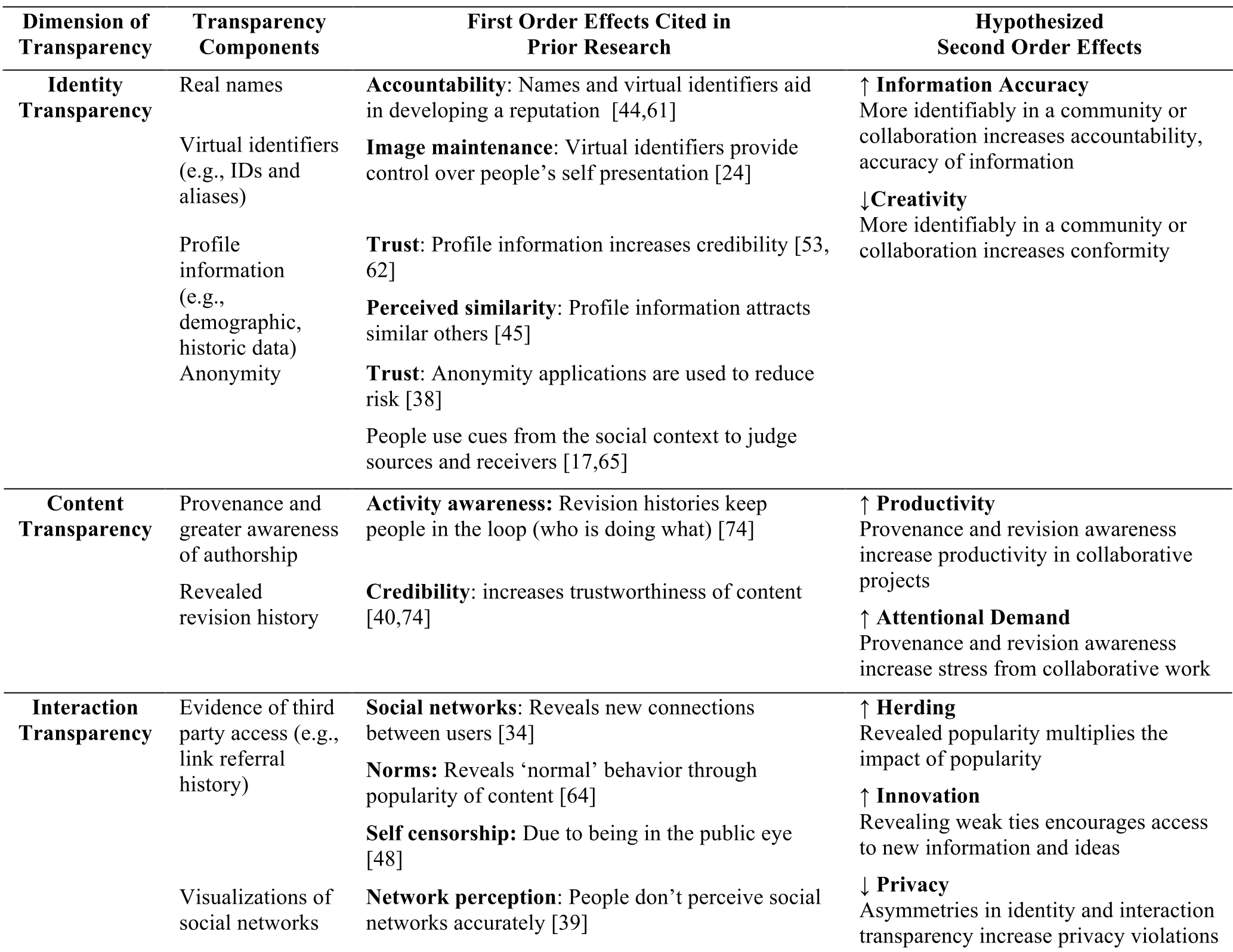
- Productivity vs. Stress: Transparency acts as a "reminding cue," but it can become an electronic "panopticon" if not managed.
- Innovation vs. Privacy: Revealing social networks can help us find "weak ties" (new information sources), but asymmetric transparency (where the system knows you, but you don't know the system/observer) leads to severe privacy violations.
Critical Insight & Conclusion
The Framework for Social Transparency reminds us that interface design is social engineering. By turning the "dials" of identity, content, and interaction visibility, platform designers are not just changing UI; they are changing human social structure.
Key Takeaway for Research: We must stop asking if a system should be transparent, and start asking what specific dimension of transparency serves the community’s goal. Do we want the accuracy of a real-name ID for a wiki, or the creative freedom of anonymity for a brainstorming session? The answer lies in the balance of this framework.