
Beyond Similarity: Building Trust-Aware Recommendations via the T-Index
Social Trust-Aware Recommendation System: A T-Index Approach
The paper introduces a social trust-aware recommendation system that replaces traditional similarity-based Collaborative Filtering with an ontological trust model. It features the "T-index"—a metric inspired by the H-index—and a "TopTrustee" list to identify and connect users with reliable, high-quality recommenders even across long network distances.
Executive Summary
In the era of information overload, Collaborative Filtering (CF) has long been the gold standard. However, CF's Achilles' heel—data sparsity—remains a persistent challenge. This paper, "Social Trust-aware Recommendation System: A T-Index Approach," proposes a paradigm shift: moving from "who is like me" to "who do others trust." By introducing the T-index, a metric derived from the scientific impact H-index, the authors build a robust, scalable, and decentralized trust network that significantly improves recommendation coverage and accuracy.
The Core Challenge: The Sparsity and Reachability Gap
Traditional CF relies on finding users with similar rating histories. In sparse datasets, these "nearest neighbors" are hard to find. Social-based systems attempt to solve this by navigating a "web of trust." However, these systems face a dilemma:
- Short Path Lengths (): Fast but misses high-quality experts who are more than 2-3 hops away.
- Long Path Lengths (): High coverage but computationally expensive and introduces "noise" through trust decay.
The authors argue that a user's global reputation or "trustworthiness" should allow them to be "teleported" into the neighborhoods of users who need reliable advice, regardless of their topological distance.
Methodology: The T-Index and TopTrustee Mechanism
The most innovative contribution of this work is the transposition of bibliometric concepts into social trust:
1. The T-Index
Similar to the H-index (where papers have at least citations), a user's T-index is if they have at least trustors who trust them with a value . This filters out users who might have many followers but low individual reliability. It identifies "Centric Users"—the authoritative nodes of user clusters.
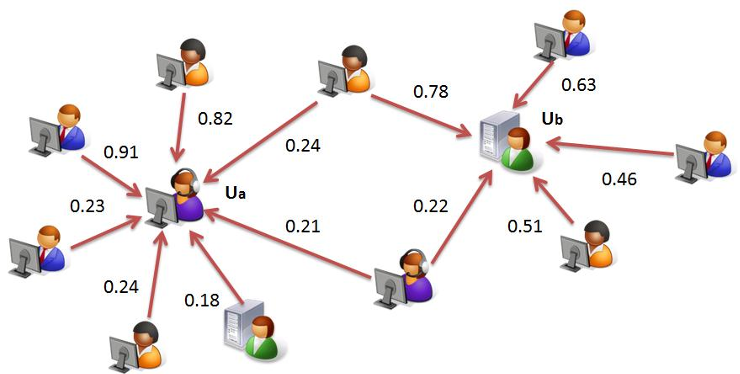 Figure 1: Comparison of Indegree vs. T-index. User has a higher T-index than , making a more reliable "Centric User" despite potentially having fewer total connections.
2. The TopTrustee List
For every item, the system maintains a TopTrustee list (of size ). These are the most trustworthy users (highest T-index) who have rated that item. When a user looks for a recommendation, they don't just look at their direct neighbors; they check the TopTrustee list, effectively creating a "shortcut" to experts across the network.
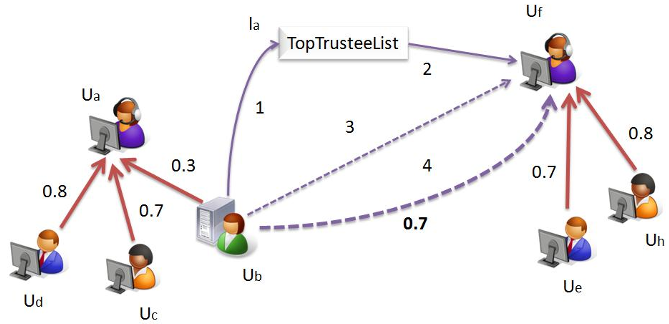 Figure 2: By using the TopTrustee list, user can connect with who is outside their local radius but highly trustworthy.
Experimental Results: Accuracy Meets Efficiency
The researchers evaluated their system using the MovieLens dataset with an ontological implementation in Java (Protégé API).
- Coverage Boost: Even with a very small search radius (), the T-index approach achieved over 93% coverage. This means nearly all items could be predicted accurately without needing to crawl the entire network.
- Precision (MAE): The Mean Absolute Error dropped significantly. For instance, with a neighborhood of 5, using T-index outperformed non-indexed versions even when the latter used much larger neighborhood sizes.
- Network Balance: The authors showed that the T-index leads to a more balanced distribution of "centric users," preventing the system from over-relying on a few "hub" nodes and creating more localized, specialty-based trust clusters.
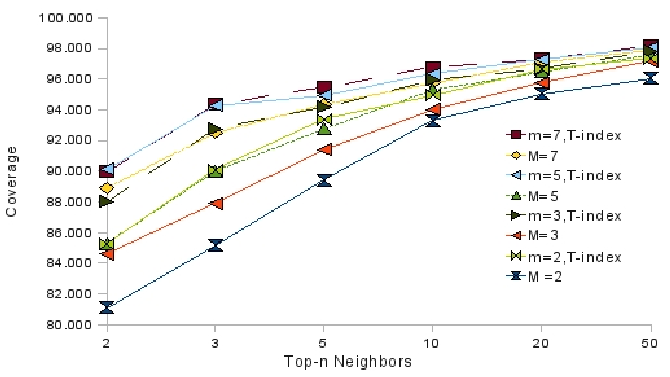 Figure 3: MAE comparison showing that T-index consistently improves prediction accuracy across different neighborhood configurations.
Critical Insight & Conclusion
This work demonstrates that trust is not just a weight; it is a structural property. By using the T-index, the system moves away from a "flat" trust model to a hierarchical one that mirrors how humans seek advice: we look to our friends (local trust) but also to established experts (global trust/T-index).
Limitations and Future Outlook
While the T-index is powerful, the system currently treats trust as a static value calculated purely from rating history. Future iterations could benefit from:
- Dynamic Trust: How trust changes over time as user preferences drift.
- Side Information: Incorporating item similarity into the trust calculation to handle "category-specific experts."
In conclusion, the T-index Approach provides a scalable framework for decentralized environments, ensuring that even in massive social networks, a reliable recommendation is only a few hops—or one TopTrustee list—away.