
Beyond Rating Similarity: Leveraging Trustee Influence for Robust Social Recommendation
A Social Trust Model Considering Trustees’ Influence
The paper proposes a novel social trust model based on Trustee-Influence (MF-NP-It) for multi-agent systems and recommender systems. By leveraging the number of trusters in a social network to weigh trust relationships, the model achieves state-of-the-art results in social recommendation, specifically improving rating prediction accuracy on the Epinions dataset.
TL;DR
Predicting who to trust in a digital ecosystem is difficult when interaction history is sparse. This paper introduces a Trustee-Influence based model that utilizes the global popularity of an agent within a trust network to weight social relationships. By integrating this into a Normalized Pairwise Regularized Matrix Factorization framework, the authors significantly improve recommendation performance in "cold-start" scenarios where traditional similarity metrics fail.
Problem & Motivation: The Failure of Similarity
In Open Multi-Agent Systems (MAS) and online social networks (like Epinions), trust is the currency of cooperation. Existing models typically calculate trust based on rating similarity—the idea that if we both liked the same movies, I should trust your future recommendations.
The Reality Check: Analytical findings from the Epinions dataset reveal a harsh reality:
- Only 7% of users have at least one commonly rated item.
- New users (the "Cold-Start" problem) have zero ratings, making similarity-based advice impossible.
The authors argue that trust isn't just about being "alike"; it's about the influence and reliability of the trustee. A user with many followers is objectively more influential and likely more trustworthy to a newcomer than a user with no social footprint.
Methodology: Quantifying Influence
The researchers pivoted from looking at what people say (ratings) to who people follow (trust links).
1. The Influence Metric
The influence of a trustee is simply the cardinal count of their trusters: The strength of a trust relationship is then directly mapped to this influence score. This ensures that in a recommendation task, "highly trusted" agents have a stronger impact on their followers' latent features than obscure ones.
2. MF-NP (Normalized Pairwise Regularized Matrix Factorization)
To turn this into a recommendation engine, the authors modified Matrix Factorization (MF). While traditional MF only looks at the user-item rating matrix, this model adds a social constraint:

The key is the Normalized Pairwise Regularization. It forces the latent feature vector of a user to be closer to their trustees' vectors , weighted by the trustees' influence. By normalizing weights, the model remains stable even when a user trusts hundreds of people.
Experiments: Performance in Sparse Networks
The model was tested against standard Matrix Factorization on the Epinions dataset (22k users, 912k ratings).
SOTA Comparison
The proposed MF-NP-It showed consistent gains:
- RMSE Improvement: ~2.00%
- MAE Improvement: ~1.79%
While 2% might seem incremental, in the world of Recommender Systems, this is a "tipping point." Research shows that a ~1.7% improvement in RMSE can lead to over a 50% increase in the accuracy of the top-5 recommendations—the ones users actually see and click on.
Data Insights
The authors provided a fascinating breakdown of "Influence vs. Activeness" in Table 1:
- The top "Active" users (most ratings) often have very few trusters.
- Conversely, the most "Trusted" users often have relatively few ratings but high-quality distributions.
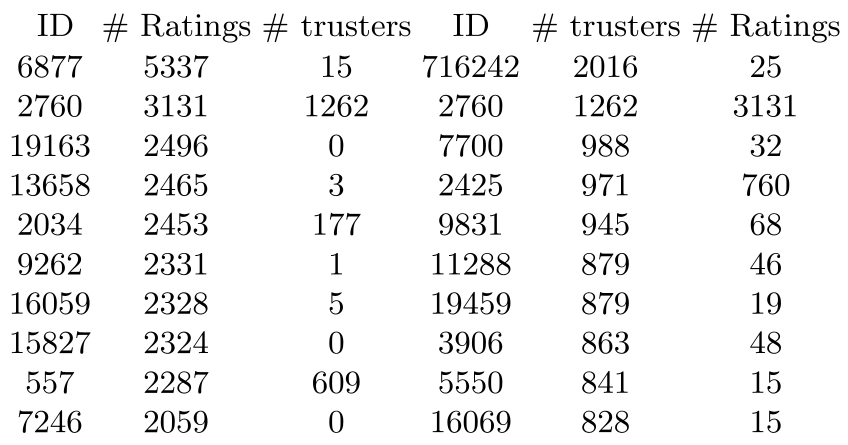 Table 1: Comparison showing that social influence (trusters) does not always correlate with rating activity.
Critical Insight & Conclusion
The core takeaway is that Social Influence is a holistic proxy for quality. While a similarity score only captures a narrow overlap between two users, an Influence score captures the "wisdom of the crowd."
Limitations & Future Work
- Static Weighting: The current model uses a global influence score. Future iterations could explore category-specific influence (e.g., an agent might be influential in "Electronics" but not "Books").
- Robustness: The model relies on the trust network being authentic. In adversarial environments, "sybil attacks" (fake trust links) could artificially inflate an agent's influence.
In summary, by shifting from local similarity to global influence, this paper provides a robust solution for the persistent cold-start problem in social multi-agent systems.