
STRS: Harmonizing Social Trust and Energy Efficiency in D2D Relay Networks
Social-Trust and Power-Efficient Relay Selection for Device-to-Device Underlaying Distributed Shared Network
The paper introduces the Social-Trust and Power-Efficient Relay Selection (STRS) algorithm for D2D underlaying distributed shared networks. It leverages a dual-layer architecture (Physical and Social) to select idle relay nodes that satisfy both high social trust and minimal power consumption requirements.
TL;DR
In the evolving landscape of 5G and beyond, Device-to-Device (D2D) communication is a cornerstone for resource sharing. However, why should a stranger's phone waste its battery to relay your data? This paper proposes STRS (Social-Trust and Power-Efficient Relay Selection), a strategy that selects relays based on "Social Trust" to ensure cooperation while minimizing the overall energy footprint of the network.
The "Selfish Node" Problem and the Power Gap
In distributed shared networks, throughput and coverage are often limited by the physical distance between users. While relaying solves the distance problem, it introduces two major hurdles:
- Social Unwillingness: Users are often "selfish" or privacy-conscious, refusing to act as relays for strangers.
- Power Constraints: Mobile devices have limited battery life. Selecting a relay solely based on distance might lead to high-power consumption if that node has a poor channel or low social incentive to boost its signal.
Previous works like Shortest-Distance Relay Selection (SDRS) focus purely on geometry, while newer Social-Aware models often ignore the hardware reality of circuit power and reception energy.
Methodology: The Two-Layer Architecture
The authors propose a dual-layer approach to bridge the gap between human behavior and microwave physics.
1. The Social Layer: Quantifying Friendship
Social trust () isn't just a binary "friend or stranger." The paper quantifies it using:
- Interaction Frequency (): How often do these devices talk?
- Interaction Duration (): How long do these encounters last?
This relationship is modeled using a Pareto Distribution, reflecting the real-world intuition that we have many "strangers" (low trust) but only a few "close contacts" (high trust).
2. The Physical Layer: Power-Aware Selection
The core innovation lies in Equation (5), which assumes a positive linear correlation between social trust and transmission power. A "friend" is physically modeled as being more willing to expend transmit power () to ensure a successful link.
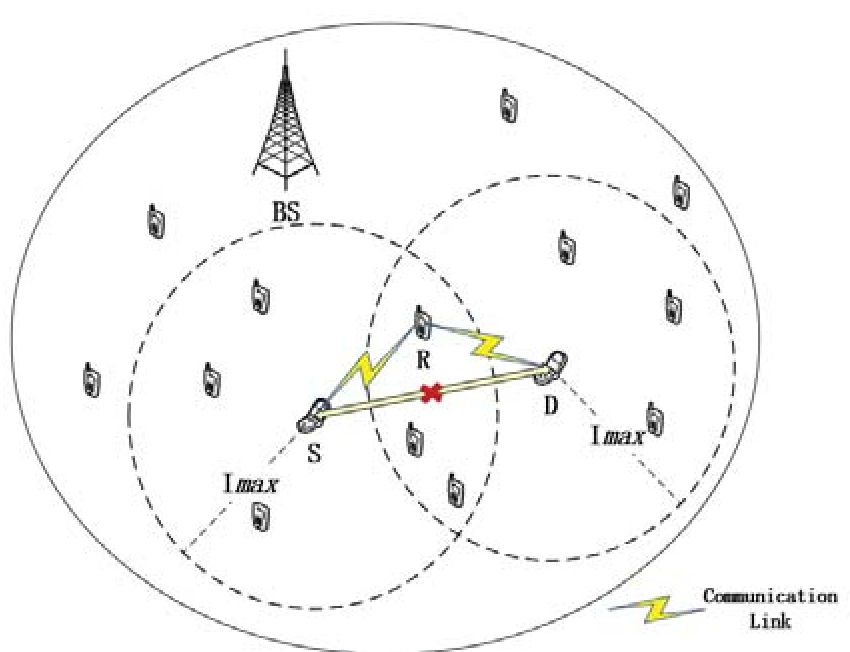
The algorithm follows a strict filtering process:
- Filter by Distance: Identify nodes in the physical range.
- Filter by Trust: Keep only nodes exceeding the social threshold ().
- Optimize for Power: From the remaining candidates, select the index that minimizes:
Experimental Insights
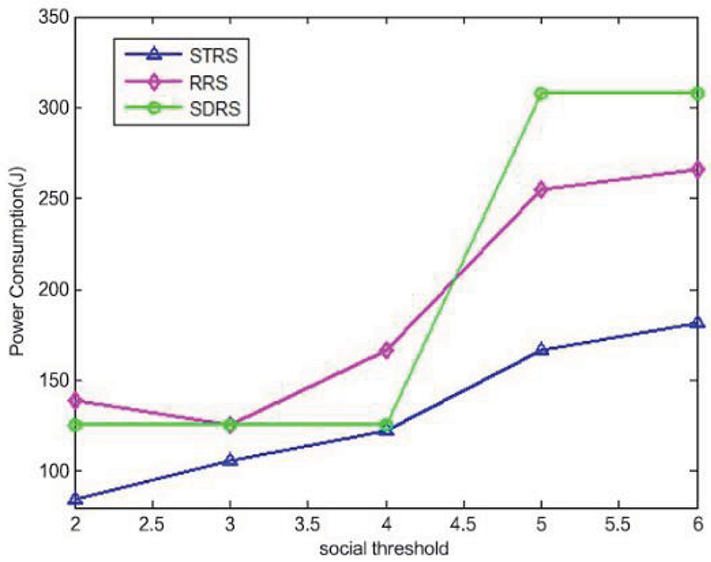
The researchers compared STRS against Random Relay Selection (RRS) and Shortest-Distance Relay Selection (SDRS).
- Impact of Social Threshold: As the trust requirement increases, power consumption actually rises slightly. Why? Because a stricter "friendship" requirement narrows the pool of candidates, sometimes forcing the system to pick a more distant friend over a nearby stranger. However, STRS consistently stays below SDRS in energy cost.
- Density Advantage: As user density increases (more nodes in the BS area), the average power consumption of STRS drops. This is the "density dividend"—more users mean a higher probability of finding a "close friend" who is also "physically proximal."
Critical Perspective: Takeaways and Future Work
The STRS algorithm introduces a vital Inductive Bias: human social structures can be used as a proxy for network reliability. By selecting relays that are socially invested in the source, the network reduces the "Probing Cost" and rejection rate.
Limitations: The model assumes the Base Station (BS) can perfectly track and calculate social weights. In a privacy-first world, calculating might require Federated Learning or decentralized trust protocols to avoid leaking interaction history to the BS.
Future Outlook: Transitioning this from a static Pareto model to a dynamic, real-time trust graph (potentially using Graph Neural Networks) could further optimize relay selection in highly mobile environments like Vehicular Networks (V2V).
Conclusion
STRS proves that "who you know" is just as important as "where you are" in the future of distributed wireless networks. By balancing social dividends with energy constraints, STRS paves the way for a more cooperative and power-efficient D2D ecosystem.