
Decoding the Layers of Disclosure: How Trust Drives the Width and Depth of SNS Sharing
A study of the effect of social trust, trust in social networking services, and sharing attitude, on two dimensions of personal information sharing behavior
This study investigates the predictors of personal information-sharing behavior on Social Networking Services (SNS) by proposing a two-dimensional framework: sharing regularity (width/frequency) and sharing density (depth/sensitivity). Grounded in the Theory of Reasoned Action (TRA), the research identifies social trust and trust in the SNS platform as critical antecedents that shape sharing attitudes and behaviors.
TL;DR
Why do we share what we share on social media? This study moves beyond simple "usage" metrics to dissect information sharing into Regularity (how often) and Density (how private). By applying the Theory of Reasoned Action (TRA), the researchers demonstrate that while social and platform trust are essential, they work primarily by shaping our attitude. Interestingly, the more frequently you post, the more likely you are to eventually share your most private secrets.
Background: The Multi-Dimensionality of Sharing
In the landscape of Social Networking Services (SNS), we often focus on "if" people use a platform. However, the nature of that use is far more complex. The authors position this work as a bridge between psychological trust theories and behavioral outcomes, categorizing sharing into two distinct vectors:
- Width (Sharing Regularity): The temporal frequency of posts.
- Depth (Sharing Density): The level of intimacy or sensitivity of the information shared (e.g., public links vs. private family photos).
Problem & Motivation: Beyond the Surface
Prior works often conflated these two dimensions or focused on "intention" rather than "actual behavior." The researchers noticed a gap: we know trust matters, but we don't quite understand how it filters through our social environment and personal beliefs to trigger different types of disclosure. They aimed to answer: Does trusting the platform have the same effect as trusting people in general?
Methodology: The TRA Framework
The study adopts the Theory of Reasoned Action (TRA), asserting that behavior is a product of Attitude and Subjective Norms.
The Research Model
The core of the methodology lies in testing how two types of trust—Social Trust (faith in humanity) and Trust in SNS (faith in the platform)—interact with these psychological drivers.
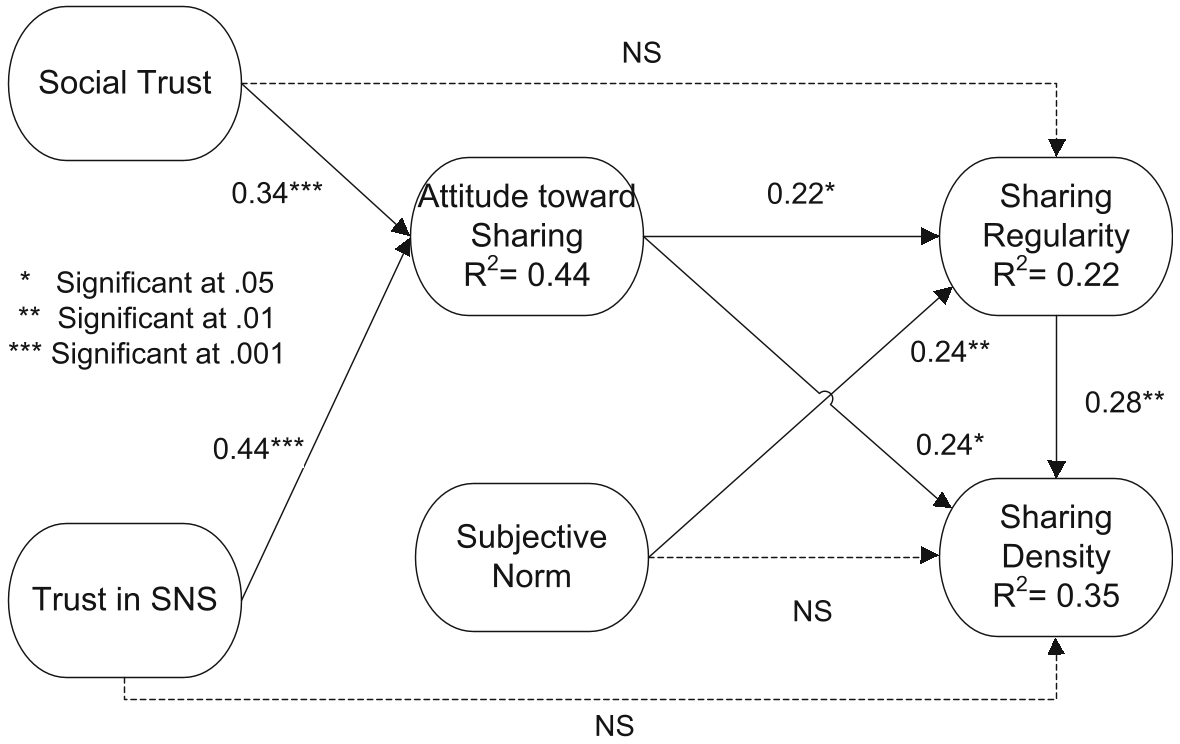 Figure 1: The structural model showing the paths from Trust constructs to Sharing Behavior.
The study utilized a survey of 117 SNS users and analyzed the results using Partial Least Squares (PLS), a method favored for its ability to handle complex causal relationships between "latent" variables that aren't directly measurable.
Key Insights & Results
The findings offer a fascinating look at the "Social Media Funnel":
- Trust is Indirect: Surprisingly, neither social trust nor platform trust directly made people share more. Instead, they improved the user's attitude toward sharing. If you trust the system, you view sharing as a "good" and "safe" activity, which then leads to action.
- The "Gateway" Effect: Hypothesis 9 was strongly supported—Sharing Regularity significantly predicts Sharing Density (β=0.28). This suggests a behavioral slippery slope: once a user becomes a frequent poster (high regularity), their inhibitions lower, and they begin sharing deeper, more private content (high density).
- Social Pressure Matters (For Frequency): Subjective norms (what your friends expect of you) drive how often you post, but they don't necessarily force you to post private things.
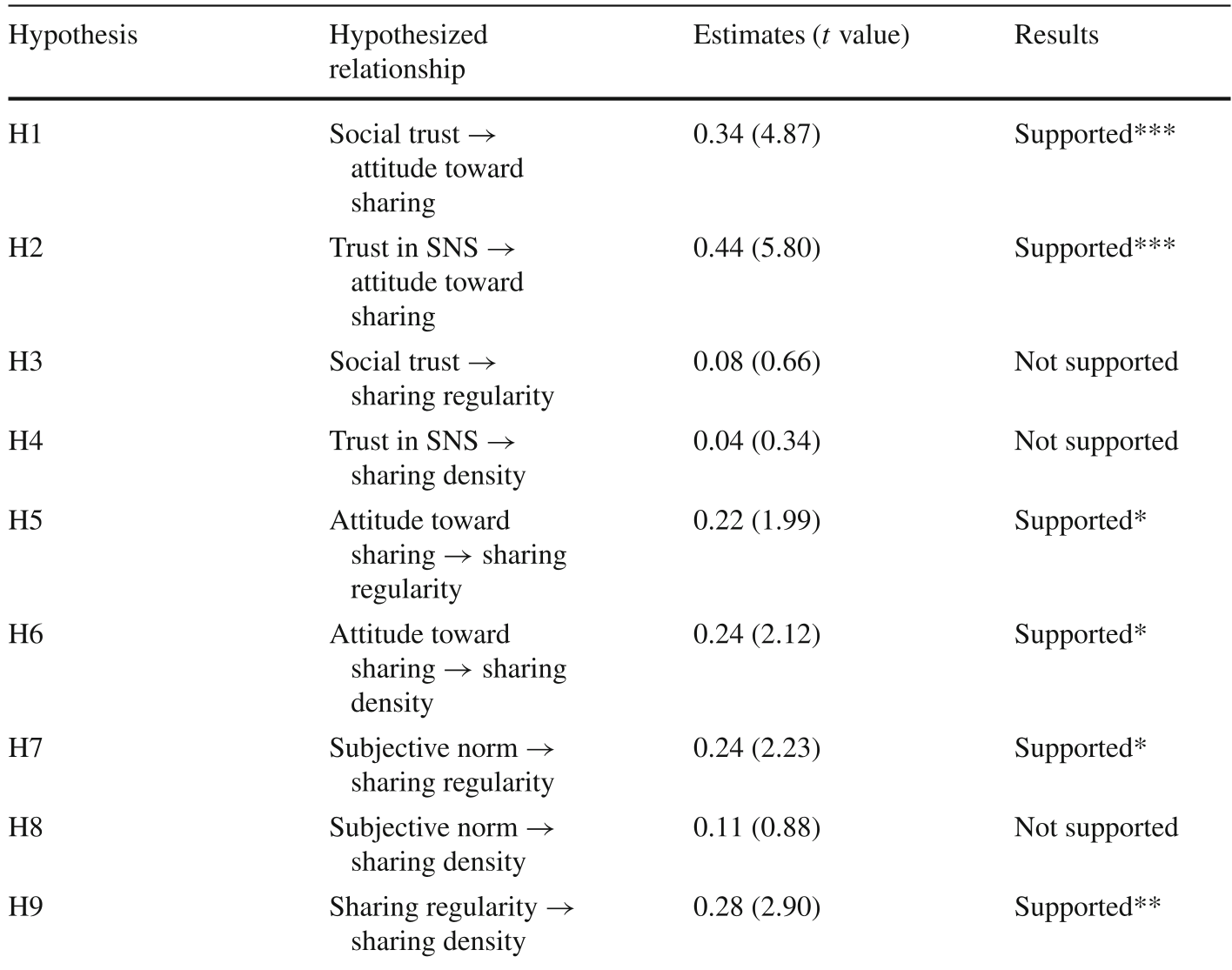 Table 1: Summary of Hypotheses Testing.
Critical Analysis & Conclusion
Takeaway for Platform Designers
If a platform wants "high-density" data (which is more valuable for targeted ads and high-fidelity user profiling), they shouldn't just ask for it upfront. They must:
- Sustain high Regularity by prompting low-stakes interactions.
- Invest in Institutional Trust (security reports, clear privacy policies) to pivot the user's internal attitude toward sharing.
Limitations
The study's reliance on a student population (undergraduate students in the USA) may limit its cross-cultural applicability. Furthermore, since the data is from 2016, the rise of "ephemeral" sharing (like Snapchat or Instagram Stories) might alter the relationship between regularity and density, as the "risk" of permanent density is mitigated by disappearing content.
Future Outlook
The next frontier is integrating the "Privacy Paradox"—the phenomenon where users express high privacy concerns yet continue to share dense information. This study provides the structural skeleton to investigate that paradox by highlighting that Behavioral Habit (Regularity) might be a stronger driver of disclosure than Risk Perception.