
ResNet.TV: Scaling Content Discovery through Social Awareness in IPTV Systems
Social TV: The impact of social awareness on content navigation within IPTV systems
The paper presents ResNet.TV, a production-grade IPTV system deployed at Lancaster University that leverages Online Social Networks (OSNs), specifically Facebook, to provide "social awareness." It introduces a dynamic channel carousel that reorders content based on the real-time viewing habits of a user's social graph to simplify content navigation.
TL;DR
Researchers at Lancaster University developed ResNet.TV, an IPTV system that uses your Facebook friends' viewing habits to organize your TV guide. By moving away from static grids and toward a Socially-Aware Carousel, they discovered that knowing what your friends are watching doesn't just make TV more social—it actually makes you watch longer and discover more diverse content.
The "Lean-Back" Dilemma: Why EPGs are Failing
The transition from broadcast to IPTV was supposed to be a revolution in choice. However, more choice often leads to a "paradox of choice" where the burden of finding content contradicts the "lean-back" (relaxing) nature of television. Traditional Electronic Program Guides (EPGs) are 2D matrices that scale poorly with hundreds of channels.
While modern recommender systems (like Netflix) help, they often suffer from the "Cold-Start" problem or rely on explicit ratings that most viewers are too lazy to provide. The authors' insight: Television has always been a social activity. Why not use our existing social networks to do the filtering for us?
Methodology: The Socially-Aware Architecture
The ResNet.TV system was designed as a "Living Lab" experiment, heavily instrumented to track every "user journey" (every click, channel change, and dwell time).
The Core Mechanism: The Social Carousel
Instead of a fixed list, the UI features a dynamic carousel. When a user logs in via Facebook, the system performs a real-time intersection between the user’s friend list and currently active IPTV sessions.
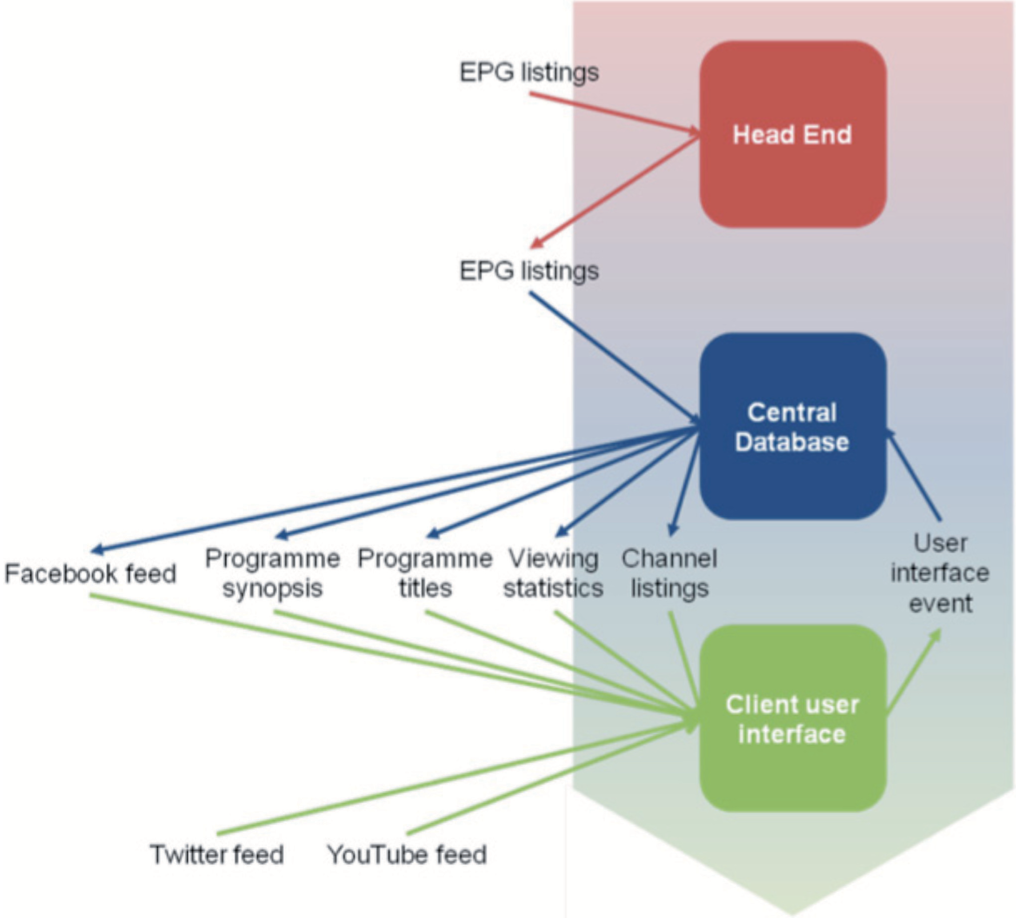 Figure: The Software Architecture showing the Data Aggregation layer connecting Social Networks to the Presentation Engine.
Key features include:
- Implicit Interest Profiling: No "5-star" ratings needed. The system measures "interest" based on how long you stay on a channel.
- Social Filtering: Users can reorder the carousel by "Popular with Friends" or "Popular with Everyone."
- Contextual Side-Panels: Integrated Twitter feeds and YouTube recommendations based on the metadata of the current show.
Experimental Results: Does Social Awareness Change Behavior?
The study compared a 13-month "Technical Trial" (nonsocial) with a 13-month deployment of the social ResNet.TV.
1. Increased Engagement
The data revealed a striking correlation: users who benefitted from social awareness (logged into Facebook) had an average viewing time of 20 minutes per session, compared to 15 minutes for nonsocial users.
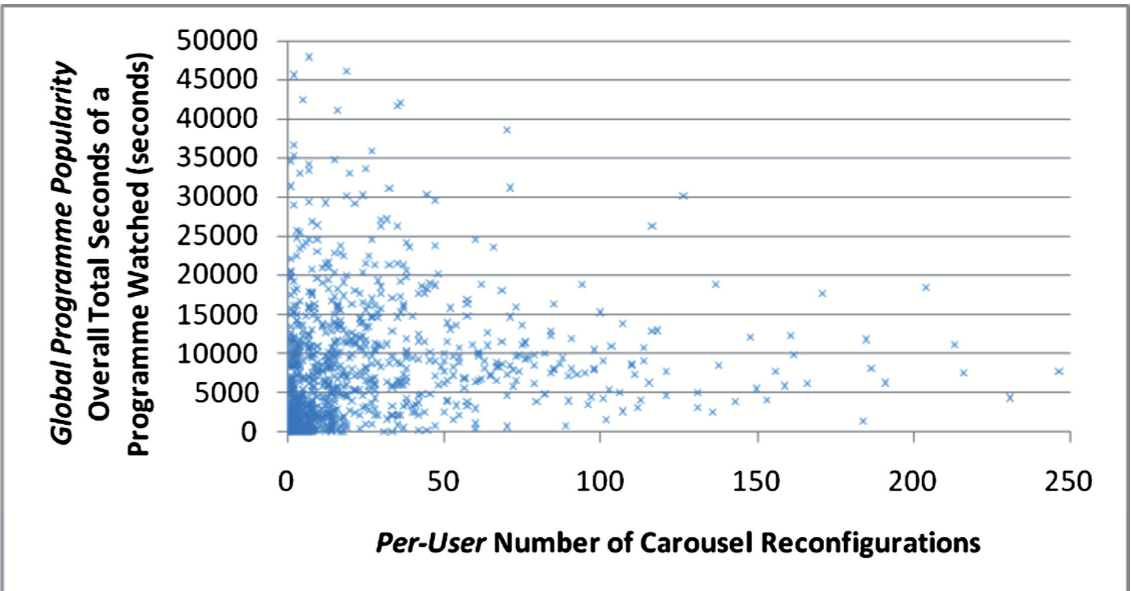 Figure: Comparison of average viewing time between default channel order, popularity order, and Facebook-integrated sessions.
2. Diversified Content Exploration
Interestingly, while nonsocial users eventually settled into a "rut" (watching fewer unique channels over time), social users actually increased the variety of channels they watched. Knowing that a friend was watching a niche channel acted as a "trusted recommendation," encouraging users to step outside their comfort zones.
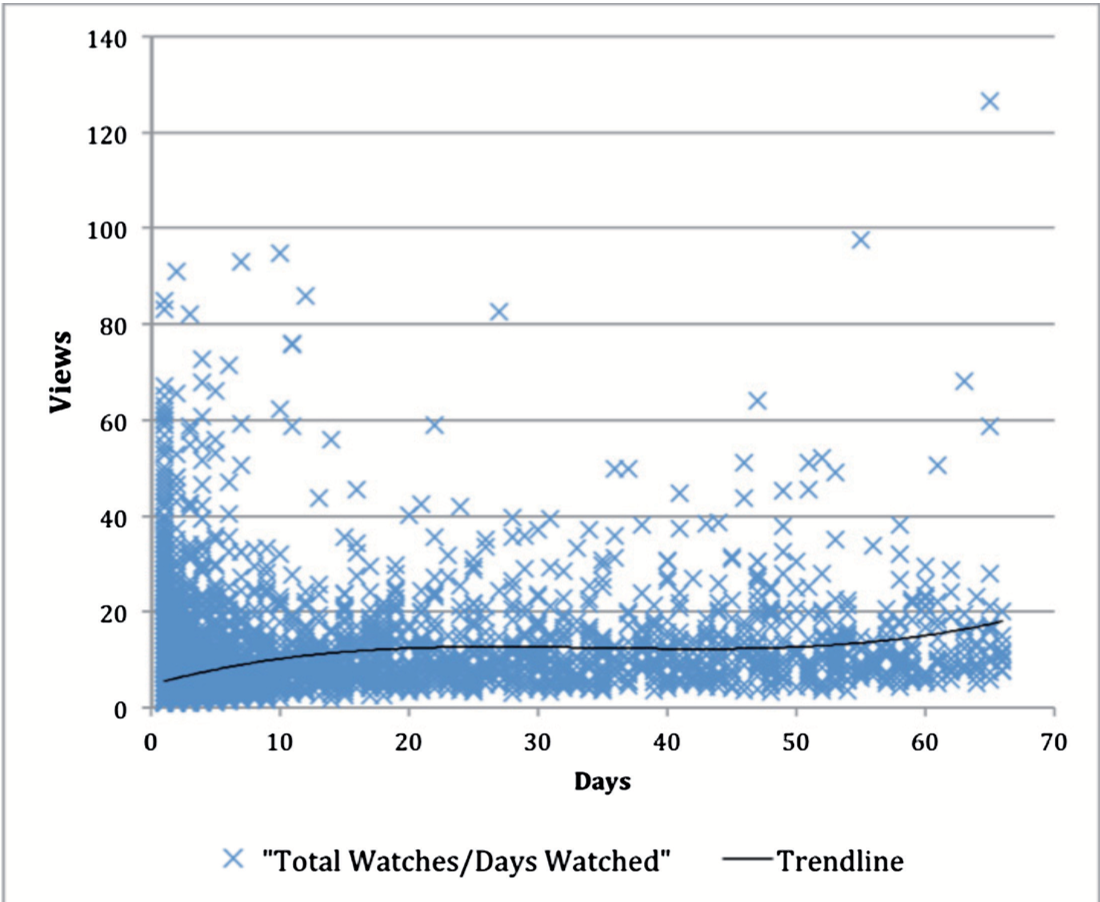 Figure: Trend showing that social awareness correlates with an increase in unique channel exploration.
Critical Insight: Popularity != Satisfaction
One of the most surprising findings was that global popularity (ordering by what "everyone" is watching) actually decreased viewing satisfaction compared to the standard numerical order. Users found global trends noisy or irrelevant. However, social popularity (what "my friends" are watching) had the opposite effect, significantly increasing engagement.
The Takeaway: We don't care what the "crowd" thinks; we care what our "tribe" thinks.
Limitations and Future Work
Despite the technical success, the authors noted a hurdle: User awareness. Many users didn't understand the value of logging into Facebook until it was explicitly explained.
Future research directions include:
- Adaptive Caching: Using social popularity to predict bandwidth demand and pre-cache VOD content closer to specific user groups.
- Cross-Media Recommendations: Linking live TV metadata to deeper archives of VOD content to bridge the gap between "broadcast" and "on-demand."
Conclusion
ResNet.TV proves that social awareness is a potent tool for content navigation. By instrumenting the UI and leveraging the social graph, the system transforms the solitary act of PC-based TV viewing back into a collective, shared experience—solving the navigation crisis not through complex AI, but through human connection.