
Social VPNs: Turning Your Friend List into a Secure Peer-to-Peer Network
Social VPNs: Integrating Overlay and Social Networks for Seamless P2P Networking
The paper introduces Social VPNs, a novel system architecture that integrates social networking APIs (e.g., Facebook) with P2P overlay networks to create self-configuring virtual private networks. By leveraging social trust relationships, it automates peer discovery, public-key exchange, and secure IP-layer connectivity without manual configuration.
TL;DR
Social VPNs represent a paradigm shift in networking: instead of manually configuring IPsec tunnels and certificates, your "social graph" becomes the configuration file. This system leverages social networking APIs to handle discovery and security, while a P2P overlay manages the heavy lifting of NAT traversal and IP routing. It enables legacy applications like file sharing and gaming to work seamlessly across the wide-area Internet as if users were on the same local LAN.
The Pain Point: The "Complexity Wall" of VPNs
Configuring a VPN is historically a nightmare for non-technical users. The "Complexity Wall" consists of:
- Identity Management: Generating and exchanging X.509 certificates or RSA keys.
- Addressing: IPv4 address spaces often collide (e.g., both users having a
192.168.1.0/24subnet). - Connectivity: Dealing with symmetric NATs and firewalls that block incoming P2P traffic.
Existing solutions like Hamachi tried to bridge this gap but relied on static, unallocated address spaces (like the 5.0.0.0 range) which eventually collide with the actual Internet.
Methodology: The Social-Middleware Bridge
The genius of the Social VPN architecture lies in its three-layer approach:
1. Social Layer (The Control Plane)
The system uses APIs (the prototype used Facebook) to:
- Publish Public Keys: Your public key is stored in your social profile data.
- Automatic Discovery: The client polls your friends list; if a friend is "online" on the VPN, their public key and overlay ID are fetched automatically.
2. Overlay Layer (The Data Plane)
The system uses the IPOP (IP-over-P2P) overlay. Every node gets a globally unique 160-bit identifier. To solve the addressability problem, the authors use a clever Double-NAT strategy:
- Global Space: High-entropy identifiers for routing in the P2P cloud.
- Local Space: A small, private IPv4 range (like
172.16.x.x) dynamically assigned on the user's machine to represent their friends.
 (Note: The above diagram illustrates the mapping process between local virtual IPs and global overlay identifiers.)
Performance: Global Reach, Local Feel
The researchers deployed 430 nodes on PlanetLab, spanning five continents.
Key Experimental Findings:
- Application Compatibility: They successfully ran high-bandwidth/low-latency apps like Warsow (3D Game), VNC, and iTunes music streaming.
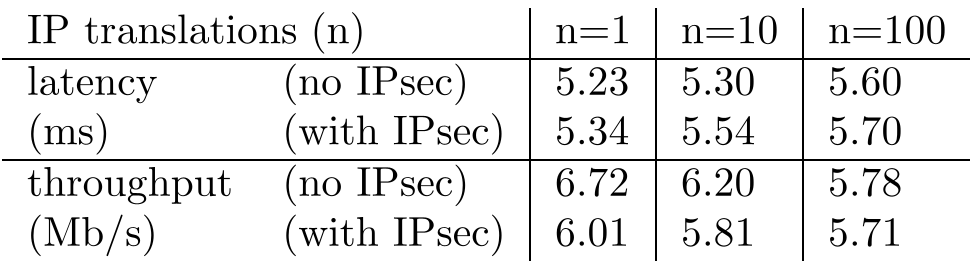
- Overhead: The encryption and translation layer adds roughly 5ms of latency—virtually unnoticeable for most residential broadband users.
- Scalability: The system's throughput remains relatively stable (dropping only slightly from 6.7 Mbps to 5.7 Mbps) even when maintaining 100 simultaneous peer mappings.
| Metric | n=1 Peer | n=10 Peers | n=100 Peers |
|---|---|---|---|
| Latency (ms) | 5.34 | 5.54 | 5.70 |
| Throughput (Mb/s) | 6.01 | 5.81 | 5.71 |
| (Table data adapted from the paper's experimental results with IPsec enabled) |
Critical Insight: The "Social Root of Trust"
The most profound contribution here is the realization that security is a social problem, not just a mathematical one. By anchoring the PKI in a social network that users already trust and use, the authors eliminate the "man-in-the-middle" risk during key exchange. If you trust the social network to authenticate your friend’s login, you can trust the public key they publish there.
Conclusion & Future Outlook
While the prototype relied on the Facebook API (standard at the time of publication), the architecture is "social-network agnostic." In a modern context, this could be implemented via decentralized identity protocols like DID or ActivityPub.
Limitations: The system is still dependent on the uptime and API policies of the host social network. Furthermore, while 6 Mbps was sufficient in 2008, modern 4K streaming or large file transfers would require optimizations in the P2P packet processing stack (likely moving from userspace "tap" devices to XDP or DPDK).
Future Work: The authors suggest using social graph distance to optimize routing—potentially using "friends of friends" as relay nodes for NAT traversal, a precursor to many modern mesh networking concepts.