
The Social Web: Global Village or Private Cliques?
The social web: global village or private cliques?
This paper investigates user sharing behaviors on Web 2.0 social media, specifically examining Flicker's privacy settings. It identifies a "default bias" toward public sharing while uncovering significant demographic and cultural variations in how users restrict access to their content.
Executive Summary
In the mid-2000s, "Web 2.0" was synonymous with radical openness and grassroots creativity. However, this paper by Shyong Lam and Elizabeth Churchill critiques this utopian "Global Village" narrative. By analyzing the behavior of Flickr users, the authors reveal a complex landscape where privacy isn't just a setting—it's a reflection of age, culture, and social structure. They argue that while defaults drive behavior, a significant minority creates "private cliques," signaling a need for more nuanced design in social platforms.
Problem & Motivation: The Myth of the Transparent User
The industry rhetoric suggests that users want to share everything. The reality? Many users are caught between the desire for social connection and the fear of "social embarrassment" or legal pitfalls.
The authors identify three main pain points:
- Complexity of Choice: Granularity (e.g., Flickr's friends vs. family vs. public) often confuses users.
- The Default Trap: Most platforms (YouTube, Blogger, etc.) set content to "Public" by default, which may not reflect true user intent but rather a lack of cognitive effort.
- The "Precipitating Event" Phenomenon: Users tend to be open until something goes wrong (e.g., stalking or a job loss), at which point they "flick the switch" to private—a reactive rather than proactive approach to privacy.
Methodology: Mapping the Shadow of Behavior
To study this without violating privacy, the team used Data Triangulation:
- Audit of Defaults: They compared sites like MySpace, Facebook, and Vox to see what users are nudged to do.
- Activity Log Analysis: They analyzed Flickr users with at least 25 photos, correlating their "percent of public photos" against demographic data.
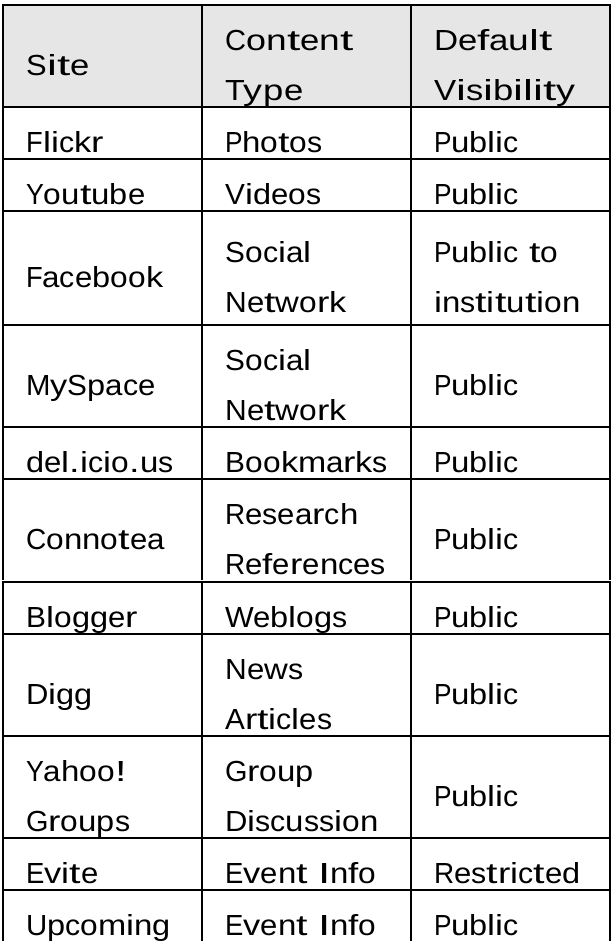 Table showing a majority of Web 2.0 sites favoring "Public" defaults.
Key Insights from Flickr Data
The study’s most striking findings come from the demographic breakdown of sharing:
1. The Age Divide
There is a clear linear decline in public sharing as user age increases. Older users are hypothesized to have more conservative risk assessments and less inherent trust in web exposure.
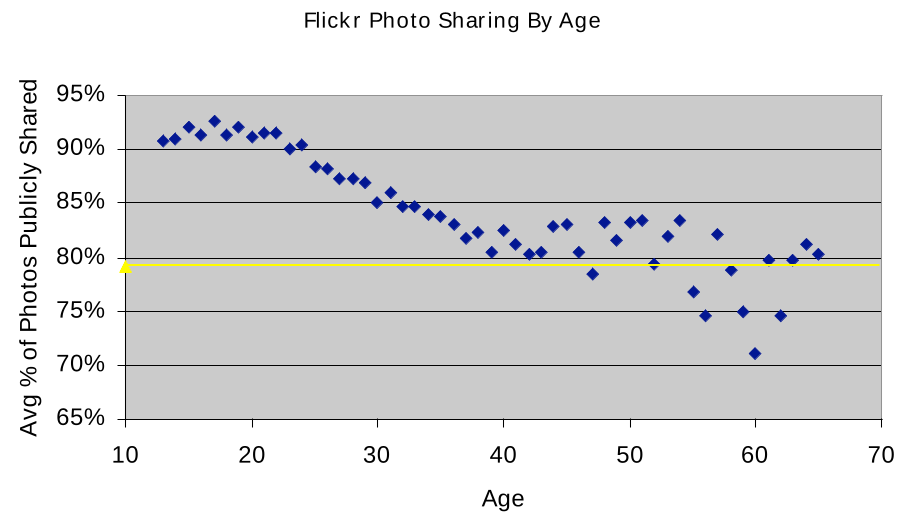 Figure: The correlation between increasing age and decreasing public sharing percentage.
2. The US vs. Europe
Culture plays a massive role. The data shows that US-based users are significantly more likely to share publicly (indicated by bright green on the maps) compared to Europeans (more red). This reflects Europe's more stringent historical privacy regulations and cultural norms.
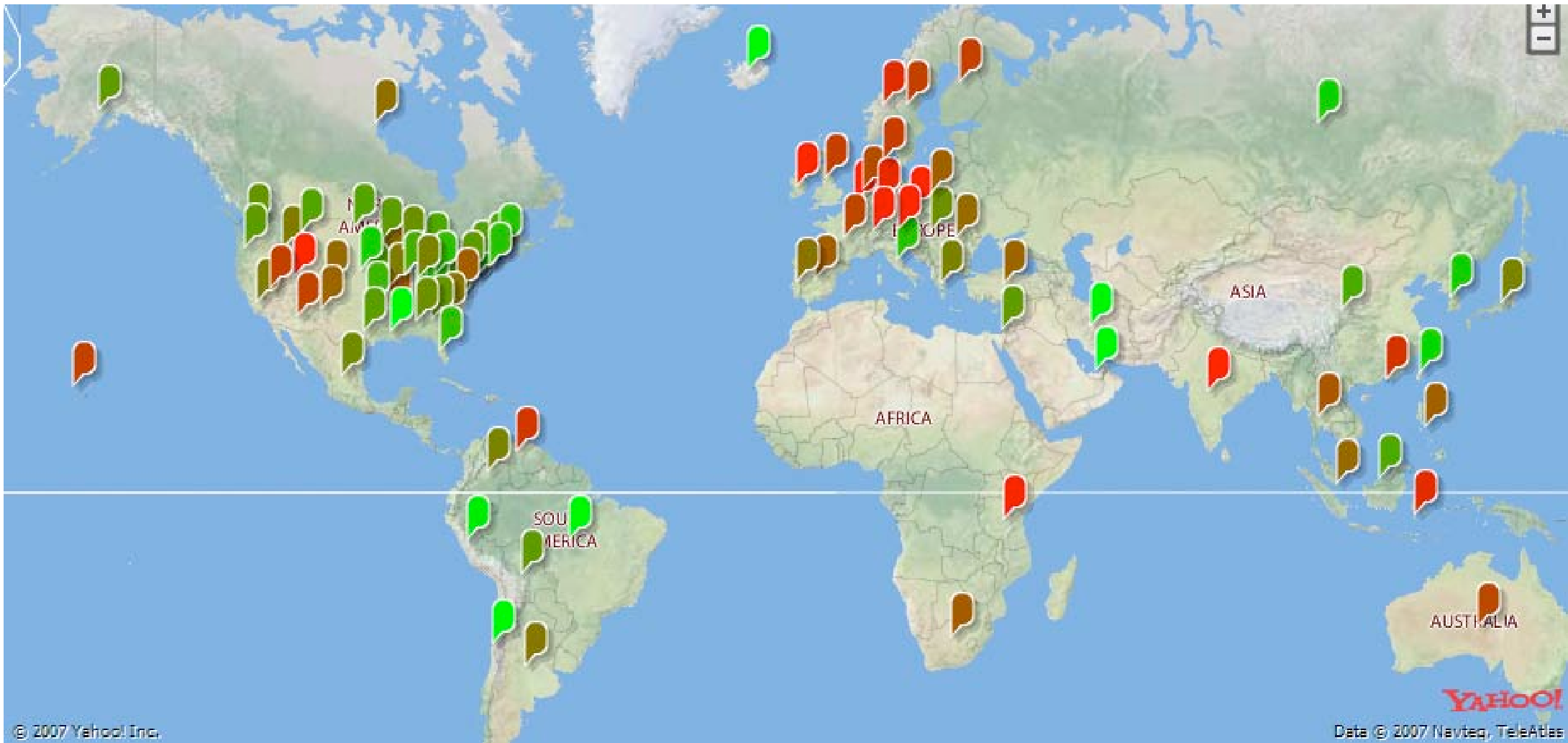 Visualizing regional differences in sharing: Green indicates high public sharing; Red indicates more private content.
3. The "Contact" Paradox
Users with zero contacts often share everything (perhaps using the site as a public hosting service). Users with a few contacts become more private (creating "private cliques" for close family). However, as the number of contacts grows very large, the user becomes more of a "social peacock," shifting back to public sharing to maximize their reach.
Critical Analysis & Conclusion: Designing for Trust
The paper concludes that designers and business managers cannot ignore the personal, local, and changing nature of sharing decisions.
Takeaways for Modern AI & Social Devs:
- Context-Aware Defaults: Defaults should perhaps be dynamic, based on a user’s demographic profile or local laws.
- Social Visualizations: Instead of just a "Public/Private" toggle, users need tools that show them what the norm is within their specific social circle or country to help them make informed choices.
Limitations: The study is a "snapshot." It doesn't capture why a user changes their mind over years. Furthermore, as an early "Web 2.0" study, it precedes the current era of algorithmic feeds, which further complicates the definition of "Public."
Ultimately, the Web is neither a pure Global Village nor just Private Cliques; it is a layered ecosystem where privacy is a social performance.