
Social Web of Things: Humanizing the Internet of Things through Social Graphs
Social Web of Things: A Survey a,*
The paper provides a comprehensive survey of the Social Web of Things (SWoT), a paradigm that integrates the Web of Things (WoT) with Social Network Sites (SNS). It evaluates communication standards (6LoWPAN, ZigBee, BLE) and proposes architectures for managing and sharing smart object data through social graphs.
TL;DR
The "Social Web of Things" (SWoT) is the next evolutionary step for IoT, moving beyond mere connectivity to a world where smart objects have "social lives." This survey explores how integrating Wireless Sensor Networks (WSNs) with Social Network Sites (SNS) allows users to manage, share, and monitor devices as easily as they interact with friends on Facebook or Twitter.
Background: From IoT to SWoT
While the Internet of Things (IoT) focuses on the plumbing—the hardware and networking protocols like ZigBee or 6LoWPAN—the Web of Things (WoT) brings these devices into the application layer of the web. The Social Web of Things (SWoT) goes further: it utilizes the "social graph" to define who can access a device, how data is shared, and how devices communicate their status to the world.
The Technical Bottleneck: Connectivity and Interoperability
The authors identify that the primary hurdle in IoT is the "addressing" of objects. Most WSNs use low-power protocols (Bluetooth, ZigBee) that don't inherently speak "Internet."
- 6LoWPAN: The survey champions this as the bridge. By enabling IPv6 over low-power wireless networks, every sensor can finally have its own unique IP address.
- Legacy Issues: Protocols like X10 (wired) or Z-Wave are limited by interference or physical cabling, making them less flexible for modern dynamic social environments.
Methodology: The Architecture of a Social Object
To make a device "social," it must be integrated into the web via RESTful APIs. The authors examine several frameworks, with a focus on the Social Access Controller (SAC).
Key Framework: SAC (Social Access Controller)
The SAC acts as a proxy between your smart home and your social network. Instead of building a custom security system for your smart lock, you use the authentication and relationship settings of your SNS (like Facebook or LinkedIn).
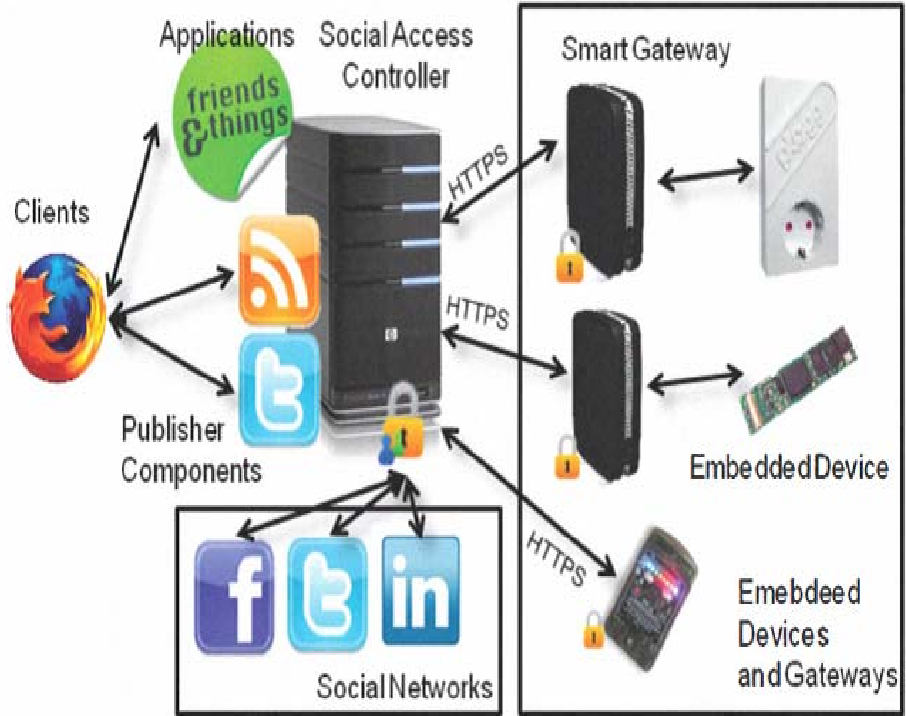 Figure 1: The SAC Architecture, showing the bridge between physical objects and Social Network APIs.
The logic is intuitive: If someone is your "friend" on a social platform, the SAC can automatically grant them temporary "guest" access to your smart home sensors or appliances without you needing to create a separate account for them.
Deep Dive: Emerging SWoT Platforms
The survey compares several pioneering systems:
- SenseFace: Visualizes body sensor network (BSN) data directly on social media walls.
- SenseShare: Uses Facebook's privacy settings to control who sees environmental sensor data.
- Twitter Integration: In some models, objects tweet their status directly, turning physical events (e.g., "The plant needs water") into social notifications.
Critical Analysis & Conclusion
The Power of Social Logic
The brilliance of SWoT is that it solves the Scalability of Trust. Managing permissions for thousands of IoT devices is a nightmare for a single user. By piggybacking on the social relationships we already maintain, we gain a ready-made security and sharing infrastructure.
Limitations
- Privacy Centralization: If your SNS account is compromised, your entire physical world (locks, cameras, sensors) becomes vulnerable.
- Interoperability: As the paper notes, early attempts like OpenSocial have struggled with adoption, and users are still often "locked in" to specific platforms.
Future Outlook
This survey serves as a roadmap for moving IoT from a technical curiosity to a ubiquitous social tool. As we move toward 6G and more advanced AI agents, the "social actors" in our networks will increasingly be the silent, smart objects that surround us.