
Social Web Services Discovery: Moving from Static Registries to Social Intelligence
Social Web Services Discovery: A Community-Based Approach
This paper introduces a "Community-Based" social network approach for Web services discovery, combining collaboration-based and recommendation-based associations to structure services. By organizing services into functional communities and leveraging historical selection data, the method optimizes the search space and improves discovery efficiency compared to traditional UDDI/ebXML standards.
TL;DR
This research shifts Web service discovery away from rigid, keyword-based UDDI registries toward a "Social Network" model. By organizing services into communities and assigning weights based on past successful collaborations, the authors propose an algorithm that finds the best service "on the fly" using principles similar to social recommendation systems.
Background: The Limits of Traditional Discovery
In the era of Service-Oriented Computing (SOC), finding the right tool for the job has become increasingly complex. Traditional discovery methods like UDDI (Universal Description Discovery and Integration) act like yellow pages—they tell you who exists, but they don't tell you who is good at their job or how well they work with others. As the number of services explodes, these static, syntactic matches fail to support the dynamic needs of modern Web 2.0 applications.
The Core Insight: Services That "Socialize"
The authors suggest that Web services should be treated as members of a social network. They define two critical types of relationships that dictate how services are discovered:
- Collaboration-based Associations (C): These define functional communities (e.g., a "Hotel Reservation" community). Services are weighted by their Success Rate—how often they were selected versus how often they were invited to participate.
- Recommendation-based Associations (R): This represents the "trust" or "linkage" between services. If a "Masonry Service" often works successfully with a "Carpenter Service," a strong recommendation link is formed between them.
The Discovery Mechanism
The proposed discovery process doesn't just scan a list; it traverses a graph. By using a greedy algorithm inspired by Prim's Algorithm, the system builds a "Maximum Spanning Tree" of services. It starts with a user request, identifies the relevant community, and then follows the strongest recommendation links to find a set of highly reliable, interconnected services.
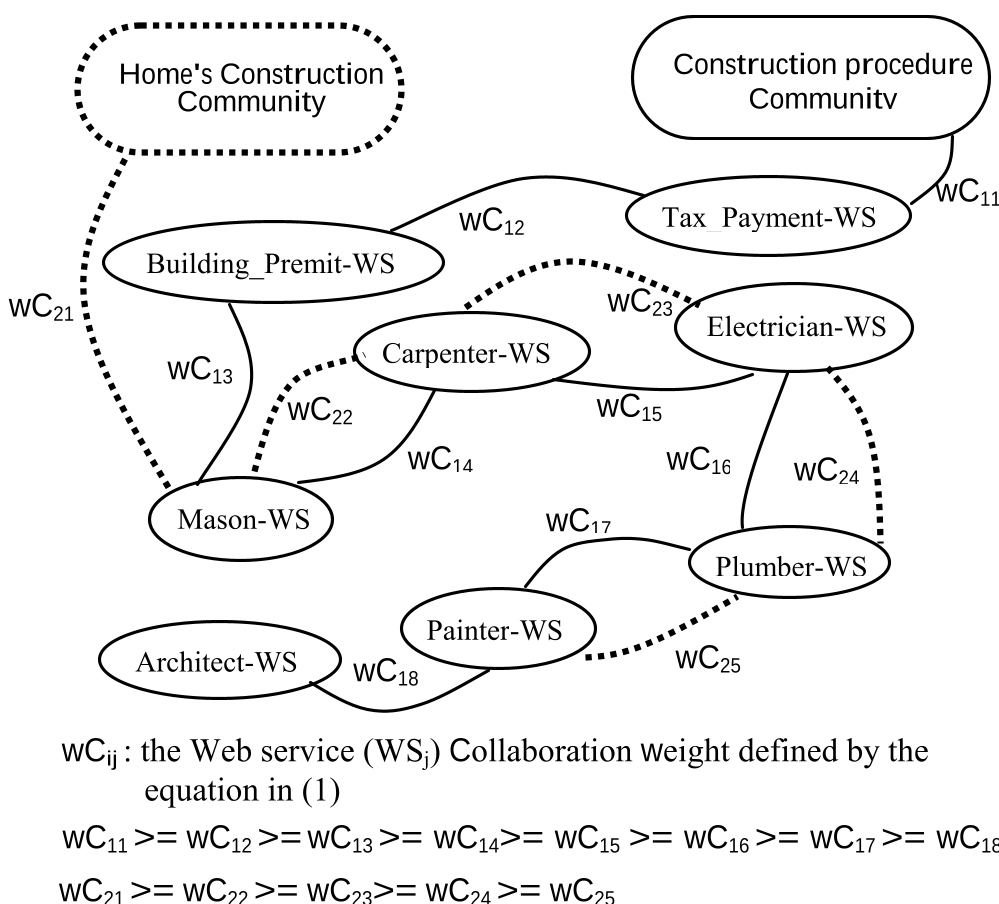 Figure 1: Illustration of how Web services are partitioned into functional communities and inter-connected via recommendation weights.
Experimental Analysis
The authors implemented the system in Java and tested it across various graph sizes. The "social" approach proved particularly efficient at scale:
- Scalability: For small to medium clusters (up to 200 nodes), the discovery time is nearly linear.
- Community Pruning: The research shows that the number of vertices in the collaboration graph (community size) has a negligible impact on runtime compared to the recommendation density. This proves that "searching within the right neighborhood" is an effective strategy for performance.
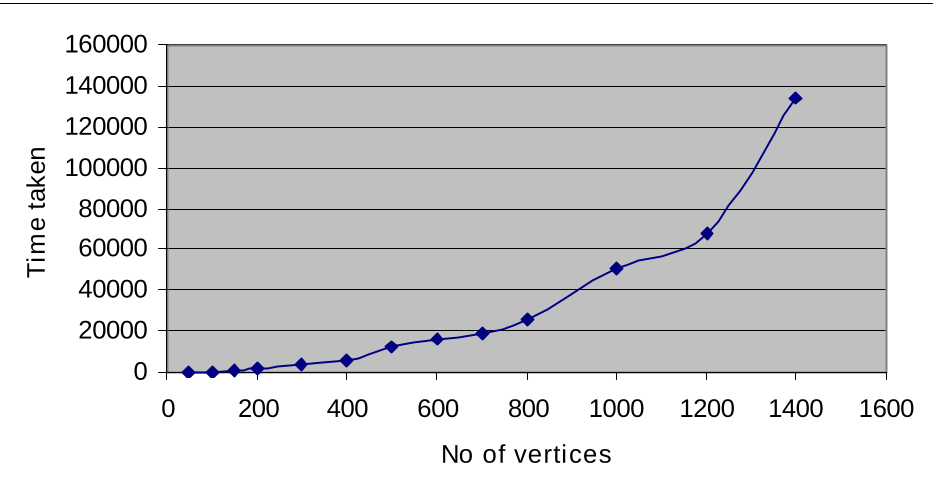 Figure 2: Time complexity analysis showing the transition from linear to n-log-n growth as the service network expands.
Critical Insight & Future Directions
While the community-based approach significantly narrows the search space, it faces a classic challenge: The Cold Start Problem. New services, no matter how capable, have no participation history and thus low weights.
Takeaway for the Industry: This paper demonstrates that the "Social Web" isn't just for humans. By applying community-based filtering and historical weighting, we can move toward a "Self-Organizing" service ecosystem where the most reliable components naturally rise to the top of discovery results. Future iterations that incorporate Semantic Ontologies (like OWL-S) could further bridge the gap between human-readable requests and machine-executable services.
Summary Table of Discovery Speed
| Nodes | Edges | Discovery Time (ms) |
|---|---|---|
| 240 | 350 | 135 |
| 1100 | 2800 | 16692 |
| 2100 | 5000 | 134211 |
The data confirms that as service density increases, the algorithm maintains manageable performance overhead for real-time applications.