
SocialAuth: Tackling Behavioral Drift in Smartphone Authentication via Social Contexts
SocialAuth: Designing Touch Behavioral Smartphone User Authentication Based on Social Networking Applications
SocialAuth is a touch behavioral authentication scheme specifically designed for social networking applications on smartphones. By focusing on app-specific interactions, it leverages a 22-feature SVM classifier to achieve a state-of-the-art Average Error Rate (AER) of 3.07%, significantly outperforming generic touch-monitoring methods.
TL;DR
SocialAuth is a novel behavioral authentication framework that solves the "instability" problem of touch-based biometrics. By focusing exclusively on gestures within social networking applications, it achieves an Average Error Rate (AER) of ~3.1%, which remains remarkably stable (at ~3.7%) even after a two-week period, effectively doubling the accuracy of general-purpose touch monitoring.
The "Inconsistency" Problem in Behavioral Biometrics
While PINs and patterns are vulnerable to "shoulder surfing" and "smudge attacks," behavioral authentication promises a seamless, continuous security layer. However, the industry has long struggled with behavioral inconsistency. A user’s touch pattern while playing a fast-paced game is drastically different from when they are casually browsing or composing an email.
Prior works (like Touchalytics) attempted to monitor all screen interactions, but this high variance makes it nearly impossible for a classifier (like SVM or Random Forest) to build a tight, reliable "normal" profile. This leads to high False Rejection Rates (FRR) where legitimate users are locked out simply because their posture or task changed.
The Insight: Social Networking as a Stable Baseline
The authors of SocialAuth hypothesize that functional focus leads to gesture stability. Users spend nearly 40% of their mobile time on social apps, where the repetitive nature of scrolling feeds, tapping "likes," and zooming into photos creates a highly consistent behavioral "fingerprint."
Methodology & Feature Engineering
SocialAuth utilizes a refined set of 22 features extracted from a modified Android OS kernel. These features go beyond simple coordinates:
- Directional Dynamics: Average touch movement speed and frequency calculated across 8 distinct directions.
- Gesture Fractions: The ratio of Single-Touch (ST), Touch-Movement (TM), and Multi-Touch (MT) events per session.
- Hard-Sensing: Integration of Touch Pressure (ATP), a feature that captures the physical "weight" of a user's interaction.
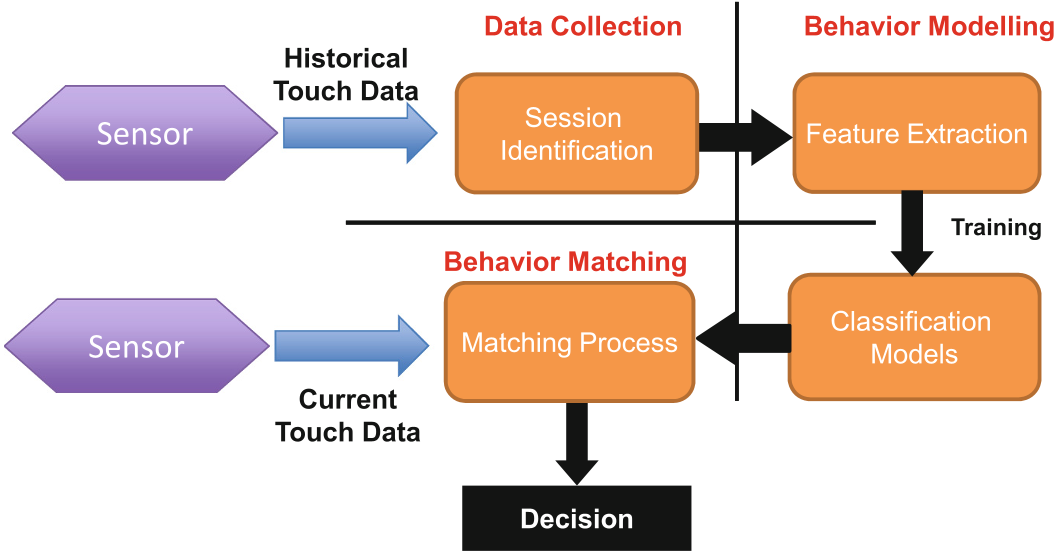 Figure 1: High-level architecture of the touch behavioral authentication system.
Experimental Results: The Proof in the Stability
The researchers conducted a comprehensive study with 50 participants, comparing two scenarios:
- S1 (General Usage): Monitoring all gestures.
- S2 (SocialAuth): Monitoring only social app interactions (Facebook, Instagram, etc.).
Quantitative Superiority
The data revealed that behavioral deviation in S2 was roughly half of that in S1. This "tightening" of user data allowed the SVM classifier to perform significantly better:
| Classifier | S1 AER (General) | S2 AER (SocialAuth) |
|---|---|---|
| SVM | 6.02% | 3.07% |
| BPNN | 9.73% | 7.15% |
| Naive Bayes | 19.70% | 12.40% |
The Long-Term Test
The true "holy grail" of this paper is the long-term performance. Most behavioral biometrics degrade quickly as users change habits. However, because social app usage is so ingrained, SocialAuth’s performance only slightly dipped from 3.07% to 3.68% after two weeks. In contrast, general monitoring (S1) plummeted to nearly a 10% error rate.
 Table 1: Detailed FAR, FRR, and AER metrics showing SVM's dominance in the SocialAuth context.
Critical Insight & Future Outlook
SocialAuth proves that the way forward for mobile security is not broader data, but better context. By filtering out "noisy" data from varied apps and focusing on the high-frequency, consistent environment of social media, we can achieve authentication that is both usable and secure.
Limitations: The current system relies on a modified Android OS to capture system-level touch events. For commercial deployment, this would need to be translated into a kernel-level module or a permission-based service that doesn't compromise system performance.
Takeaway: In the future, your "authentication" might not be a password you remember, but the subtle way you scroll through your Instagram feed.