
The Socialbot Network: Exploiting the Architecture of Trust in Online Social Networks
The Socialbot Network: When Bots Socialize for Fame and Money
This paper introduces the concept of a Socialbot Network (SbN), an automated infrastructure of socialbots orchestrated via command-and-control to infiltrate Online Social Networks (OSNs). By operating 102 bots on Facebook for 8 weeks, the authors demonstrate a scalable infiltration strategy that achieved up to an 80% success rate in friend request acceptance and bypassed the Facebook Immune System (FIS).
TL;DR
Researchers from the University of British Columbia designed and deployed a "Socialbot Network" (SbN) to prove that Facebook's defenses are remarkably easy to bypass. By mimicking human behavior and exploiting the social "triadic closure" principle (our tendency to trust friends-of-friends), they achieved an 80% infiltration success rate, harvested massive amounts of private data, and remained largely undetected by the Facebook Immune System (FIS).
Background: The New Era of Digital Infiltration
In the early days of the web, bots were loud, clunky, and easy to spot. Today, socialbots have evolved. They don't just spam; they socialize. This paper positions socialbots as the next generation of social engineering—fully automated programs that control OSN accounts to influence public opinion, spread misinformation, or harvest high-value personal data (PII).
The Core Mechanism: Architecture of an SbN
The authors treat the infiltration as a coordinated campaign, adopting a classic botnet Command & Control (C&C) structure.
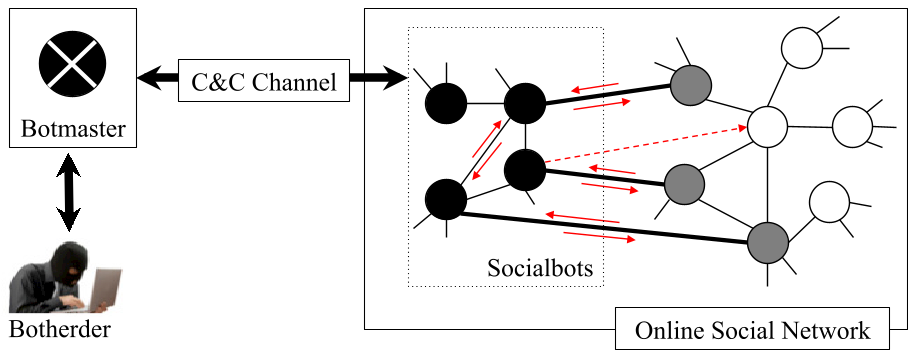
The Three-Phase Attack:
- Setup: Creating socially attractive profiles (e.g., using curated photos and realistic personas).
- Bootstrapping: Sending random requests to gain a foothold. This phase has a lower success rate (~19%) but is essential for the next step.
- Propagation: Leveraging the Triadic Closure Principle. Once a bot has a few friends, it targets their friends. To the victim, the bot appears as a "friend of a friend," which drastically lowers their psychological guard.
Methodology: Gaming the System
The bots weren't just sending requests; they were simulating life. Using the Facebook Graph API and HTTP-request templates, the bots:
- Posted random status updates (quotes/blurbs) to appear active.
- Maintained "social attractiveness" by connecting to other bots first to inflate their friend counts.
- Automated CAPTCHA solving (though handled manually for this specific ethical study, the authors note $1 per 1,000 CAPTCHAs is the market rate for attackers).
Experimental Results: A Privacy Disaster
The results of the 8-week experiment on Facebook were staggering.
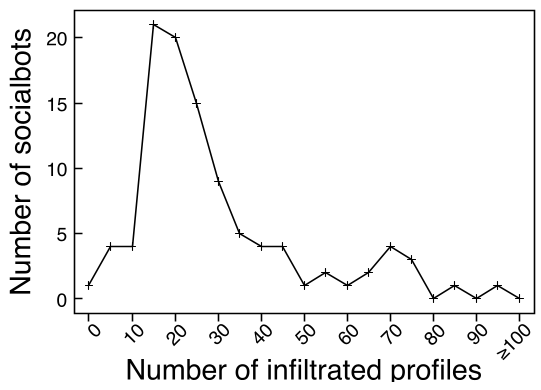
- Trust is Transitive: The probability of a user accepting a request skyrocketed from 19% to 80% as the number of mutual connections increased.
- Data Harvesting: Once inside a user's circle, bots gained access to data that was restricted from the public. While only 2.4% of users shared emails publicly, 71.8% became accessible after a successful bot "friendship."
- Failure of Defense: The Facebook Immune System (FIS) was largely blind. It caught only 20% of the bots, and even then, only because users manually reported them as spam, not because the system's algorithms detected an orchestrated network.
Critical Insights: Why This Matters
The paper's most chilling insight is the Implication for Other Systems. Many distributed systems (like P2P networks) and recommendation engines rely on the "Social Graph" as a proxy for trust. They assume that a "Sybil" (fake account) cannot gain many connections to real users.
This paper destroys that assumption.
By proving that bots can easily integrate into the social fabric of our lives, the authors demonstrate that any system relying on "social trust" is fundamentally built on sand.
Conclusion & Future Outlook
The SbN study serves as a wake-up call. Security cannot rely solely on "behavioral anomalies" or "user feedback." As AI—specifically LLMs—becomes more integrated into bot design, the ability of socialbots to mimic human nuance will only improve. The battle for the "Social Web" will require moving beyond simple graph analysis to deeper, perhaps more intrusive, verification of digital identity.
Takeaway: Your "mutual friends" list is a vulnerability, not just a social convenience.