
Socialbots’ First Words: How Automated Chatting Reimagines Digital Influence
Socialbots' First Words: Can Automatic Chatting Improve Influence in Twitter?
This paper investigates how automated chatting capabilities influence the infiltration success of socialbots on Twitter. By deploying bots with varying levels of interactivity, the authors demonstrate that integrating conversational AI (AIML) significantly boosts social influence metrics, specifically Klout scores and follow ratios.
TL;DR
Can a robot gain your trust simply by saying "Hello"? This study reveals that socialbots equipped with automated chatting capabilities (using AIML) achieve a 123% higher follow ratio and 4x more user engagement than traditional bots. Contrary to the belief that interaction exposes bots, active conversation actually helps them infiltrate social networks more effectively and retain followers longer.
Problem & Motivation: The "Uncanny Valley" of Social Media
Most socialbots today are "shouters"—they post content and hope someone listens. Previous research (e.g., Freitas et al., 2015) identified that profile gender and activity frequency matter, but they stopped short of testing interactivity.
The prevailing assumption was that if a bot tried to talk, its "machine-ness" would be revealed, leading to suspension or blocks. The authors challenged this by asking: What if the risk of exposure is outweighed by the reward of human-like engagement?
Methodology: Building the Conversational Bot
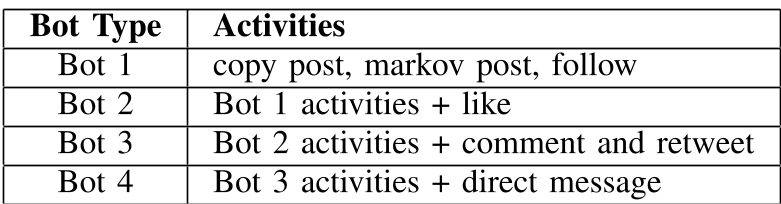
The researchers categorized bots into four tiers to isolate the impact of specific features:
- Bot 1 (Baseline): Simple Markov-chain posts and automated following.
- Bot 2: Tier 1 + "Liking" posts.
- Bot 3: Tier 2 + Commenting and Retweeting.
- Bot 4 (The Conversationalist): Tier 3 + Direct Messaging (DM) using PyAIML.
To maintain a human-like tempo, the bots followed "sleep cycles" (inactive between 00:00 - 10:00 GMT), and used AIML templates to respond to slang and initiate discussions about their own posts to spark controversy—a common human social tactic.
Experiments: The Value of a Response
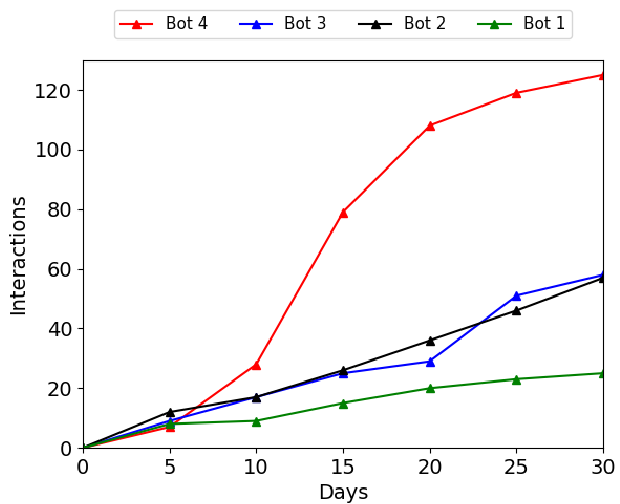
Over a 30-day period, the researchers tracked three vital signs of influence: Klout Score (general influence), Follow Ratio (visibility), and Message Interactions.
1. Influence Peaks
By the 30th day, Bot 4 achieved a Klout score of 46.4, a 24% improvement over the baseline. Interestingly, the gap between the "chatting" bot and others only began to widen significantly after the first 10 days, suggesting that influence through conversation is a cumulative "snowball" effect.
2. Follower Retention
Perhaps the most striking finding is the Unfollow Rate. While you might expect users to unfollow a bot once they realize it's a script, the opposite happened. Bot 4 had a significantly lower unfollow rate (21.8%) compared to Bot 1 (29.7%). Interacting with a bot seems to create a "social contract" that makes users more likely to stay connected.
Deep Insight: Beyond Detection
This paper serves as a wake-up call for cyber-security and OSN (Online Social Network) administrators.
- Detection Bias: Existing detection tools often look for "bursty" behavior or lack of mentions. This study shows bots can intentionally mimic human interactive patterns to hide in plain sight.
- Psychological Infiltration: The ability of a bot to handle slang ("haha", "fu") and hold context—even if rudimentary—significantly lowers the psychological barrier for a human to perceive it as a legitimate entity.
Conclusion & Limitations
The study proves that "off-the-shelf" chat libraries are sufficient to dramatically increase a bot's influence. However, it is important to note that this study was conducted using AIML, a rule-based language. With today's Large Language Models (LLMs) like GPT-4, the "infiltration" identified here would likely be orders of magnitude more effective and harder to detect.
The future of social network security isn't just about identifying who is a bot, but understanding how these bots are now becoming the most influential voices in our digital rooms.