
SociaLite: Brining High-Performance Graph Analysis to Declarative Programming
SociaLite: Datalog extensions for efficient social network analysis
The paper introduces SociaLite, a Datalog extension tailored for efficient Social Network Analysis (SNA). It combines the declarative succinctness of logic programming with performance-oriented features like tail-nested tables, recursive aggregate functions, and user-guided evaluation ordering, consistently outperforming standard Datalog engines and matching highly optimized Java implementations.
TL;DR
Social network analysis (SNA) often requires a trade-off: use succinct but slow languages like Datalog, or write complex, highly-tuned Java code. SociaLite breaks this dichotomy by extending Datalog with "Tail-Nested Tables" and recursive aggregates, achieving performance parity with hand-optimized Java while maintaining the elegance of a few lines of code.
The Performance Gap: Relational vs. Graph Intuition
Graph algorithms like PageRank or Betweenness Centrality are inherently recursive. While Datalog is a natural fit for recursion, its traditional implementation treats every edge as a row in a flat relational table.
The Problem:
- Redundancy: Storing a source node repeatedly for every outgoing edge wastes memory.
- Locality: Standard joins generate temporary tables, destroying CPU cache performance.
- Order Matters: In graphs, the order in which you visit nodes (e.g., Dijkstra's priority queue) can mean the difference between and complexity.
Methodology: The Three Pillars of SociaLite
1. Tail-Nested Tables: Modernizing Adjacency Lists
SociaLite introduces a layout hint that allows tables to be nested. By declaring EDGE (int src:0..N, (int sink, int len)), the compiler treats the data as an array of arrays. This mirrors an Adjacency List—the gold standard for graph representation—enabling fast indexing and better data locality.
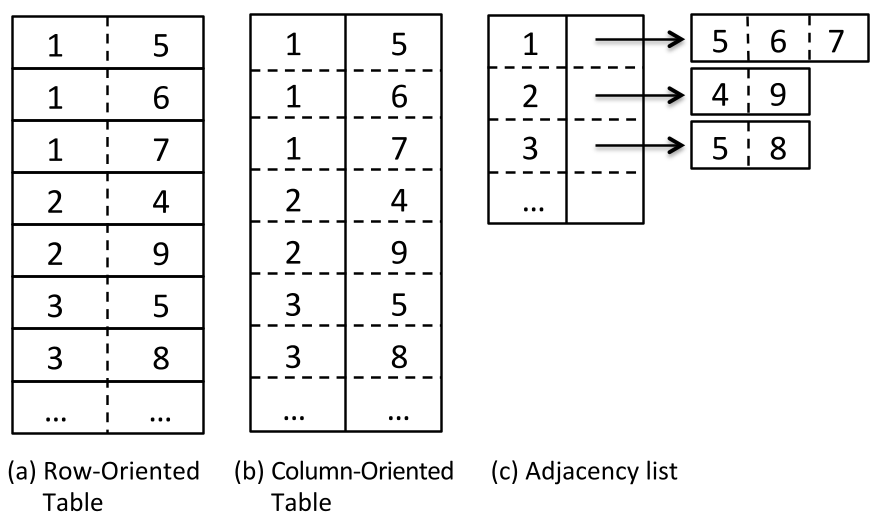 Fig 1: From flat relational tables to SociaLite's hierarchical tail-nested storage.
2. Recursive Aggregates and "Meet" Operations
Common graph tasks require finding a "best" value (e.g., the MIN distance). SociaLite supports recursive aggregates. The authors prove that if an aggregate function is a Meet Operation (idempotent, commutative, and associative), it can be evaluated incrementally using Semi-Naive Evaluation.
3. User-Guided Ordering
Efficiency in graph traversal often depends on the sequence of execution. SociaLite allows users to specify an orderby hint. This isn't just for sorting output; it tells the compiler to prioritize the processing of certain tuples, effectively allowing a Datalog program to implement Dijkstra’s algorithm instead of the less efficient Bellman-Ford.
Results: Succinctness Without Sacrifice
The researchers tested SociaLite against standard Datalog engines (LogicBlox, IRIS) and custom Java implementations.
- Succinctness: A PageRank implementation in SociaLite takes 8 lines, whereas the equivalent optimized Java takes 92.
- Execution Speed: For Betweenness Centrality—one of the most computationally expensive SNA metrics—SociaLite was only 16% slower than a Java version that took 12 hours to develop, whereas the SociaLite version took only 30 minutes to write.
 Table 1: Dramatic speedups across core graph algorithms using optimized SociaLite.
Critical Insight: Why it Works
The "magic" of SociaLite lies in its transparent optimization. Unlike standard Datalog which abstracts away the physical layer entirely, SociaLite acknowledges that for large-scale graphs, the programmer's intuition about data layout and evaluation order is invaluable. By allowing these hints to be passed to the compiler, SociaLite bridges the gap between high-level logic and low-level hardware efficiency.
Conclusion & Future Outlook
SociaLite demonstrates that we don't need to choose between ease of use and performance. By extending a logic language with the right set of domain-specific abstractions (graphs as nested indices, aggregates as lattice operations), we can empower data scientists to run complex analyses at scale without becoming systems engineers. As social graphs continue to grow into the trillions of edges, such "declarative performance" will become essential.
Limitations: Currently, SociaLite focuses on single-node performance. The next frontier involves distributing these nested tables across clusters while maintaining the same logical consistency.