
Sociality-Driven Adaptivity: Solving the Multicast Overhead in DTNs
Sociality-Aided New Adaptive Infection Recovery Schemes for Multicast DTNs
This paper introduces a sociality-aided adaptive infection recovery scheme combined with polymorphic epidemic routing and network coding for multicast Delay-Tolerant Networks (DTNs). By leveraging interest-based node grouping and adaptive probability-based "antipacket" propagation, the method optimizes the tradeoff between data delivery reliability and network overhead.
TL;DR
Efficiency in Delay-Tolerant Networks (DTNs) has long been a tug-of-war between Epidemic Flooding (high reliability, massive overhead) and Infection Recovery (low overhead, poor reliability). This paper bridges the gap by introducing social-aware grouping and adaptive recovery probabilities, ensuring that "antipackets" (recovery signals) don't kill a multicast message before it reaches every destination.
The "Early Death" Problem in DTN Multicast
In a DTN, nodes move sporadically and exchange data only during short "contact" windows. In a multicast scenario, we want to reach multiple destinations. Traditional recovery techniques like the Immune or Vaccine schemes are "greedy"—they start deleting packets and spreading "antipackets" the moment the first destination is reached.
The Motivation: If the network is socially clustered, a packet might satisfy a destination in Community A and immediately be deleted, even though Community B is still starving for that data. The authors noticed that existing schemes lack adaptivity to the number of destinations and the social structure of the network.
Methodology: Sociality + Polymorphism + Adaptivity
1. Interest Casting & Homophily
The system uses a Cosine Similarity metric to define groups. Nodes exchange interest profiles (Z-dimensional vectors). If the similarity exceeds a threshold , they belong to the same group. This "Sociality" is used to prioritize relays that are more likely to meet the intended multicast targets.
2. Polymorphic Epidemic Routing (Network Coding)
Instead of just sending packet , the source sends segments and an XOR-coded packet . This increases the "utility" of any single encounter, as receiving any two allows for the reconstruction of .
3. Adaptive Recovery (The Secret Sauce)
The core innovation is the Adaptive Soft Recovery Scheme. Instead of recovery being an all-or-nothing event, the recovery probability is modeled as: This formula ensures that recovery starts slowly and ramps up only after enough time has passed for the destinations to likely have been reached.
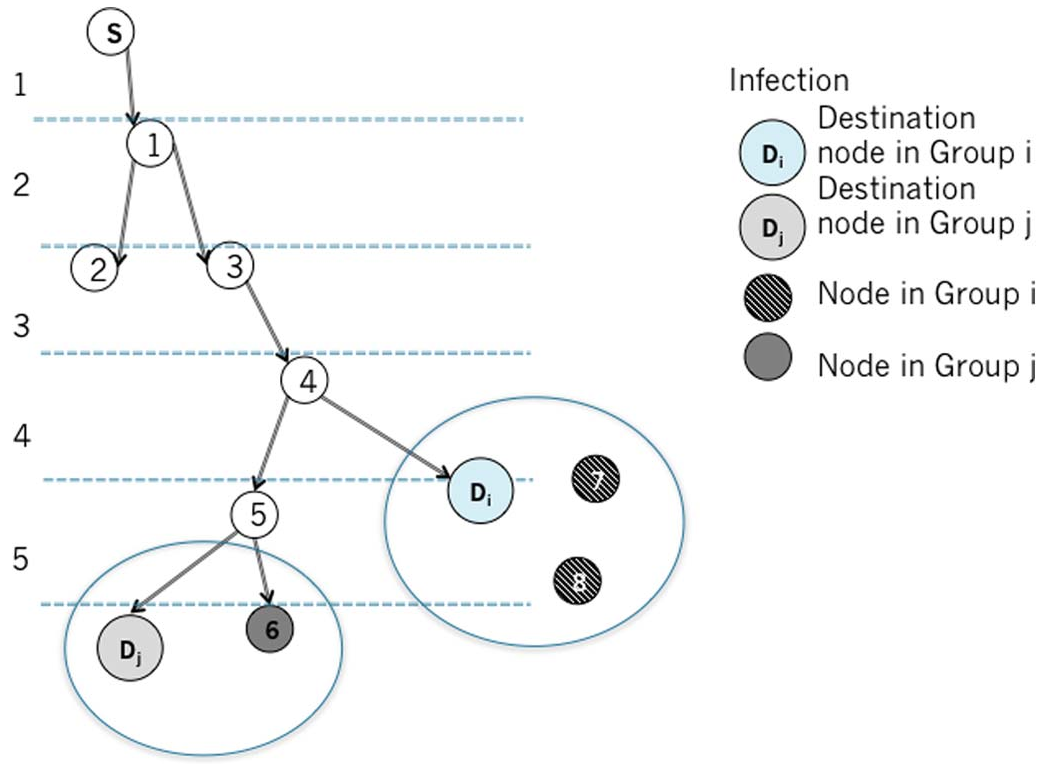 Figure 1: Evolution of the infection and recovery process across different social groups.
Experiments and Results
The authors tested two settings: one where groups are isolated (LABEL forwarding) and one where inter-group contacts are possible.
Performance Highlights:
- Reliability: In the Vaccine scheme (the most aggressive), standard recovery caused many destinations to miss the packet. The Adaptive Global Timeout fixed this, ensuring the packet lifetime always exceeded the delivery delay .
- Efficiency: Under social-aware settings, delivery delay was reduced by 20% because inter-group contacts were leveraged effectively as "bridges."
- Overhead Control: The adaptive schemes prevented the "packet storm" typical of SANE or pure Epidemic routing while maintaining a higher success rate than static Immune schemes.
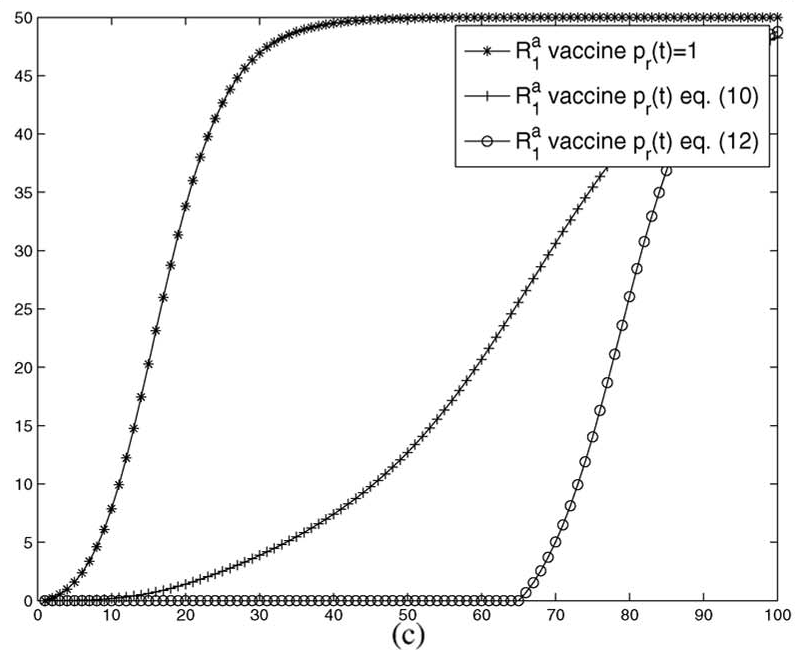 Figure 2: Analysis of recovery rates () highlighting the difference between standard and adaptive (9, 11) schemes.
Critical Insight: Sociality as a Double-Edged Sword
An interesting takeaway from the study is that sociality can be detrimental if combined with aggressive, non-adaptive recovery. If nodes in a tight-knit community are too quick to spread "antipackets," they effectively quarantine the data within their bubble before it can bridge to other groups.
The paper proves that the most robust DTN multicast architectural choice is a "slow" recovery mechanism (like Immune) coupled with "fast" social bridging or an aggressive recovery (Vaccine) strictly gated by an adaptive global timeout.
Conclusion
By integrating social homophily with fluid-limit Markov models for recovery, Galluccio et al. provide a mathematical foundation for the next generation of "socially-intelligent" DTN protocols. This work suggests that DTN efficiency isn't just about moving data faster—it's about knowing exactly when to stop.