
ASC: Solving WLAN Load Imbalance via Social-Aware Spectral Clustering
A sociality-aware online AP association algorithm based on spectral clustering
The paper introduces ASC (Algorithm based on Spectral Clustering), a novel online AP association scheme for enterprise WLANs. By leveraging spectral clustering to identify social "homophily" among users, it achieves superior load balancing by distributing socially-related users (who tend to join and leave in union) across different Access Points.
TL;DR
In modern enterprise WLANs, the biggest threat to stability isn't just peak traffic, but the synchronized behavior of social groups. This paper presents ASC, an online AP selection algorithm that uses spectral clustering to group users who behave similarly (joining/leaving together) and proactively distributes them across different Access Points. This "socially-aware" strategy outperforms standard Least Load First (LLF) methods by 22-58%.
Problem & Motivation: The "Group Departure" Trap
Most AP association algorithms are reactive. They look at current signal strength (RSSI) or current load. However, they are blind to the future.
Imagine a group of friends or colleagues in a meeting room. They all join the nearest AP (AP1) because it has the strongest signal. Later, they all leave for lunch at the same time. Suddenly, AP1's load drops to zero while other APs remain congested. The network spends a significant amount of time "re-balancing" after the fact.
The authors' core insight is Homophily: users with strong social relationships tend to have similar network usage and, crucially, similar departure times. If we can identify these "clusters" of users early, we can spread them across multiple APs from the start, ensuring the network stays balanced even when a whole group disappears.
Methodology: Turning Traffic into Social Insight
The ASC algorithm operates in three distinct phases:
- Data Collection: When a user connects, the system monitors their bandwidth usage for an initial 5-minute window.
- Spectral Clustering: The controller builds a similarity matrix based on these traffic patterns. Spectral clustering is then applied to group users. It views users as nodes in a graph, where edges represent the similarity in their bandwidth fluctuation curves.
- Strategic Association: Once cluster numbers are assigned, the controller ensures that users of the same "type" are not concentrated on the same AP.

The beauty of this method is that it is online. Unlike previous social-aware research that required pre-training or explicit social media profile access, ASC identifies relationships implicitly through live network traffic.
Experimental Results: Real-World Performance
The researchers didn't just use synthetic models; they collected 1.5TB of data over 37 days from a university teaching building.
1. The Balancing Index ()
Using Jain's Fairness Index as a proxy for load balance, ASC consistently stayed closer to the ideal value of 1. During high-traffic periods (morning and afternoon), ASC provided significantly more stable throughput across five APs than the Least Load First (LLF) algorithm.

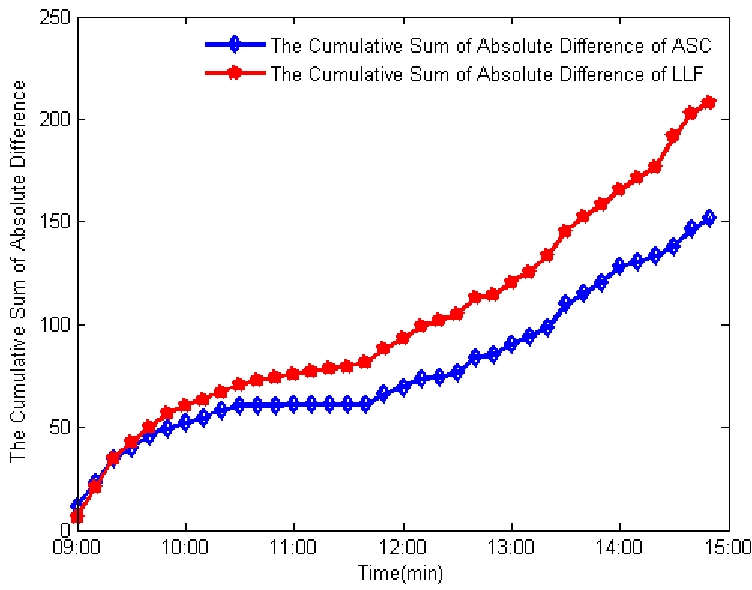
2. Cumulative Sum of Absolute Difference ()
While LLF tries to balance current numbers of users, it fails to account for total throughput variance. ASC achieved a 151.57 Mbps total difference score, compared to 208.27 Mbps for LLF—a nearly 40% improvement in actual traffic distribution.
Critical Analysis & Takeaways
The paper makes a compelling case for predictive social clustering. However, there are two key points to consider:
- The "Noon" Anomaly: As noted in the results, ASC's advantage diminishes during lunch breaks when user density is low. This suggests the algorithm's overhead might be less justified in sparse networks.
- Computation Cost: Spectral clustering involves eigenvalue decomposition. While feasible for an enterprise controller managing a few hundred users, scaling this to thousands of users in real-time requires efficient matrix updates.
Conclusion: This work proves that "socially-aware" is not just a buzzword. By understanding the human patterns behind the packets, we can build wireless networks that don't just react to load, but strategically prepare for the inevitable flux of human behavior.