
Socialize Online Learning: Bridging the Gap Between Formal Education and Social Networks
Socialize online learning: Why we should integrate learning content management with Online Social Networks
The paper proposes a novel framework to integrate Learning Content Management Systems (LCMS) with Online Social Networks (OSN) to foster "Socialized Online Learning." It introduces an instructor-less, adaptive system that uses the hylOs LCMS to enable self-paced but collaborative learning within established social graphs.
Executive Summary
TL;DR: This paper explores why we should stop building "learning silos" and instead bring educational content to where people already spend their time: Online Social Networks (OSNs). By integrating the hylOs Learning Content Management System with OSN APIs, the authors propose an instructor-less environment that automatically forms learning groups based on psychological profiles and real-time interaction data.
Context: This work positions itself at the intersection of CSCL (Computer-Supported Collaborative Learning) and AEH (Adaptive Educational Hypermedia), aiming to solve the "loneliness" of self-paced learning and the "rigidity" of instructor-led courses.
Problem & Motivation: The "Instructor Bottleneck"
Existing eLearning platforms often feel like digital archives—static and isolating. When they do attempt collaboration (CSCL), they usually require a human instructor to:
- Direct Group Sourcing: Manually pairing students with similar knowledge levels.
- Manage Content: Orchestrating how and when materials are seen.
- Facilitate Progress: Providing the "social glue" that keeps learners motivated.
The authors argue that OSNs like Facebook or Google+ already have the "social glue." The challenge is: How can we automate the instructor's role to create effective, spontaneous learning groups within these social ecosystems?
Methodology: The Instructor-Less Architecture
The proposed system relies on a sophisticated tech stack that sits on top of a social network's graph.
1. Automated Team Building
Instead of manual placement, the system uses three filters:
- Learning Style Assessment: Utilizing the Felder-Silverman Theory (FST), the system tracks "Active vs. Reflective" or "Visual vs. Verbal" tendencies. Crucially, it moves away from boring questionnaires toward Interaction Analysis, using neural networks to infer styles from mouse movements and eye-gaze data captured via video chat APIs.
- Knowledge Estimation: Tracking the history of consumed Learning Objects (eLOs) to ensure group members are on the same page.
- Heuristic Grouping: Since finding the "perfect" group in a graph of millions is NP-complete, the authors suggest genetic algorithms to find "good enough" clusters of compatible learners.
2. Integration via hylOs
The core engine is hylOs, an LCMS that separates content from presentation using XML. This allows the same educational material to be transformed via XSL into a format that fits perfectly inside a social network's UI.
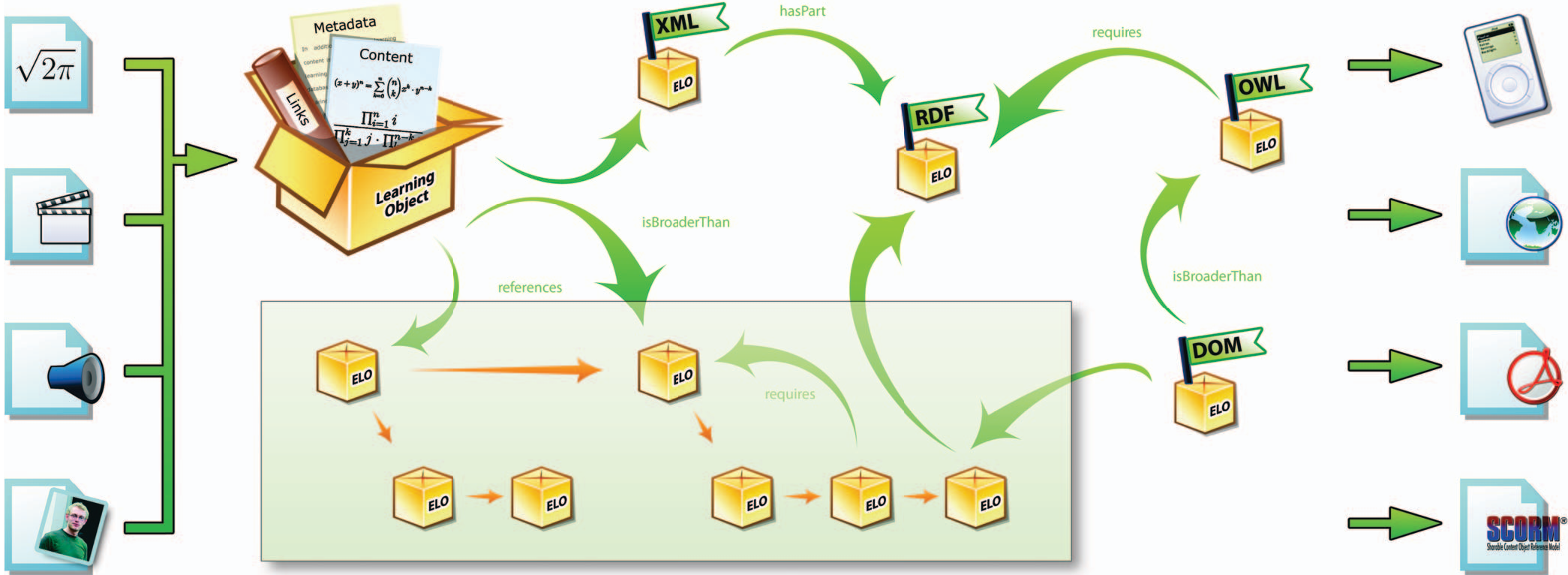 Figure 1: The hylOs system architecture showing the Ontological Evaluation Layer and the Course Runtime Plugin.
Experiments & Monitoring: More Than Just "Likes"
To ensure the system actually works, the authors focus on Learning Consistency:
- Ubiquitous Learning (uLearning): Adapting content to context. If a user is on a mobile device in a noisy environment, the system might prioritize text over audio.
- Group Cohesion: How do we know if a group is actually "learning"? The authors propose Lexical Analysis. By monitoring the frequency of the first-person plural ("we") in chat logs, the system can quantitatively measure group intensity and health.
Critical Insight & Conclusion
Takeaway
The true value of this research lies in its Heuristic Approach to social education. By treating learning as a feature of social networks rather than a separate destination, we can lower the friction of lifelong learning.
Limitations
- Privacy Concerns: The paper was written in a pre-GDPR era; today, tracking eye-gaze and mouse patterns within a social network would face significant regulatory and ethical hurdles.
- API Dependency: The system's effectiveness is heavily reliant on the openness of commercial OSN APIs (which have become increasingly closed in recent years).
Future Outlook
As we move toward a world of "micro-learning," the integration of AI-driven group formation and adaptive hypermedia will likely migrate toward decentralized social protocols, allowing learners to own their "learning graph" across different platforms.