
Reflex: Rethinking Spontaneous Social Interaction in Mobile Apps
Socialize spontaneously with mobile applications
Reflex is a system framework designed to enable spontaneous, real-time social interactions within mobile applications without requiring explicit user registration. It leverages Google App Engine (GAE) for scalable presence management and a distributed "Reflector Cloud" for low-latency data relay, achieving seamless collaboration in apps like the MusicScore composition tool.
TL;DR
Reflex is a high-performance framework for iOS that allows developers to integrate real-time social features into their apps—think collaborative music editing or gaming—without forcing users to sign up for accounts. By combining Google App Engine for scale and a custom "Reflector Cloud" for speed, it automates the complex logic of switching between 3G, Wi-Fi, and Bluetooth to maximize performance and battery life.
Background & Motivation: Beyond the "Friend Request"
Most social interactions online today are curated: you find a friend, send a request, and eventually interact asynchronously. But mobile usage is shifting toward spontaneity. Imagine being in a stadium or a classroom and wanting to collaborate instantly with those around you without the friction of passwords or "friending."
Prior frameworks like Game Kit or XMPP-based IMs fall short because they either require proprietary accounts or use purely peer-to-peer meshes that fail behind NATs/firewalls. The authors argue that a truly "spontaneous" experience must be anonymous, real-time, and network-agnostic.
Methodology: The Cloud Meets the Edge
The Reflex architecture is split into two specialized layers:
1. The Spontaneous Presence Cloud (GAE)
Built on Google App Engine, this layer handles the "Yellow Pages" of the app. It uses JSON-RPC over HTTP for user discovery. To handle the unique constraints of GAE's Datastore (like the lack of multi-property inequality filters), Reflex uses Geohashing for location-based searches and Memcache to speed up profile reads by over 5x.
2. The Reflector Cloud & Local Switching
For the actual data-heavy heavy lifting (e.g., streaming music notes), Reflex uses a geographically distributed "Reflector Cloud" (deployed on PlanetLab).
The "magic" happens in the Transparent Switcher:
- Cloud Relay: If users are remote, data flows through the nearest Reflector.
- Local Ad-hoc: If Reflex detects users are in the same room, it moves the traffic to Bluetooth or Wi-Fi automatically.
- Proxy Mode: A device with 3G can act as a gateway for nearby devices with no internet.
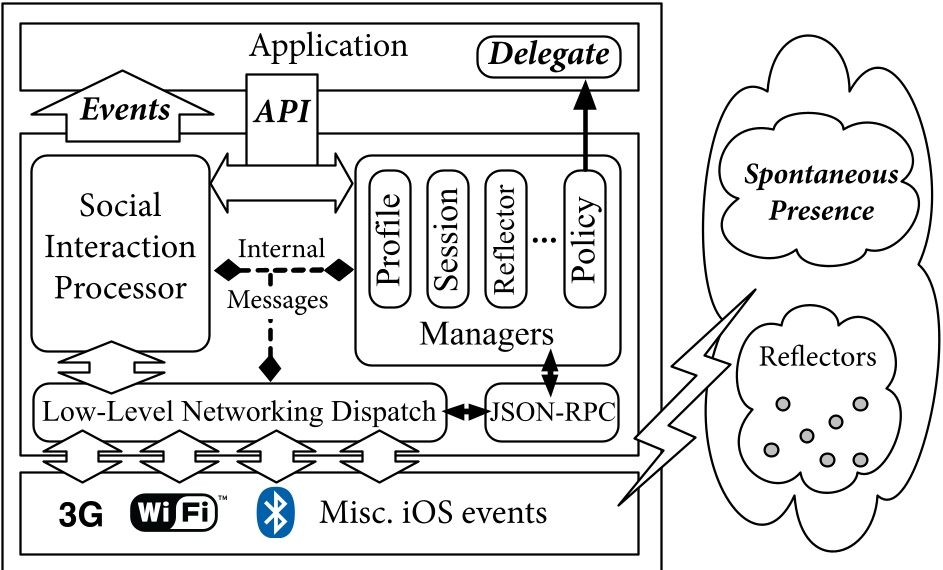 Fig 1: The architectural overview showing the decoupling of Application logic from the Reflex Presence and Session managers.
Evaluation: MusicScore in Action
To prove Reflex works, the authors built MusicScore, a complex music composition app for iPad.
Performance Highlights:
- Scalability: The GAE backend dynamically spawns instances to handle "flash crowds," keeping response times under 100ms.
- Latency: Switching to local Wi-Fi reduced latency by 74% compared to 3G.
- Efficiency: Using local interactions increased battery life from ~6 hours to over 7.4 hours.
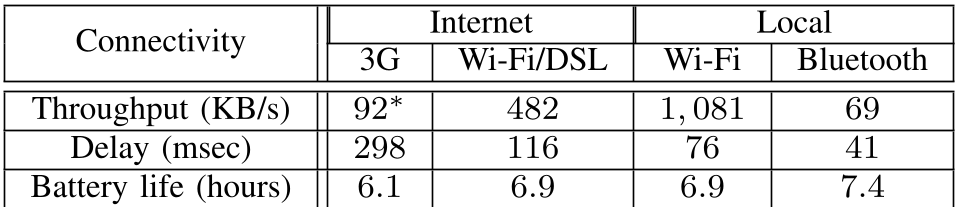 Fig 2: Comparative performance of different network interfaces. Note the massive latency drop and battery gain when using local connectivity.
Critical Insight & Conclusion
The genius of Reflex isn't just in using the cloud; it's in knowing when to leave the cloud. By treating local connectivity (Bluetooth/Wi-Fi) as a first-class citizen rather than a fallback, Reflex achieves the low latency required for professional-grade creative tools like MusicScore.
While the paper was written in an earlier era of mobile (iOS/GAE focus), its core philosophy—anonymous persistence and multi-modal networking—remains a blueprint for modern decentralized and "local-first" software movements.
Limitations
- The reliance on a JavaScript-based channel client within an Objective-C framework (at the time) introduced minor overhead.
- Privacy in anonymous profiles: While "spontaneous," the lack of hard identity creates potential for moderation challenges in a large-scale public app.
Reflex proves that the future of mobile socializing isn't just "liking" a post; it's the seamless, spontaneous creation of content, powered by a smart, invisible network layer.