
Socialized Mobile Photography: Turning Crowdsourced Data into Professional Insights
14398_Socialized Mobile Photography Learning to Photograph With Social Context via Mobile Devices.
This paper introduces "Socialized Mobile Photography," a system that assists amateur users in capturing high-quality photos by leveraging crowdsourced social media data and mobile context. By mining composition and exposure rules from community-contributed images (e.g., Flickr), the system suggests optimal view enclosures (composition) and camera parameters (Aperture, ISO, Exposure Time) for specific landmarks.
TL;DR
Even with high-end smartphone sensors, capturing a "professional" photo remains difficult for amateurs. This paper presents a system that uses the collective intelligence of millions of Flickr photos to tell you exactly how to frame your shot and which camera settings (ISO, Aperture, Shutter Speed) to use based on your location, time of day, and current weather.
The "One-Size-Fits-All" Rule Fallacy
Most photography apps rely on generic guides like the "Rule of Thirds." However, professional photography is deeply scene-dependent. A sunrise at the Golden Gate Bridge requires different exposure and framing than a foggy afternoon at the Eiffel Tower. Existing post-processing tools (like Photoshop) can't fix a badly composed or over-exposed image where data is fundamentally lost. The authors argue that the solution lies in social context—learning from the successes of others who have stood in your exact spot.
Methodology: The Logic of the Digital Mentor
The system operates in two distinct phases: Offline Learning and Online Suggestion.
1. Offline: Mining Professional Knowledge
The system doesn't just look at any photo; it clusters millions of social media images into Viewpoint Clusters.
- Viewpoint Clustering: Using SIFT features and GPS, it groups photos that share the same "iconic" perspective.
- Aesthetic Scoring: It filters these photos using social signals (views, favorites, interestingness) to identify what makes a "good" shot in that specific cluster.
- Metric Learning: For exposure, it learns how factors like weather (clear vs. foggy) and time (sunrise vs. noon) shift the ideal Aperture and ISO.
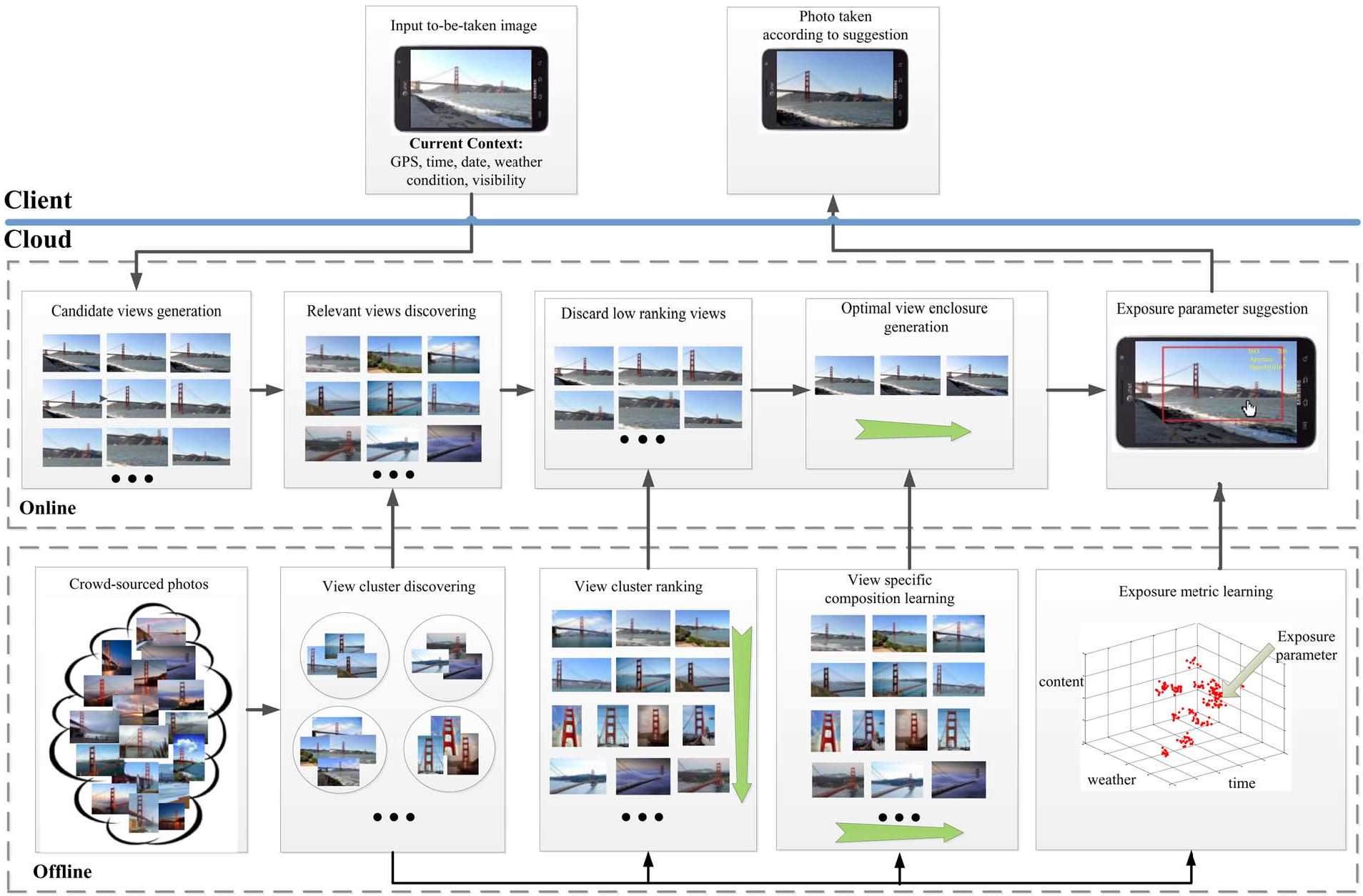
2. Online: Real-time Suggestion
When a user points their phone at a landmark, the system:
- Generates thousands of potential "crops" (view enclosures).
- Discards low-ranked clusters.
- Uses the learned View-Specific Composition Model to find the window with the highest aesthetic score.
- Adjusts the EXIF parameters (Aperture, ISO, ET) to ensure the shot isn't blurred or incorrectly exposed.

Experimental Proof: Better than the Original?
The authors tested the system on eight global hotspots, including the Taj Mahal and the Sydney Opera House.
- Composition: Professional and amateur photographers rated the "Suggested Views" higher than the user's original capture in nearly every category (focal length, object placement, and overall balance).
- Exposure: The system successfully reduced instances of "hand-jitter" blur by dynamically adjusting ISO when the predicted exposure time was too long—a common pitfall for amateur mobile users.

Critical Insight: The Future of the "Social Camera"
This research moves beyond simple image processing and into the realm of Knowledge Transfer. By treating the world's social media archive as a massive, labeled training set for professional behavior, your phone becomes more than a sensor; it becomes an apprentice to the world's best photographers.
Limitations & Future Work
The current system is limited to known "hot spots" where data is plentiful. The next frontier is Photography Knowledge Transfer—applying the "rules" learned at the Golden Gate Bridge to a similar bridge in a rural area where no social media data exists. Additionally, integrating 3D scene reconstruction could allow the system to suggest moves the user haven't even made yet (e.g., "Walk 10 feet to the left for a better angle").
Conclusion
Socialized Mobile Photography effectively bridges the gap between hardware capability and artistic skill. By grounding AI in the specific context of where and when a photo is taken, it provides a much more robust solution than general aesthetic models.