
Socialized Mobile Photography: Crowdsourcing the "Professional Eye"
6601_Socialized Mobile Photography Learning to Photograph With Social Context via Mobile Devices.
The paper introduces a Socialized Mobile Photography system that assists amateur users in capturing high-quality photos by suggesting optimal view enclosures (composition) and camera settings (aperture, ISO, exposure time). It leverages crowdsourced social media data (Flickr) and mobile context (GPS, time, weather) to mine scene-specific photography rules.
TL;DR
Capturing a professional-grade photo is no longer just about the hardware in your pocket; it’s about the "data" behind the lens. This paper presents a system that uses millions of crowdsourced images from Flickr to teach your phone how to frame a shot and set its exposure based on your specific location, time of day, and even the current weather.
The Problem: Why "Auto-Mode" Isn't Enough
Modern smartphones have incredible sensors, yet amateur photos often fall short of professional "masterpieces." Why? Because photography is a fundamentally context-dependent art.
- Compositional Complexity: Rules like the "Rule of Thirds" are often broken by pros for symmetry or tension. A fixed algorithm can't know which rule to apply to the Statue of Liberty vs. the Eiffel Tower.
- Unrecoverable Exposure: Post-processing (like Photoshop) can't fix a photo where the sky is "blown out" (over-exposed). The settings must be right at the moment the shutter clicks.
The Core Insight: Social Context as a Knowledge Base
The authors argue that the best photography teacher is the "crowd." By analyzing millions of photos of landmarks:
- Geo-location tells the system what you are looking at.
- Time and Weather act as proxies for lighting conditions.
- Social Metadata (likes, views, favorites) serves as a filter for what constitutes "high quality."
Methodology: The "Secret Sauce"
The system operates in a two-stage pipeline: Offline Learning and Online Suggestion.
1. View Cluster Discovering
Instead of assuming one rule fits all, the system clusters photos into specific "viewpoints." For example, at the Golden Gate Bridge, it identifies clusters for "close-ups of the pier" vs. "wide-angle panoramic views."
2. Metric Learning for Exposure
The system doesn't just guess settings; it uses Large Margin Nearest Neighbor (LMNN) metric learning. It transforms a feature space (made of time, month, and weather) so that photos taken in similar lighting conditions are grouped together, allowing it to predict the perfect Exposure Compensation (EC), Aperture, and ISO.
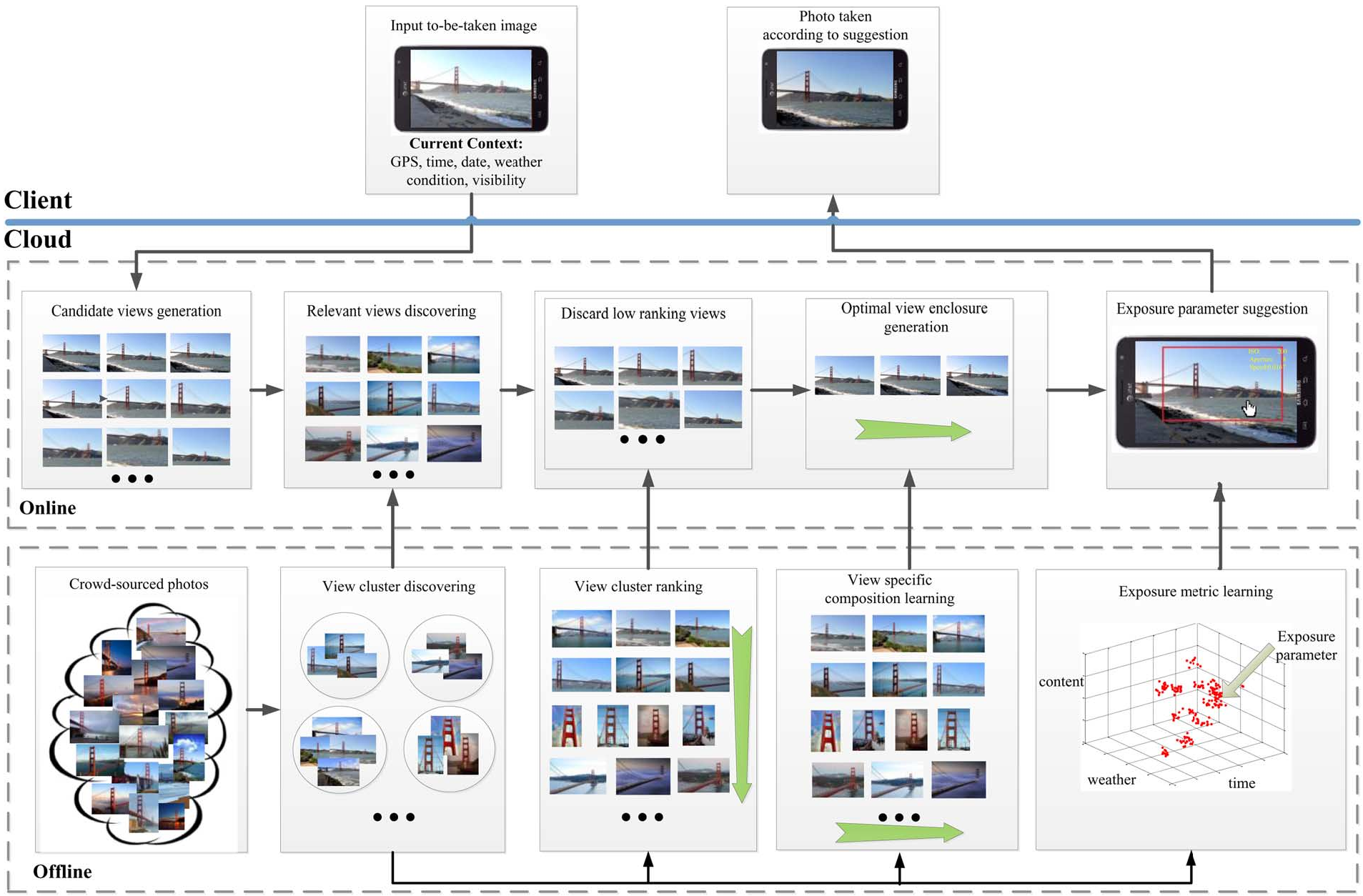 Figure: The framework of the proposed socialized mobile photography system.
Experiments & Real-World Performance
The researchers tested the system on 8 global landmarks (e.g., Taj Mahal, Sydney Opera House).
Key Findings:
- Objective Accuracy: The composition learning engine reduced prediction error significantly, outperforming general aesthetic models.
- Subjective Satisfaction: In a study involving 15 photographers, the suggested views were rated significantly higher in "focal length appeal" and "object placement" than the original user captures.
 Figure: Subjective evaluation examples showing input wide-views vs. the system's suggested framing.
Critical Insight & Future Outlook
The brilliance of this work lies in its Inductive Bias: it assumes that if a thousand people took great photos of a spot in the rain at 5 PM, the "average" of their best settings is likely the optimal setting for a new visitor.
Limitations:
- The current system relies on "hot spots" with high data density. Taking a photo in a remote, un-photographed area would render the "social" aspect useless.
- It is currently limited to the "view enclosure" of the user's initial shot.
The Future: Imagine this integrated into AR glasses, where a "ghost frame" of a professional's golden-hour shot is overlaid on your vision, guiding you exactly where to stand and when to press the button. This paper lays the mathematical and procedural foundation for that future.
Conclusion
Socialized Mobile Photography marks a shift from Computational Photography (fixing images with math) to Contextual Photography (capturing images with collective wisdom). It proves that your phone doesn't just need a better sensor; it needs a better "memory" of how the world has been successfully captured before.