
Socialized Policy Administration: Crowdsourcing Security Through Privacy-Preserving Friendship
Socialized policy administration
This paper introduces Socialized Policy Administration (SPA), a novel framework that leverages online social networks to help non-expert users configure complex mobile application permissions (privacy/security policies) through friend recommendations. The system ensures privacy by utilizing partially homomorphic encryption (specifically the Paillier cryptosystem) to aggregate friend configurations without exposing individual preferences.
Executive Summary
TL;DR: The "Socialized Policy Administration" (SPA) framework allows you to configure your Android app permissions by asking your "tech-expert" friends for their settings—without them ever having to reveal their private choices to you or a central server.
In the complex ecosystem of mobile security, users are often the weakest link. Most users click "Allow" on every permission request simply because they don't understand the risks. This paper marks a significant shift in policy-based management by moving from centralized authority to a decentralized, socialized model. It bridges the gap between expert knowledge and novice needs by using Partially Homomorphic Encryption to turn social networks into secure engines for security recommendations.
The Motivation: The "Clueless User" Paradox
Managing permissions is hard. Even programmers struggle to distinguish between a "legitimate" and a "malicious" permission request in a third-party app. While the common practice is to ask a "tech-savvy" friend for help, doing so digitally creates a privacy nightmare:
- Contextual Privacy: If I share my settings with you, you know my preferences.
- Trust Deficit: How do we prevent a "semi-trusted" cloud server from seeing everyone's configurations?
- Expertise Weighting: Not all friends are equally knowledgeable. A "CS major" friend’s settings should carry more weight than an "elderly relative's."
Methodology: Privacy-Preserving Social Aggregation
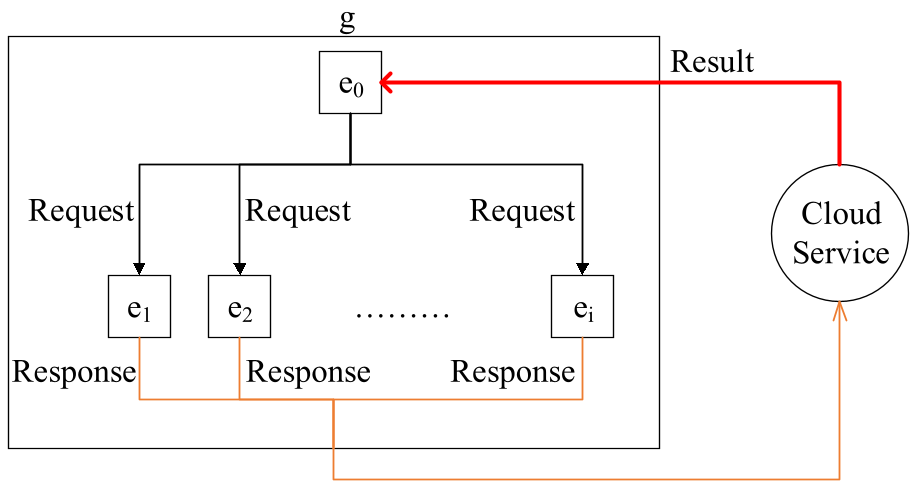
The authors propose the Composite SPA model. Unlike basic models that treat all votes as equal, Composite SPA allows a requester to assign a "weight" to each friend.
The Core Mechanism: Paillier Encryption
To solve the privacy-performance trade-off, the authors use Paillier encryption, an additive homomorphic system. This allows the cloud server to perform math on encrypted data:
- Summing Votes: The server adds up the encrypted responses without knowing if a user chose "On" or "Off."
- Weighted Average: The server can multiply a plaintext weight by an encrypted setting value.
The Majority/Minority Logic
How do you determine the "majority" setting if everything is encrypted? The authors developed a comparison algorithm that computes the difference between encrypted options (e.g., Option A vs. Option B), multiplies it by a random positive number to mask the exact difference, and allows the requester to decrypt only the sign of the result. This reveals which option was more popular without revealing exactly how many people voted for it.
Experiments & SOTA Results
The researchers built a prototype on Telegram, an encrypted messaging app. This is a critical "in-the-wild" test rather than a mere simulation.
Server and Client Efficiency
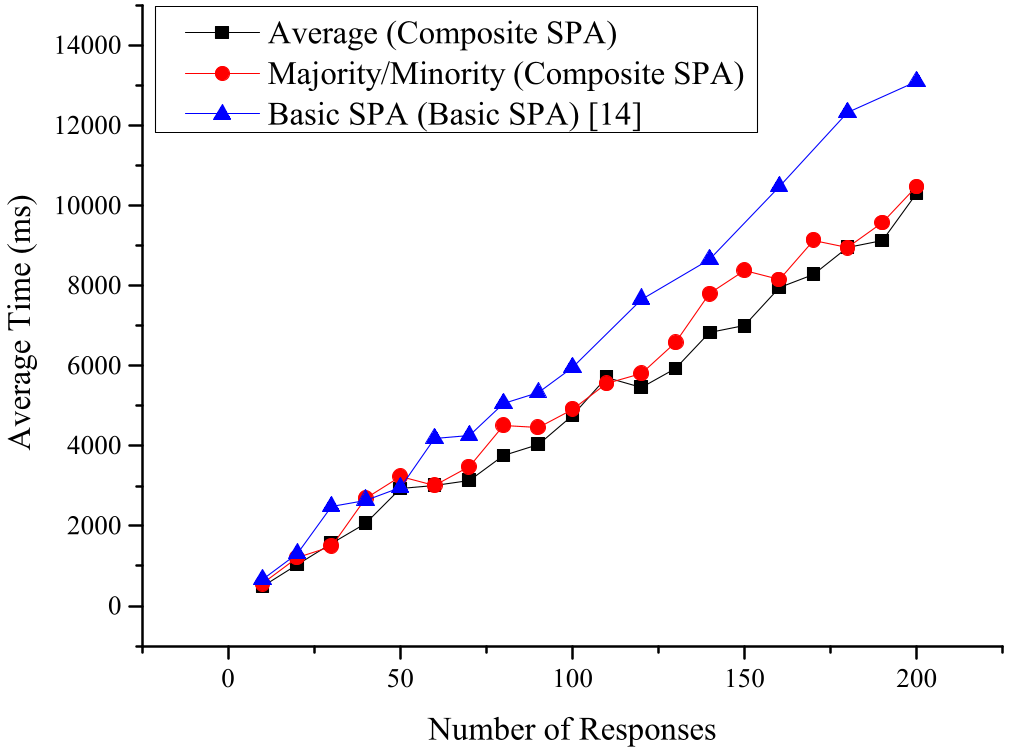
The evaluation shows that the system is highly scalable. The time taken to merge responses increases linearly, which is ideal for large social groups.
Key Performance Metrics:
- CPU Usage: Stayed below 11% on a Google Nexus 4, ensuring that the background encryption doesn't drain the battery or lag the phone.
- Latency: While Majority/Minority policies are slower than simple averages, the asynchronous nature of the requests means the user experience remains smooth.
Critical Analysis & Conclusion
The "Social" Vulnerability
The paper honestly addresses a significant limitation: the "Sybil Attack" variant. If a requester sends a request to one real friend and two "fake" accounts they control, they can mathematically "solve" the friend's private settings. The system mitigates this by enforcing a minimum respondent threshold (e.g., at least 3 friends), but users must still be wary of collusion.
Final Takeaway
SPA represents a sophisticated application of applied cryptography to a human-centric problem. It acknowledges that security is often a social effort. By offloading the complexity of Paillier encryption to the background, it allows users to simply say, "I'll trust my friends' judgment," while mathematically guaranteeing that that trust doesn't lead to a data breach. For future mobile OS designs, this "Socialized" approach could be the key to making privacy accessible to the masses.