
SSRM: Why Realistic Human Mobility is the Secret Sauce for Cooperation
Promotion of cooperation in public goods game by Socialized Speed-Restricted movement
This paper introduces the Socialized Speed-Restricted Mobility (SSRM) model to study cooperation in mobile social networks using Evolutionary Game Theory (EGT). By formulating interactions as a Public Goods Game (PGG), the authors demonstrate that realistic movement patterns, characterized by degree heterogeneity and reduced neighborhood randomness, significantly promote the emergence of cooperation.
In the digital wilderness of mobile ad-hoc networks, "selfishness" is the default setting. Whether it's conserving battery or saving bandwidth, users naturally drift toward defection—reaping the benefits of the network while contributing nothing. This "tragedy of the commons" has long plagued researchers. While credit-based systems and reputation scores exist, they are costly to implement.
This paper, "Promotion of Cooperation in Public Goods Game by Socialized Speed-Restricted Movement", takes a different path. It asks: What if the way we move naturally encourages us to cooperate?
TL;DR
By replacing simplistic "random walk" models with a Socialized Speed-Restricted Mobility (SSRM) model, the authors prove that realistic human movement patterns—staying near "home" and having diverse travel ranges—actually protect and promote cooperation in mobile networks.
The Flaw in Previous Models: The "Invader" Problem
Traditional Evolutionary Game Theory (EGT) studies on mobility often concluded that movement kills cooperation. Why? Because in those models, users move like gas molecules—randomly and at high speeds. This allows "defectors" to constantly encounter new groups, exploit them, and move on before the "cooperators" can form stable, protective clusters.
Methodology: Bringing "Home" to the Network
The authors argue that real human motion isn't random. We have "home locations" and specific radii of gyration. They modeled this using the SSRM framework:
- Home-Centric Movement: Each user moves within a circular area centered at an initial home position.
- Social Heterogeneity: The size of these areas isn't uniform. Some users are "hubs" (large range), while most are "local" (small range), following Exponential or Pareto distributions.
- The Memory Effect (): Unlike previous models that updated strategies every step, SSRM introduces a Neighbor Collection Process. Users explore their neighborhood for steps, building a stable "view" of their social circle before playing the Public Goods Game (PGG).
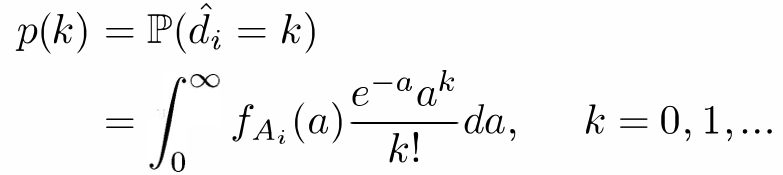
How Heterogeneity Saves the Day
The paper reveals a fascinating transition. When (simultaneous movement and strategy update), the network looks like a chaotic soup where cooperation struggles. But as increases, two things happen:
- Reduced Randomness: Neighbors become more predictable. The stability metric increases, meaning you interact with the same people more often.
- The Hub Effect: "Hubs" (users with larger ranges) naturally accumulate more neighbors. In the evolution of strategy, these hubs tend to become permanent cooperators. These "Cooperator Hubs" then act as anchors, drawing their neighbors into cooperative strategies and creating a robust community that defectors cannot penetrate.
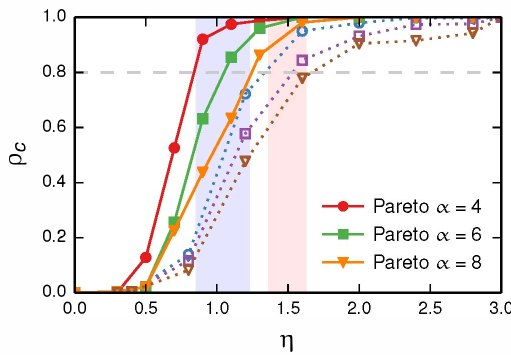
Key Performance Benchmarks
- Degree Distribution: The model successfully mirrors real-world social networks, producing Power-Law tails (Pareto) and Exponential tails.
- Cooperation Rate (): In heterogeneous networks with high , cooperation reaches SOTA levels () even when the reward factor is close to 1. In contrast, homogeneous random movement models often require to be significantly higher to survive.
Critical Insight: The "Social" in Social Networks
The genius of this paper lies in the realization that mobility is not just physical—it is structural. By restricting movement to centers of interest ("homes"), we inject Inductive Bias into the network topology. This bias favors the formation of stable clusters, which is the fundamental requirement for reciprocity to evolve.
Conclusion & Future Work
The SSRM model provides a much-needed bridge between realistic mobility modeling and evolutionary game theory. It proves that the "cooperation-killing" nature of mobility found in earlier studies was an artifact of oversimplified motion models.
The next frontier? Applying this EGT framework to specific protocols like Cooperative Caching or Crowdsourcing, where the "Public Goods" are actual data packets and bandwidth.