
Socialized WBANs: Bridging Body Sensors and Social Dynamics for Epidemic Control
8130_Socialized WBANs in mobile sensing environments.
This paper introduces "Socialized WBANs" (s-WBANs), a novel framework that integrates Wireless Body Area Networks with mobile social network data. It features a biometrics-based key agreement scheme and a "critical network" model for epidemic control, achieving significantly lower infection rates compared to random quarantine methods.
TL;DR
The paper proposes Socialized Wireless Body Area Networks (s-WBANs), a paradigm shift that connects individual health sensors with the social context provided by smartphones. By fusing vital signs with social interaction data, the authors develop a "Critical Network" model that identifies high-risk individuals during disease outbreaks, proving far more effective than traditional random quarantine strategies.
Background & Motivation: Moving Beyond Isolated Sensors
Conventional Wireless Body Area Networks (WBANs) are designed to monitor an individual's physiology in a vacuum. However, humans are inherently social. In a mobile sensing environment, the proximity of others and the frequency of interactions significantly impact both the technical performance of a network (data relaying, interference) and its clinical utility (epidemic tracking).
The authors argue that existing protocols ignore the social structure, leading to:
- Inefficiency: Missing opportunities for cooperative data transmission between socially connected devices.
- Security Risks: Traditional key exchange is too heavy for tiny sensors.
- Functional Gaps: An inability to use personal health data for broader public health interventions like SARS or H1N1 control.
Methodology: The s-WBAN Framework
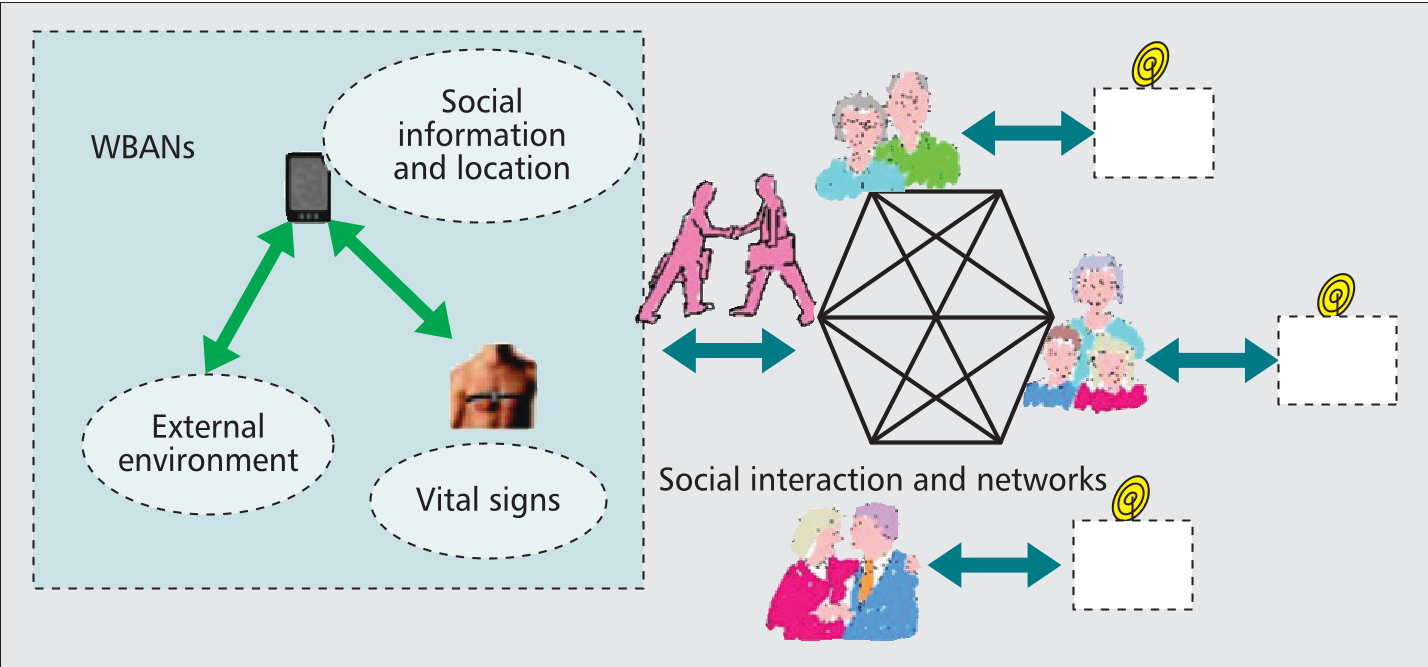
The core of the s-WBAN is the fusion of vital signs and social interaction sensing.
1. Two-Tier Social Sensing
To accurately map social interactions, the system uses a hierarchy:
- Tier 1 (Bluetooth): Initial detection of nearby users to establish potential social contacts.
- Tier 2 (Acoustic Sensors): High-precision distance measurement to verify "physical contact" levels necessary for disease transmission modeling.
2. The Critical Network & Information Fusion
The researchers introduced a mathematical construct called the Critical Network, represented as a colored weighted graph .
- Nodes (): Individuals with health states (Normal, Abnormal, Recovered).
- Arcs (): Social interactions, with weights representing the probability of infection or influence.
- Snapshots: Time-stamped planes that track how the network evolves over time.
3. Biometric Security via IJS
Privacy is handled through the Improved Jules Sudan (IJS) algorithm. Instead of distributing static keys, the system uses Inter Pulse Interval (IPI) or cardiac rhythms of the user to generate biokeys. This allows sensors on the same body to recognize each other securely without a pre-shared secret, reducing communication overhead compared to the "Fuzzy Vault" approach.
Experiments: Fighting Epidemics with Data
The most compelling application of s-WBANs is Epidemic Control. The authors simulated disease spread across three network topologies: Power Law, Small World, and Random Graph.
Key Result: Identification of Critical Nodes
By using the information fusion from s-WBANs, the system identifies "Critical Nodes"—individuals who act as super-spreaders due to high social activity or health vulnerability.
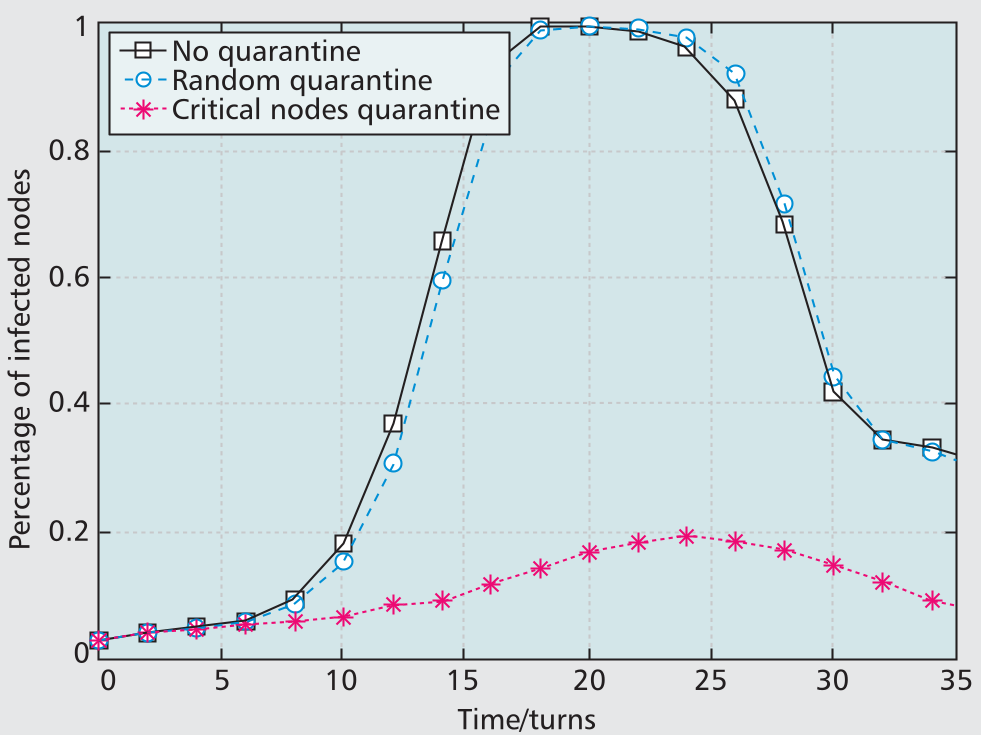
- Finding: Quarantining even a small number of these "critical nodes" leads to a much faster reduction in the infection curve compared to a random quarantine strategy.
- Visualization: As shown in Fig. 3, the s-WBAN-driven intervention (Critical Node ID) keeps the total number of infected nodes significantly lower over the same time horizon.
Critical Analysis & Conclusion
This paper serves as a bridge between two worlds: low-level sensor networking and high-level social network analysis.
Strengths:
- Resource Efficiency: Using biometric features for security is a clever workaround for the "key distribution" problem in lightweight sensors.
- Practicality: Using the smartphone as a gateway (Tier-1 control) leverages existing hardware for complex social sensing.
Limitations:
- Data Unavailability: The model assumes a high density of WBAN deployment, which may not be feasible in all urban environments.
- Privacy Ethics: While the paper discusses security, the centralized collection of "who you were with and for how long" alongside vital signs raises significant ethical questions regarding mass surveillance.
Future Outlook: As we move toward a "Social Internet of Things" (SIoT), the principles of s-WBANs could be extended to smart cities, where environmental sensors and wearable devices collaborate to predict health trends in real-time.