
Beyond the AI Loop: Why Socializing is the Antidote to Mobile Game Boredom
Socializing in mobile gaming
This paper explores the integration of social elements into mobile gaming to enhance user experience and extend game life cycles. It presents empirical research on Malaysian and Thai youth behaviors and showcases two conceptual mobile games, "Mostro" and "Buzzy," designed to facilitate teamwork, competition, and communication.
TL;DR
Mobile games often die a quick death due to repetitiveness. This research argues that the secret to longevity isn't better graphics, but Socializing. By analyzing youth gamers in Malaysia and Thailand, the authors propose a shift from solo AI-driven play to community-based designs that prioritize human connection, competition, and peer recommendation.
The "Burnout" Problem in Mobile Gaming
In 2008, the mobile gaming landscape was dominated by single-player titles. While games like Snake or simple puzzle apps were successful initial attractions, they faced a fatal flaw: the Boredom Threshold. Once a player masters the game's mechanics or finishes the levels, the app is deleted.
The authors' research identifies that while PC gamers spend hours immersed in Massively Multiplayer Online Games (MMOGs) due to the social fabric—guilds, chats, and rivalries—mobile gamers were left in a vacuum. The challenge was: how do we bring that "Hardcore" social stickiness to the "Casual" mobile platform?
Methodology: From Insight to Interface
The research team conducted in-depth interviews with youth in Bangkok and Kuala Lumpur. They discovered that "gaming" was rarely about the software itself; it was a tool for bonding.
The Four Pillars of Social Gaming
- Teamwork: Moving beyond solo play to group coordination.
- Competition: The drive to beat a brother’s high score or gain public recognition.
- Communication: Using the game as a conversation starter or a reason to "hang out."
- Recommendation: The power of peer pressure; people start and stop games as a group.
To test these theories, the team developed two core concepts: Mostro and Buzzy.
Case Study 1: Mostro (The Social Virtual Pet)
Mostro isn't just a pet simulator; it’s a "humanized" pet society. Players don't just feed their pets—they send them to school, choose professions (like a Chef or Doctor), and "Mingle" in virtual forums.
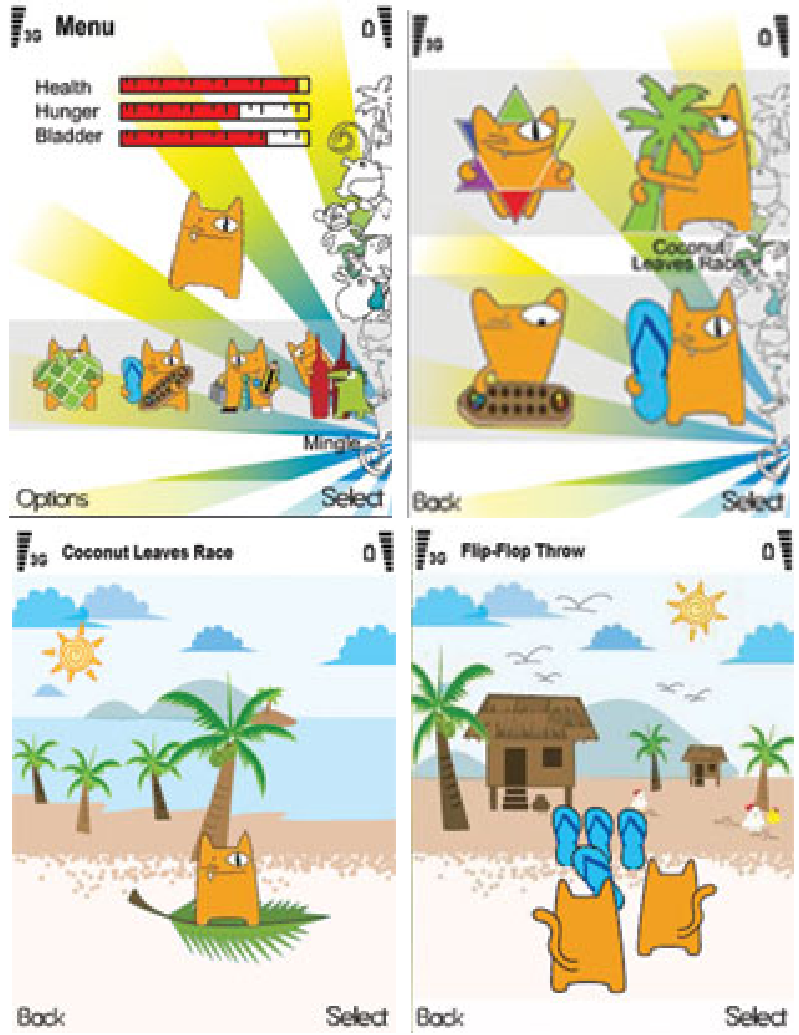 Figure: The Mostro interface integrates social M-blogs and buddy lists directly into the pet management loop.
Case Study 2: Buzzy (The Bee Civilization)
Buzzy takes socializing further by introducing Colonies. It mimics the complexity of PC MMOGs by allowing players to create bee cities, trade weapons (potions/honey), and even bail friends out of a "virtual jail."
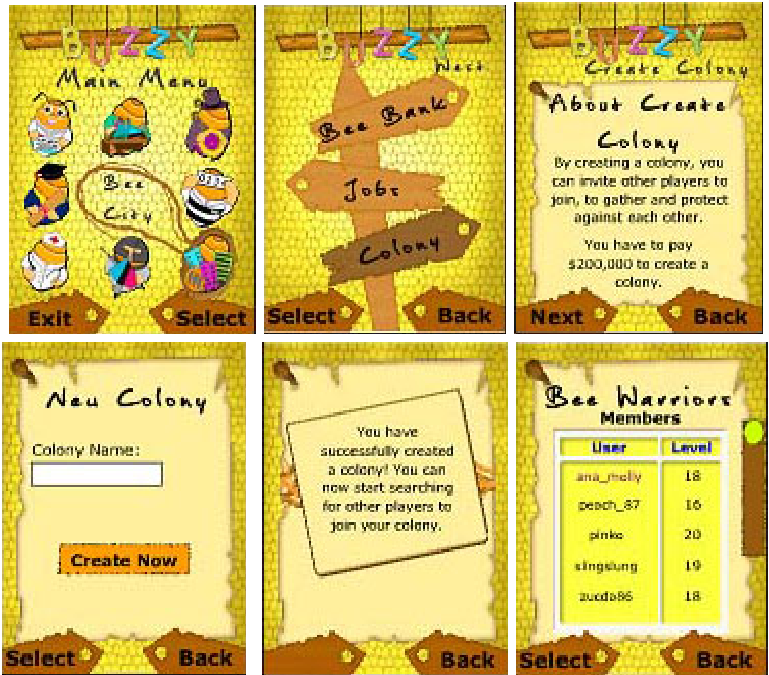 Figure: Buzzy emphasizes community recruitment through integrated SMS/Email invites, turning recommendation into a core game mechanic.
Critical Results: Human vs. AI
The user evaluations yielded a fascinating insight: players found even simple traditional games (like Chinese Checkers or a sandal-throwing game) significantly more engaging when played against a "real" person rather than a sophisticated AI.
Key Findings:
- Self-Identity: Players use virtual characters to project their own status and preferences.
- The Recognition Loop: Public scoreboards aren't just for ego; they provide the "pressure" needed to stay active in the game community.
- The Connectivity Barrier: In 2008, high data pricing and latency were the biggest hurdles to this vision—a problem largely solved by today's 5G and LTE networks.
Summary & Future Outlook
This paper was a precursor to the modern mobile era of Clash of Clans or Roblox. It correctly predicted that the value of a mobile game is determined by the social network it facilitates.
Takeaway: If you are building a mobile product today, don't ask "how fun is the gameplay?" Ask "how does this game help the user talk to their friends?" Socializing isn't just a feature; it is the infrastructure of retention.
Limitations: The study's focus on Malaysian and Thai youth provides great regional insight but may not account for cultural differences in social interaction in Western or European markets. Furthermore, the conceptual nature of the student projects means technical implementation (battery drain, server load) remained untested.