
Bandit: Enhancing Elderly Exercise Through Socially Assistive Robotics
Using Socially Assistive Human-Robot Interaction to Motivate Physical Exercise for Older Adults A robot designed to engage elderly users in physical exercise is described in this paper; a user study indicates a strong user preference for a relational robot
This paper introduces a Socially Assistive Robot (SAR) system named "Bandit," designed to motivate elderly users to perform seated physical exercises. The researchers developed a humanoid platform that uses praise, relational discourse, and interactive games to enhance intrinsic motivation, achieving High User Ratings and significant engagement in clinical user studies.
TL;DR
Researchers at USC developed "Bandit," a humanoid robot that serves as a physical exercise coach for the elderly. By implementing "Relational Discourse"—using names, humor, and praise—the robot significantly boosted user enjoyment and motivation compared to a purely functional, instruction-only coach. This work proves that the "personality" of a medical robot is a key factor in rehabilitation success.
Background: The Healthcare Gap
As the global population ages, the demand for physical therapy outstrips the supply of nurses. While exercise is vital for preventing cognitive decline and muscle atrophy, the primary hurdle is adherence. Doing "chair aerobics" alone is boring; doing it with a robot that remembers your name and tells jokes is a game-changer.
Motivation: Why "Social" Assistance?
The authors argue that robots shouldn't just be tools; they should be "Socially Assistive." Unlike previous systems that were either remote-controlled (like TAIZO) or purely functional (like robotic walkers), this system aims to influence Intrinsic Motivation. The insight here is that humans are more likely to finish a task if they feel a sense of "Flow" and "Relation" with the instructor.
Methodology: The Architecture of Motivation
The system utilizes the Bandit platform, a torso with 19 degrees of freedom (DOF) capable of expressive facial movements (eyebrows/mouth) and arm gestures.
1. Relational Discourse
The robot doesn't just say "Move your arm." It uses:
- Praise: "Fantastic job, Mary!"
- Continuity: "I remember you did great on the Memory game last time."
- Empathy: Reassuring the user if they miss a gesture.
2. The Exercise Games
Three modes keep the user engaged:
- Workout: Traditional instructor-led imitation.
- Imitation: The user leads, and the robot follows (empowerment).
- Memory: A cognitively challenging game where the user repeats growing sequences of gestures.
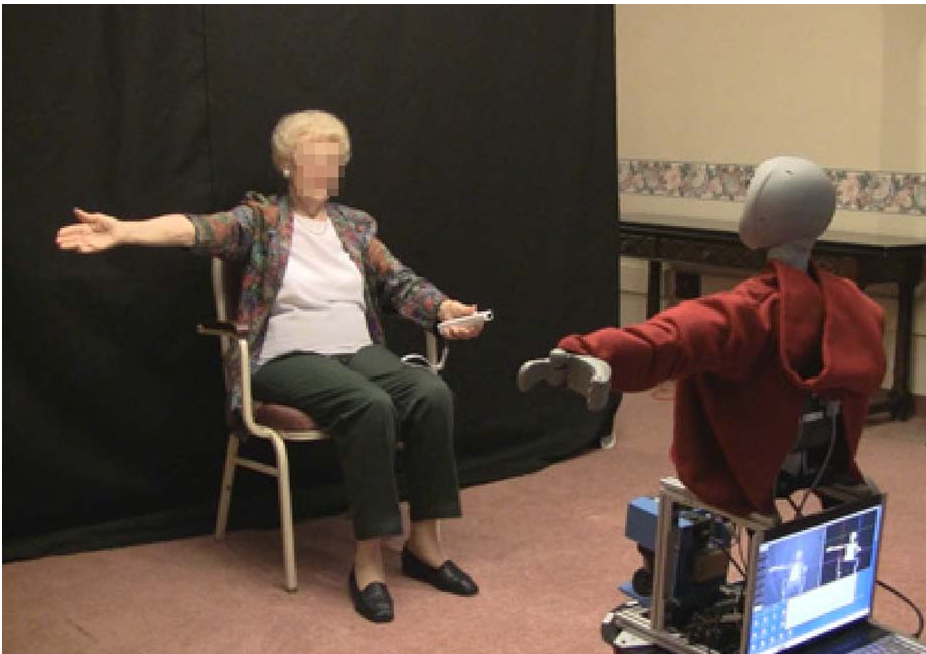 Fig 1: The setup displays the 1-on-1 interaction between the seated user and the Bandit robot.
3. Visual Perception
To ensure the robot can "see" errors, a vision module segments the user's silhouette against a black curtain (necessary given the 2012-era technology) to track hand and elbow angles in real-time.
Experiments & Results: Personality Wins
The researchers conducted two major studies.
Study I: Relational vs. Non-Relational
The "Relational" robot used social bonding; the "Non-Relational" robot was purely instructional. The results were overwhelming:
- Enjoyment: 85% of users preferred the Relational robot.
- Motivation: 85% found the Relational robot more effective at keeping them active.
- Performance: Interestingly, objective performance (speed/accuracy) was similar in both, but the subjective experience—which drives long-term habits—was much higher for the Relational bot.
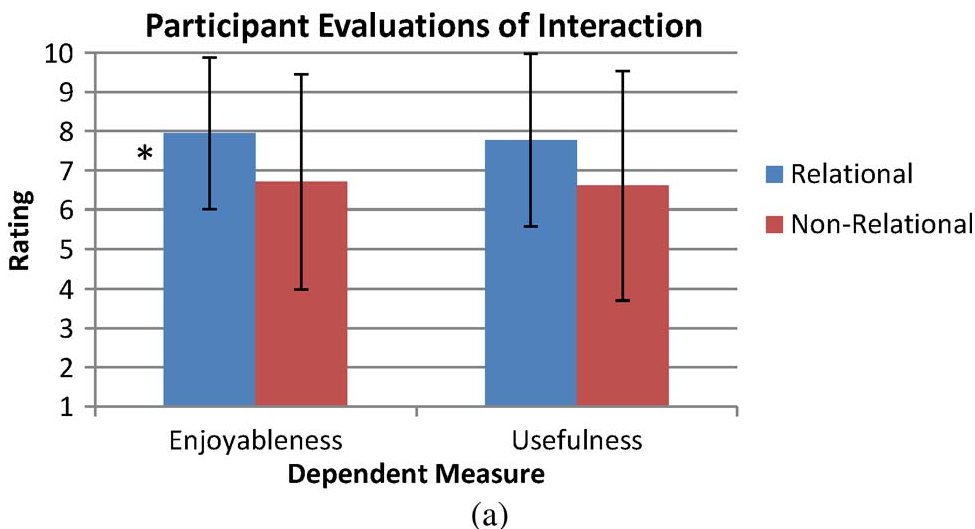 Fig 2: Comparative ratings showing the Relational condition scoring higher in enjoyment and perceived coach quality.
Study II: The Paradox of Choice
The second study tested "Self-Determination" by allowing users to choose the games. While 92% enjoyed having a choice, some users actually preferred the robot to take charge, viewing it as the "expert instructor." This highlights a critical need for personalized autonomy parameters.
Critical Insight: The Future of Care
This paper's core contribution is the validation of social interaction as a therapeutic tool. It moves beyond "Can a robot move?" to "Can a robot care?"
Limitations
The system relied on a black curtain for vision—a limitation the authors noted would be solved by depth sensors (like Kinect). Furthermore, the long-term "novelty effect" remains a question: would users stay as motivated after six months of interaction?
Conclusion
The study proves that Socially Assistive Robotics is not just about entertainment; it’s about creating a robust, autonomous partner for healthy aging. By leveraging psychology and HRI, we can build systems that don't just help the elderly live longer, but live better.