
Socially-Aware D2D Pairing: Enhancing Network Utility through Human Connection
Socially-Aware D2D Pair Strategy: A Stable Matching Approach
This paper proposes a social-aware Device-to-Device (D2D) pairing strategy that utilizes a stable matching approach to optimize spectrum resource allocation. By employing the Gale-Shapley (GS) algorithm, it maximizes the sum rate of D2D pairs weighted by social trust levels while significantly improving user satisfaction through a one-to-one matching model.
TL;DR
The future of 5G/6G isn't just about faster hardware; it's about understanding the "social layer" of the users holding the devices. This paper introduces a Stable Matching Approach that uses the Gale-Shapley algorithm to pair D2D users based on their social trust. By weighting the transmission rate with social intimacy, the authors achieve a dual win: higher aggregate throughput and significantly improved user satisfaction.
The Human Factor in Wireless Networks
Most traditional D2D (Device-to-Device) communication research treats mobile devices as cold, objective nodes. However, in reality, users are "selfish." A student is much more likely to share their spectrum or data with a lab-mate (high trust) than with a total stranger (low trust).
The technical challenge is two-fold:
- NP-Hard Complexity: Jointly optimizing user pairing and spectrum allocation involves discrete variables and nonlinear objectives, making it a computational nightmare.
- Social Ignorance: Existing algorithms might pair two nodes that are physically close but socially distant, leading to poor user cooperation and potential security risks.
Methodology: Bridging the Social and Physical Gap
1. Modeling Social Tie Strengths
The authors use a Small-World Network model to simulate real-world social trajectories. They represent user relationships in an adjacency matrix and calculate an "Interest Similarity" score using the following formula:
This eigenvector-based similarity serves as the foundation for the "trust ranking" each user maintains.
2. The Gale-Shapley Stable Matching
To solve the NP-hard pairing problem, the paper adopts the Gale-Shapley (GS) algorithm. Instead of a centralized optimizer, each D2D transmitter (TX) "proposes" to its most trusted receiver (RX).
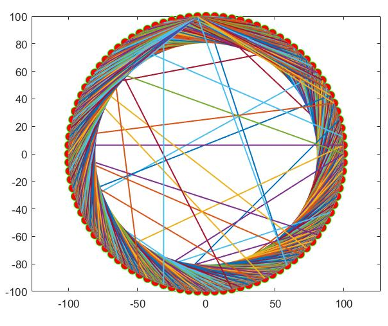
- Propose: TXs send requests to their top-ranked RX based on social trust.
- Deferred Acceptance: RXs temporary hold the best offer and reject others.
- Stability: The process iterates until no TX can find a better partner who would also prefer them, ensuring a stable matching where no two nodes have an incentive to "cheat" and pair with others.
Experimental Validation
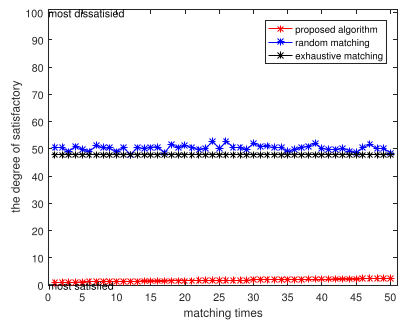
The paper evaluates the algorithm against two baselines: Random Matching and Exhaustive Matching (which only considers physical distance).
User Satisfaction
As seen in the results, the GS algorithm ensures that users are matched with partners high on their social preference list. The average "satisfaction rank" remains consistently low (where lower is better), meaning users are generally paired with their most trusted contacts.
Sum Rate Performance
Interestingly, by focusing on social ties, the total network rate does not suffer; in fact, it improves. As the number of users grows, the "Socially-Aware GS" algorithm scales effectively, outperforming random allocation significantly.

Critical Insight & Conclusion
This work highlights a critical shift in networking: Social-Awareness as a Performance Metric. By transforming a hard optimization problem into a matching game, the authors achieve:
- Low Complexity: vs. exponential search.
- Incentive Compatibility: Users are more willing to share resources with those they trust.
Limitations: The current model assumes one-to-one matching. In dense urban environments or stadium scenarios, one-to-many or many-to-many matching (multicast) would be a necessary evolution to handle the sheer volume of concurrent content requests.
Future Outlook: Integrating these social metrics into MARL (Multi-Agent Reinforcement Learning) could allow networks to dynamically adapt to shifting social ties in real-time.