
S-CLONE: Reimagining Social Network Storage through Socially-Aware Replication
S-CLONE: Socially-aware data replication for social networks
This paper introduces S-CLONE, a socially-aware data replication scheme designed for Online Social Networks (OSNs). By optimizing replica placement based on social graph locality, S-CLONE significantly reduces average read costs while maintaining balanced server loads and equal data availability for all users.
TL;DR
Online Social Networks (OSNs) are essentially high-frequency distributed databases. Current systems like Facebook's Cassandra use random hashing to distribute data, which destroys "Social Locality"—the tendency of users to access their friends' data. S-CLONE fixes this by strategically placing data replicas on the same servers where a user's friends are already located, slashing read latency by up to 80% while maintaining a strict storage budget.
The Problem: The "Scatter-Gather" Tax
When you open an OSN app, the system fetches updates from dozens of friends. In a standard DHT (Distributed Hash Table) setup, these friends' data are scattered randomly across a cluster of hundreds of servers. This results in a "Scatter-Gather" problem: a single user request triggers a cascade of internal network I/O across the data center.
Prior attempts to solve this faced a "Tale of Two Extremes":
- Perfect Locality: Co-locate everyone with their friends, leading to "hot" servers and exploding storage costs.
- Random Replication: Evenly distributed but stays "blind" to social connections, requiring massive replication (K) to accidentally hit locality.
Methodology: The Logic of S-CLONE
The core intuition of S-CLONE is simple yet powerful: Place a user's replica where most of their neighbors' primary data lives.
1. The Location Histogram
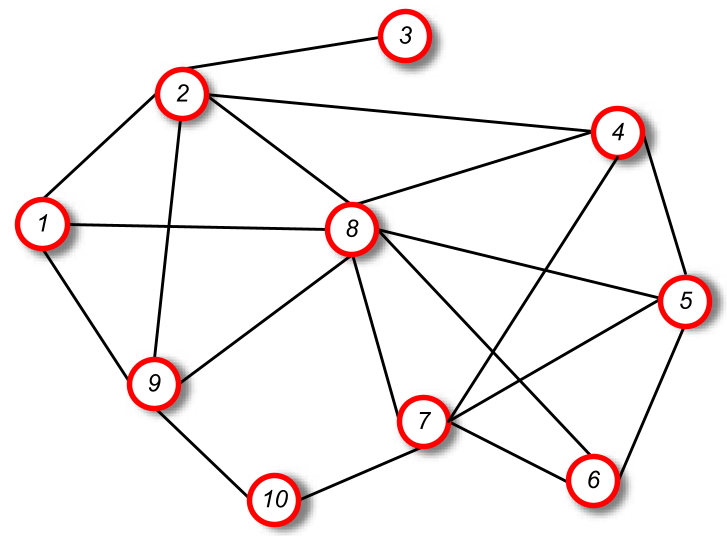
For each user , the system calculates a histogram representing how many of 's neighbors are primarily stored on server . S-CLONE picks the top servers from this histogram to host replicas of user .
2. The Adjust Phase (Load Balancing)
For users with very few friends (typical in power-law distributions), there aren't enough "high-value" servers. In these cases, S-CLONE falls back to a load-balancing mode, placing replicas on the servers with the lowest current storage occupancy. This prevents the "socially popular" servers from being overwhelmed.
Performance: Efficiency Meets Equilibrium
The researchers tested S-CLONE against Facebook regional datasets and synthetic Barabasi-Albert graphs.
Read Cost Reduction
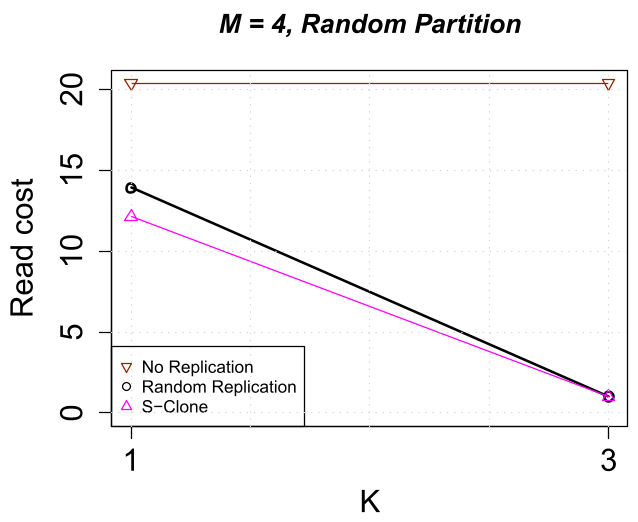
As shown in the charts below, S-CLONE dominates random replication. In an environment with 128 servers, S-CLONE reduces the read cost from ~25 servers down to nearly 1 server (perfect locality) with significantly fewer replicas than random approaches.
Handling Dynamics
Social networks are not static; links are added and users leave daily. S-CLONE's dynamic migration mechanism ensures that as the graph evolves, replicas are migrated to maintain locality. Surprisingly, the migration cost per event is remarkably low (less than 3.2 replicas moved per event in a 32-server cluster).
Critical Insight: Why This Matters
The brilliance of S-CLONE lies in its Inductive Bias. It recognizes that data in social networks isn't independent and identically distributed (i.i.d.). By treating the social graph as a structural map for the physical hardware, S-CLONE bridges the gap between graph theory and systems engineering.
Limitations & Future Work
While S-CLONE is highly effective, it assumes an undirected graph for simplicity. In platforms like Twitter (Follower/Following), the asymmetry might require more complex histogram weights. Furthermore, future iterations could look at Heterogeneous Query Rates—treating "Influencers" differently than passive observers.
Conclusion
S-CLONE proves that you don't need an infinite budget to achieve ultra-low latency in social networks. By being "socially aware," storage systems can work with the natural flow of human interaction rather than against it.