
Socially Aware Edge Collaboration: Revolutionizing Video Distribution via SVC and D2D
Socially Aware Energy-Efficient Mobile Edge Collaboration for Video Distribution
This paper proposes a Socially Aware Energy-Efficient Mobile Edge Collaboration (SA-MEC) framework for video distribution, utilizing Scalable Video Coding (SVC) and D2D communications. It achieves significant base station offloading and energy efficiency by grouping users into virtual communities and collaborative clusters based on social interests and physical proximity.
TL;DR
The explosion of mobile video traffic has pushed cellular base stations to their limits. This paper introduces a Socially Aware Energy-Efficient Mobile Edge Collaboration framework that leverages Device-to-Device (D2D) links and Scalable Video Coding (SVC) to offload BS traffic by up to 92%. By grouping users into "Virtual Communities" based on interests and "Collaborative Clusters" based on location, the system treats edge users as active distributors rather than passive consumers.
Problem & Motivation: The Redundancy Trap
Despite the high popularity of specific videos (often following a Zipf distribution), standard cellular architectures repeatedly transmit the same content to individual users. This creates a massive waste of spectrum and energy.
While D2D communication offers a solution, it faces a "Willingness Paradox": Why would a user consume their own battery to help a neighbor? Previous works often assumed universal cooperation or ignored social interests. The authors argue that effective collaboration must account for:
- Social Stability: Long-term interests are more reliable than transient locations.
- Energy Fairness: Transmission strategies must adapt to the residual energy of user devices.
- Service Elasticity: Video bitrates must be flexible to accommodate fluctuating channel conditions.
Methodology: The Two-Step Collaboration Architecture
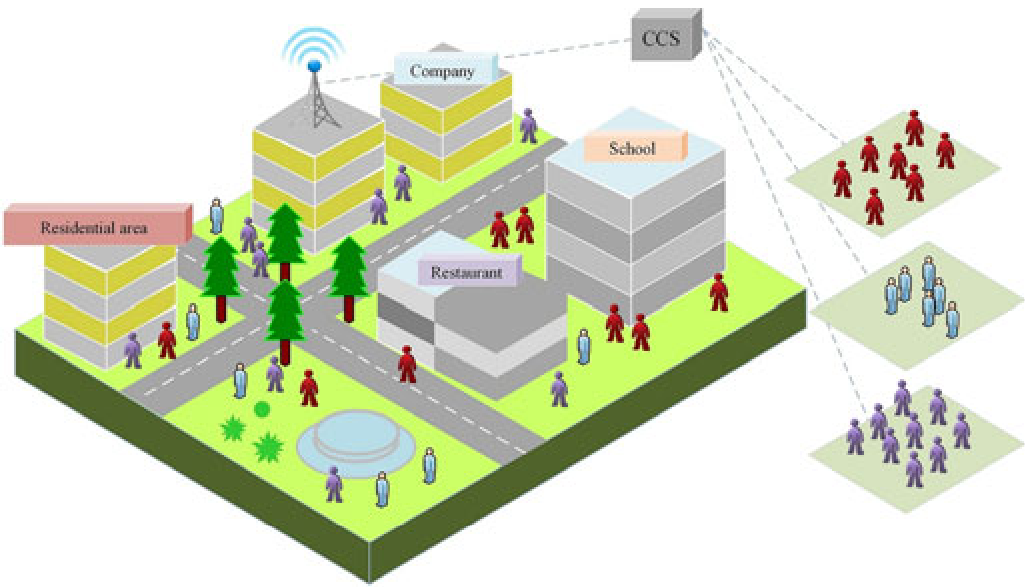
1. Virtual Community & Cluster Formation
The paper employs a decentralized logic for node relationship analysis. First, it uses a Coalition Game based on the Jaccard coefficient to group users into virtual communities based on content preferences. Second, it uses a Grid-based Clustering method to handle physical proximity, ensuring that D2D links are only established between users within a sustainable communication range.
2. Multi-Layer Video Sharing (SVC)
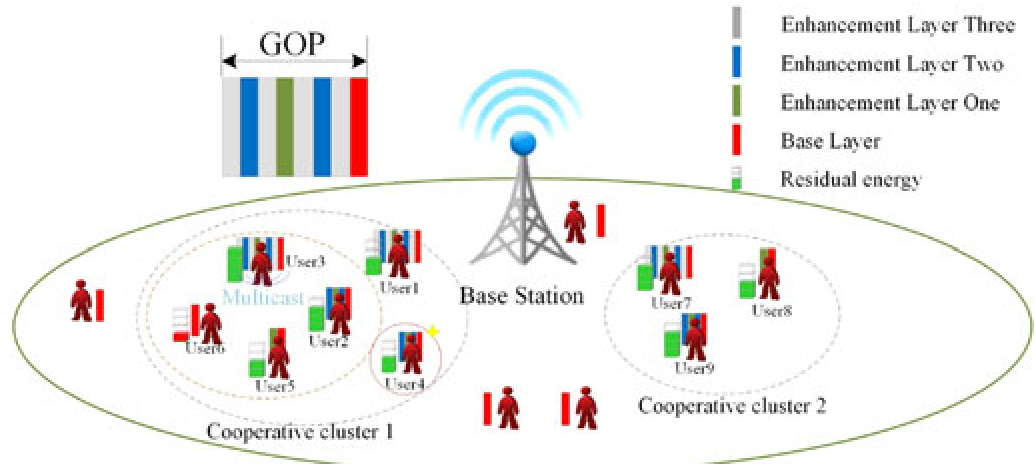
Instead of a "one-size-fits-all" file, the video is encoded into a Base Layer (BL) and multiple Enhancement Layers (EL).
- Phase 1 (BS to Clusters): The BS multicasts the BL to all users at the lowest robust rate to ensure basic service. It then multicasts ELs to collaborative clusters.
- Phase 2 (Intra-cluster Sharing): Users who successfully received ELs act as "Relays," sharing data with nearby peers based on social similarity and residual battery life.
Experiments & Results: Performance Breakthroughs
The team validated their approach using the Infocom 06 human mobility trace. Key metrics included Peak Signal to Noise Ratio (PSNR) and Video Delivery Rate (VDR).
- Offloading Efficiency: As the "user tolerance delay" increases (allowing more time for users to encounter each other), the BS offloading rate climbs from ~72% to over 92%.
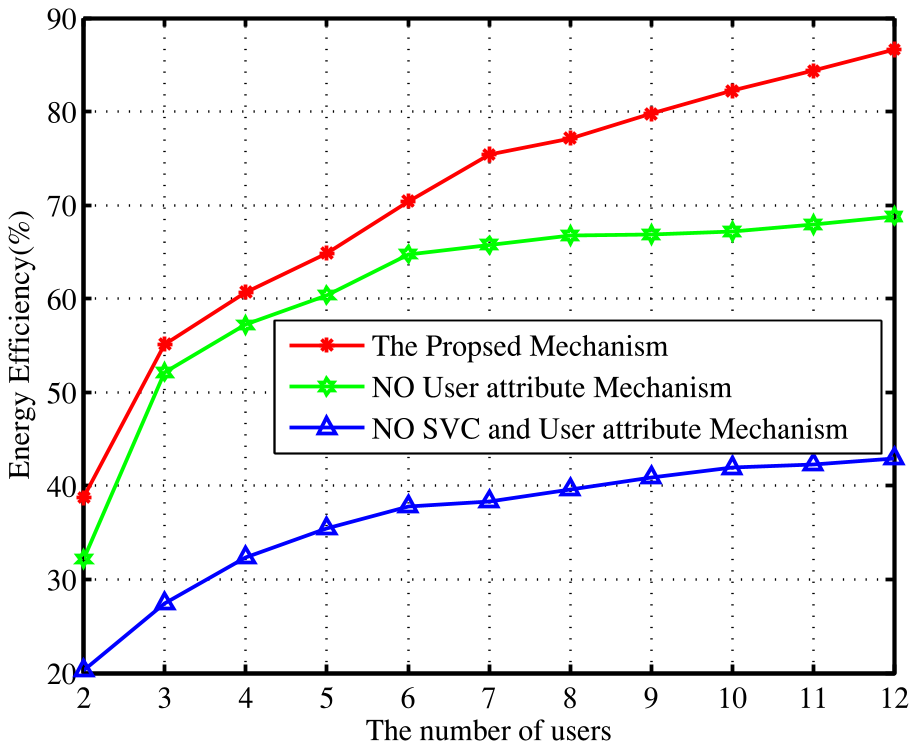
- Energy Savings: By utilizing SVC, the system reduces the energy overhead on transmitters. Compared to baseline methods without social awareness, the proposed mechanism improved energy efficiency by 49.6%.
- Quality Gains: The PSNR remained consistently higher than 35 dB, translating to "Good" or "Excellent" Mean Opinion Scores (MOS).
Deep Insight & Conclusion
The brilliance of this work lies in its holistic view of the edge. It doesn't just treat the edge as a compute location, but as a social network. By using coalition games to model user behavior, the authors provide a mathematical foundation for why certain users should group together.
Takeaway: Future 6G architectures will likely rely on this "Social-Physical" coupling. However, a remaining challenge is Privacy—how do we share user interest vectors (preference lists) without exposing private consumption habits? Future research into Federated Learning combined with this MEC collaboration could be the next frontier.