
SEConD: Harmonizing Social Interaction and ISP Efficiency for Video Delivery
A socially-aware ISP-friendly mechanism for efficient content delivery
The paper introduces SEConD (Socially-aware ISP-friendly Mechanism for Enhancing Content Delivery), a hybrid framework combining social messaging overlays, local proxy servers (SPS), and P2P streaming. Specifically designed for User-Generated Content (UGC) with long-tail demand, it achieves SOTA-level reductions in inter-domain traffic and origin server load.
TL;DR
The exponential growth of User-Generated Content (UGC) is breaking traditional CDNs. SEConD is a socially-aware mechanism that uses social relationship metadata to predict video demand. By combining local proxy caching (SPS) with on-demand P2P swarms, it slashes inter-domain traffic by 87% while ensuring a seamless, no-stall viewing experience for users.
Problem & Motivation: The Long-Tail Challenge
While mega-hits (the "popular head") are easily cached by CDNs, OSNs like Facebook and YouTube are dominated by the Long-Tail: content shared within small social circles. Traditional caching fails here because:
- Inefficiency: Long-tail content has too many unique items for global caches.
- Traffic Costs: P2P systems often cross AS (Autonomous System) boundaries, incurring massive transit fees for ISPs.
- QoE Issues: Pure client-server models suffer from start-up latency, while pure P2P suffers from peer churn and low upload bandwidth.
The authors’ intuition is that social ties predict locality. If a friend in your local AS shares a video, you are likely to watch it soon.
Methodology: The SEConD Architecture
The SEConD mechanism is built on four pillars designed to move the "heavy lifting" to the network edge.
1. Socially-aware Messaging Overlays
Instead of blindly pushing large video files, SEConD creates a bipartite graph between uploaders and potential viewers (Followers/Non-followers). When a video is uploaded, only small alert messages are pushed. This triggers a "pull-based" prefetching of only the video prefix (the first few seconds), ensuring the video starts instantly when the user clicks.
2. The Socially-aware Proxy Server (SPS)
Every AS gets an SPS. This isn't just a cache; it's a Resourceful Peer.
- Traffic Localization: It fetches the video once from the origin and serves all local users.
- P2P Orchestrator: It acts as a tracker for local swarms.
- QoE Guarantor: If the P2P upload speed drops below the video bit-rate, the SPS steps in to provide the missing bandwidth.
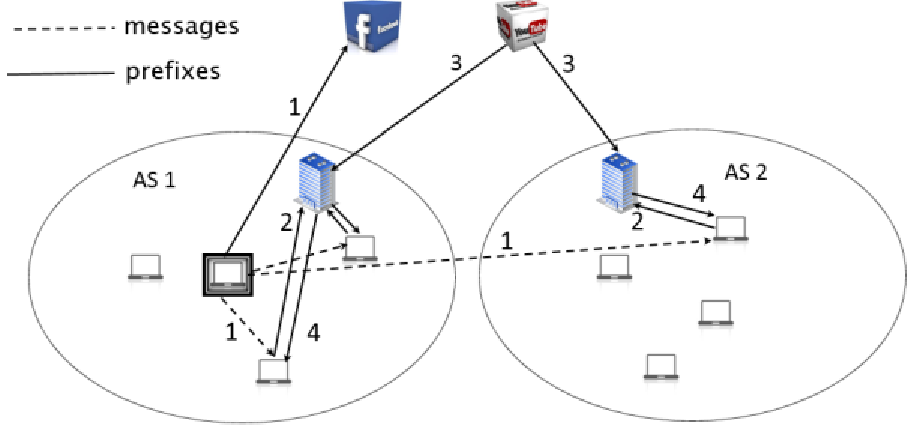 Fig 1: The prefetching algorithm workflow involving the Source, SPS, and Video Server.
Experiments & Results
The authors simulated a 3,963-node social graph based on real Facebook data (SNAP dataset) across 4 ASes.
SOTA Comparison: Beyond SocialTube
Compared to SocialTube, SEConD demonstrates superior efficiency in network utilization.
- Inter-AS Traffic: While SocialTube reduces traffic slightly, SEConD achieves a massive 87% reduction compared to standard client-server models.
- Origin Server Offloading: In SEConD, the origin server (e.g., YouTube) only contributes 12.1% of the bits, compared to 55.3% in SocialTube. This is because SEConD’s SPS is much better at capturing and serving local demand.
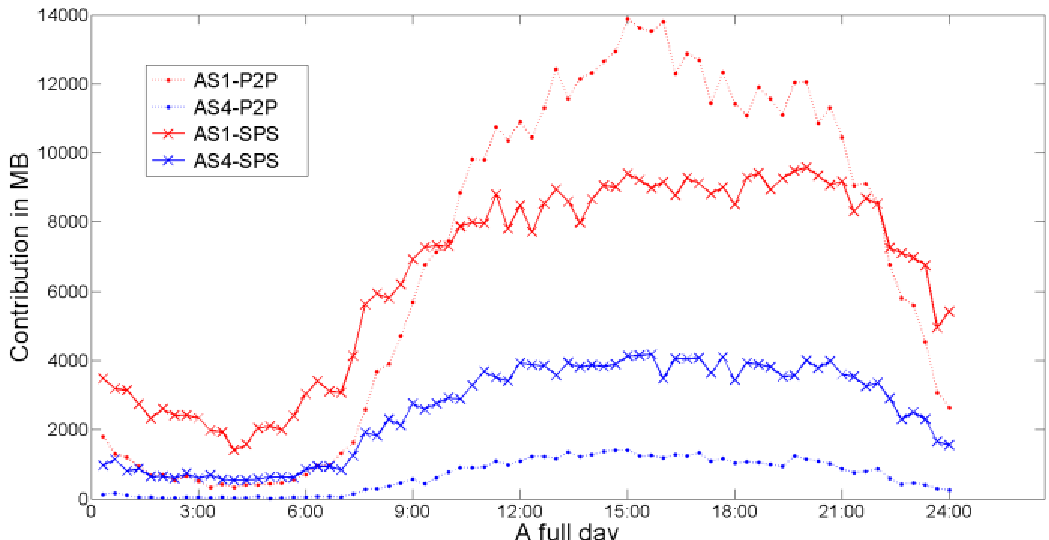 Fig 2: Total inter-AS traffic over a 24-hour cycle. SEConD (bottom line) remains consistently lower than SocialTube and Client-Server models.
The Impact of AS Size
The study reveals a crucial scaling property: Larger ASes benefit more from P2P, while smaller ASes rely more on the SPS.
- In large ASes (AS1), the SPS contribution is 48% because the local P2P swarm is self-sustaining.
- In small ASes (AS4), the SPS must contribute 79% of the traffic to maintain QoE.
Critical Analysis & Conclusion
Takeaway
SEConD proves that "network awareness" (knowing the AS topology) is just as important as "social awareness." By making the proxy server part of the OSN/P2P ecosystem, ISPs can transform from "dumb pipes" into active participants that improve user experience while cutting costs.
Limitations & Future Work
One limitation is the reliance on the OSN provider to share social graph data with the ISP, which raises privacy and business competition concerns. Future iterations might explore encrypted social metadata or decentralized social graphs to allow ISPs to optimize traffic without accessing private user relationships. Additionally, extending this to dynamic adaptive streaming (DASH) where bit-rates change in real-time would be a valuable next step.
Summary of Contribution
SEConD represents a significant step towards an ISP-friendly Internet, where social demand patterns are used to optimize underlying network resources proactively rather than reactively.