
SAMPhO: Breaking the "Flat Routing" Barrier in Mobile Social Networks
Socially-Aware Multi-phase Opportunistic Routing for Distributed Mobile Social Networks
This paper introduces SAMPhO (Socially-Aware Multi-Phase Opportunistic), a novel routing protocol for distributed Mobile Social Networks (MSNs) that segments the routing process into four distinct phases based on social conditions. By dynamically switching between ego-betweenness and a new tie-strength metric (CIMI), it achieves SOTA delivery rates while maintaining high resource efficiency.
TL;DR
Mobile Social Networks (MSNs) are often sparse and disconnected, making reliable data transfer a nightmare. The SAMPhO protocol moves away from "one-size-fits-all" metrics, instead using a multi-phase approach that mimics how humans pass information: local ad-hoc transfer, global hub searching, and finally, targeted delivery through social ties. It achieves near-Epidemic delivery rates (~90%) with a fraction of the resource cost.
The Problem: The Flaw of Finite Metrics
In the realm of Delay Tolerant Networks (DTN), existing protocols like PROPHET or SimBetTS attempt to predict the "best" next carrier. However, these methods often fail because they treat the path from source to destination as a singular logical step. A metric that identifies a "social hub" (global importance) is rarely the same metric needed to identify a "close friend" (local tie strength).
Methodology: The Four Phases of SAMPhO
The core innovation lies in the Socially-Aware Multi-Phase Opportunistic (SAMPhO) protocol. The authors identify that a message's journey consists of different social "climates":
- Ad-hoc Phase: If a direct multi-hop path exists, use standard DYMO routing.
- Centrality-based Phase: If the destination is unknown, move the message to "Social Hubs" using Ego-Betweenness.
- Copy Spreading: Highly central nodes copy the message to other hubs to increase the chance of finding the destination's community.
- Probability-based Phase: Once near the destination's circle, use the CIMI (Complementary Inter-Meeting Interval) metric to pick the carrier most likely to encounter the target.
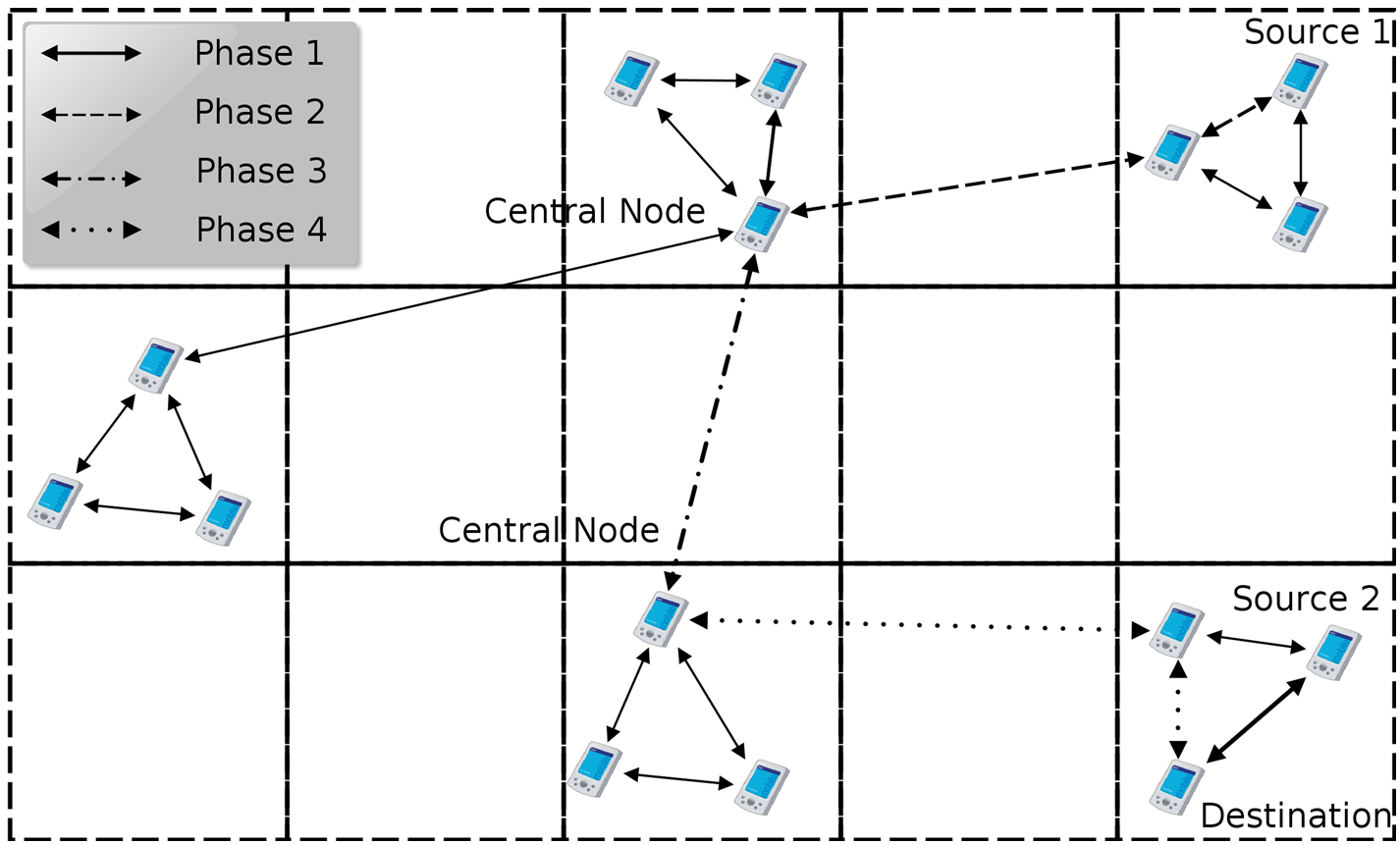 Figure: The transition between different phases based on social proximity.
The CIMI Metric
The authors introduce CIMI to solve the "irregularity" problem in social meetings. Unlike simple contact duration, CIMI considers the frequency and time since the last encounter, halving the weight of a tie if a scheduled meeting is missed.
Experiments and Results
The authors developed SAORS, a modular testing framework in OMNeT++, using the ECMM mobility model which accurately reflects human social movements (group mobility and pause periods).
Performance vs. Efficiency
While the Epidemic protocol (flooding) represents the upper bound for delivery, it is ecologically disastrous for device battery and bandwidth. SAMPhO bridges this gap:
- Delivery Rate: Hits ~90%, significantly outperforming SimBetTS and dLife.
- Buffer Occupancy: Occupies much less space than current multi-copy SOTAs.
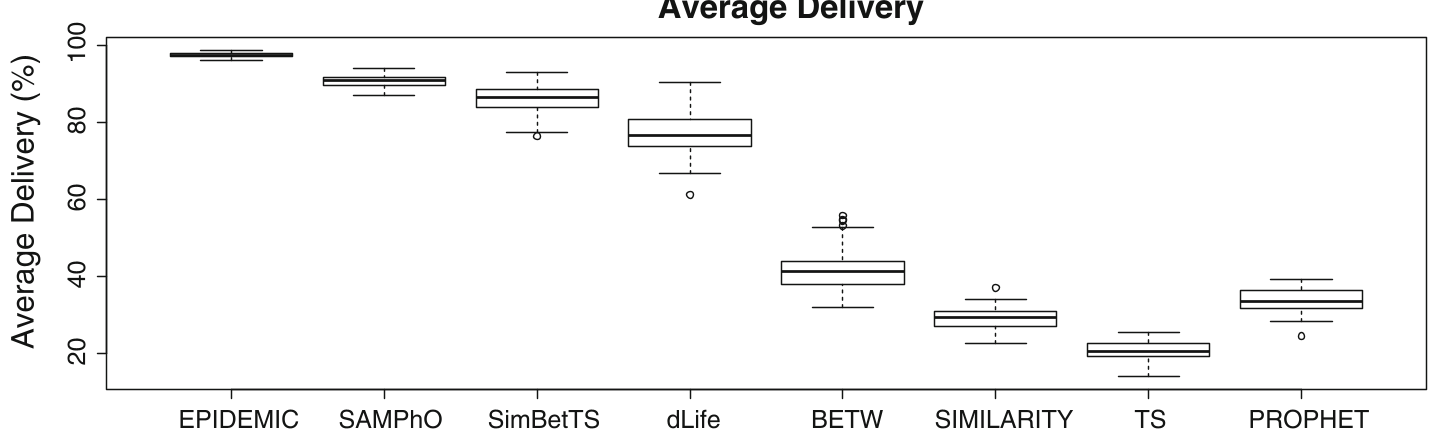 Figure: Delivery rates across various protocols. SAMPhO remains consistent even as scenarios grow more complex.
Scalability
One of the most impressive findings is SAMPhO's stability. As the number of nodes and communities increases, SAMPhO's delivery rate remains virtually flat, whereas competitors like PROPHET see sharp declines. This suggests that the multi-phase logic is inherently scalable.
Critical Analysis & Conclusion
Takeaways
SAMPhO proves that context matters more than the metric. By switching mechanisms based on whether a node "knows" the destination's community, the protocol avoids wasting copies in the wrong parts of the network.
Limitations
The primary weakness of SAMPhO is its reliance on Social Tie Detection accuracy. If the CIMI metric fails to capture the social structure correctly, the protocol limits copy generation too early, potentially dropping the delivery rate. Furthermore, the selection of sensitivity thresholds (SS and AS) currently requires manual tuning.
Future Outlook
The next step for this research is the transition from synthetic models to real-world traces and the development of an automated distributed mechanism to tune sensitivity parameters in real-time.