
Socially-Aware Networking: Turning Human Behavior into Routing Intelligence
19130_Socially Aware Networking: A Survey.
This paper provides a comprehensive survey of Socially-Aware Networking (SAN), a human-centric paradigm that integrates social properties into mobile network design. It covers state-of-the-art research in routing, incentive mechanisms, and data dissemination, highlighting how human behaviors (e.g., community, centrality) can optimize communication in intermittently connected environments like DTNs.
TL;DR
Socially-Aware Networking (SAN) is an emerging paradigm that leverages the social patterns of humans—the actual carriers of mobile devices—to solve the "intermittent connectivity" problem in mobile networks. By analyzing communities, tie strengths, and social centrality, SAN moves beyond random encounter models to create highly efficient, predictable, and robust communication protocols.
The Human Connection: Why Social Context Matters
For decades, mobile networking research treated devices as autonomous entities moving in a vacuum. However, the reality is that phones move because people move. Humans are social creatures: we go to work at set times, hang out in specific communities, and interact more frequently with friends than strangers.
The core insight of the SAN survey is that these social regularities are not noise—they are the signal. By quantifying social relationships, we can predict future meeting opportunities with higher accuracy than any mathematical random-walk model.
Methodology: The Architecture of SAN
The paper proposes a structured flow for making networks "socially aware":
- Sensing & Learning: Using gyroscopes, GPS, and Bluetooth via mobile sensing to capture raw movement and interaction data.
- Property Extraction: Processing raw data to identify key social metrics:
- Community: Groups with high internal link density.
- Centrality: Identifying "popular" nodes that act as effective relays.
- Tie Strength: Measuring the intimacy and frequency of contact between individuals.
- Protocol Design: Using these insights to drive routing, data dissemination, and incentive mechanisms.
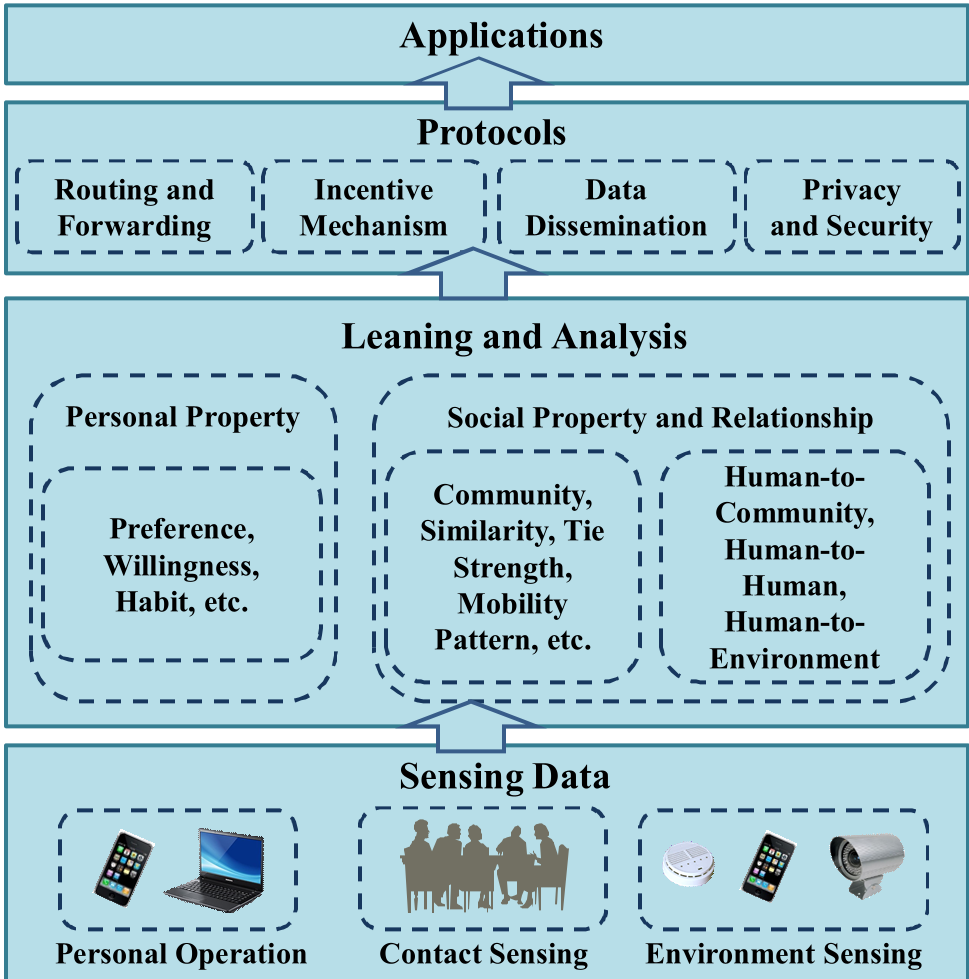 Figure 1: The multilayered architecture of Socially-Aware Networking, from sensing to application.
Routing and Forwarding: The "Bubble" and the "Ego"
One of the most significant contributions discussed is BUBBLE RAP. In this protocol, messages "bubble up" through a hierarchy:
- Global Ranking: The message is passed to nodes with higher global popularity until it reaches a node in the same community as the destination.
- Local Ranking: Once inside the target community, it utilizes local centrality to reach the specific recipient.
Similarly, SimBet uses "Ego-centric" analysis, where nodes evaluate their own betweenness centrality and similarity to the destination based solely on locally available information, making it highly scalable for decentralized environments.
Dealing with Human Nature: Selfishness and Incentives
In a real-world SAN, nodes (people) are naturally selfish. They may refuse to forward data to save battery or memory. The paper categorizes solutions into:
- Reputation-Based: Rewarding helpful nodes and excluding "black holes."
- Credit/Tit-for-Tat: Using virtual currency or mutual exchange (barter) to ensure fairness.
- Trust-Based: Leveraging existing social ties (e.g., "I'll forward for my friend but not for a stranger") to establish secure routing paths.
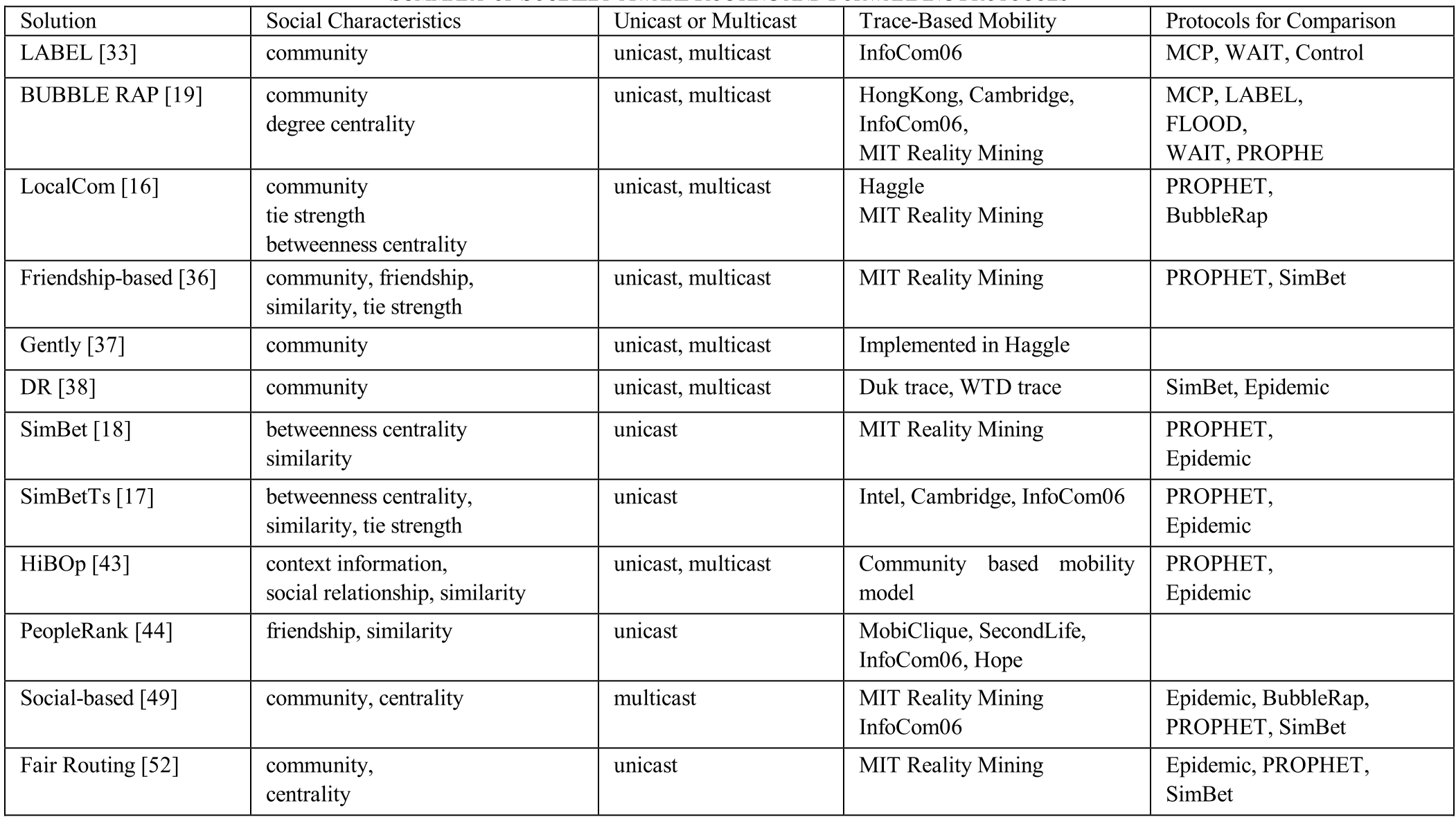 Table 1: Comparison of leading SAN protocols highlighting social characteristics and mobility traces used for validation.
Critical Insight: The Privacy Paradox
While SAN offers a leap in efficiency, it introduces a massive Privacy Challenge. To work effectively, the network needs to know who your friends are and where you go. The survey identifies this as a critical open issue: how do we design "Privacy-Preserving SAN" that utilizes social patterns without exposing personal identities?
Conclusion
Socially-Aware Networking isn't just about faster data transfer; it's about the convergence of human society and cyber-physical systems. As we move toward 6G and more sophisticated IoT environments, the ability of our networks to understand who we are and how we interact will be the differentiator between a "dumb pipe" and a truly intelligent infrastructure.
Key Takeaways for Researchers:
- Context is King: Moving beyond GPS to include interests and social roles (e.g., "teacher," "student") can further optimize data dissemination.
- Incentives are Mandatory: A protocol that assumes 100% cooperation will fail in the wild; social selfishness must be built into the mathematical model.